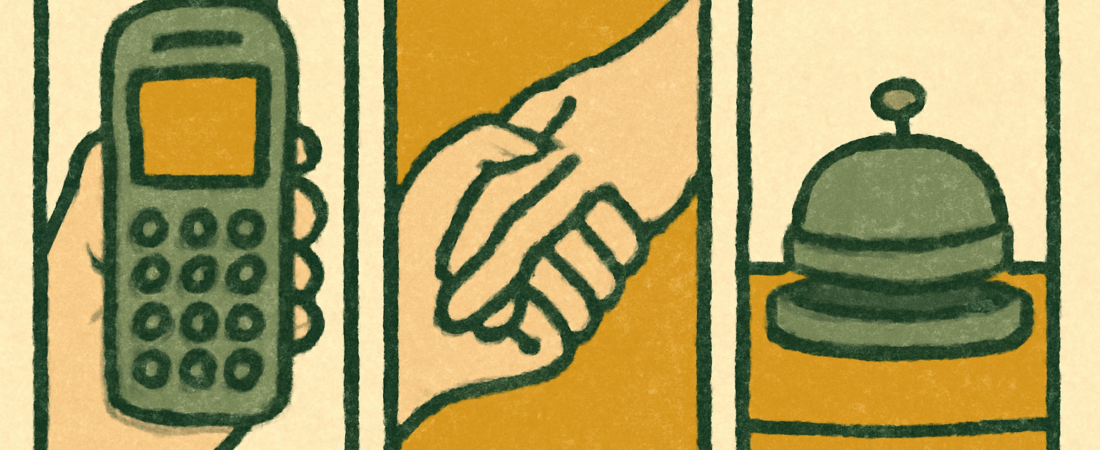
Konglish words look like English but carry Korean meanings. “Hand phone” means a mobile phone. “Skinship” means friendly physical closeness, like holding hands. “Service” means something free, like a complimentary side dish. Knowing these three helps you avoid awkward moments, and the National Institute of Korean Language tracks how such words are actually used.
Last checked: 2026-11-03
- What Konglish really is
- Hand phone: the mobile phone
- Skinship: closeness, not romance
- Service: it means free
- How to check what people say now
- Quick comparison table
- FAQ
- Sources
- Related guides
What Konglish really is
Konglish is a blend of Korean and English. Some words are borrowed directly. Others are invented from English parts. Many English speakers hear them and feel sure they understand. Often they do not.
Linguists often call these words “Korean-made English.” Koreans usually treat them as ordinary Korean vocabulary. So the words are not mistakes. They are simply a different dictionary.
This guide does not rank words by popularity. Exact usage counts change over time. Instead, it shows you how to find current data yourself.
Hand phone: the mobile phone
“Hand phone” (핸드폰, haendeupon) means a mobile phone. It is the Korean version of “cell phone” or “mobile.” English speakers sometimes find it odd, but the meaning is easy to guess.
Many Koreans also say “smartphone” or simply “phone.” Another common term is 휴대폰 (hyudaepon), a more formal word. You will see it on store signs and official forms.
The practical tip is simple. If someone asks for your “hand phone number,” they want your mobile number. Nothing more is hidden in the phrase.
Skinship: closeness, not romance
“Skinship” (스킨십, seukinsip) describes physical closeness. Think of holding hands, linking arms or a hug between friends. It is not an English word in everyday use, so it can confuse visitors from abroad.
Context matters a great deal. Parents and children use skinship. Close friends use it too. Couples use it as well, so the word can include romance. It does not automatically mean romance, though.
A common surprise for visitors involves same-gender friends. Friends of the same gender often walk arm in arm. This is usually just friendship. Do not read it as a romantic signal.
Comfort levels differ between people. If you feel uneasy, it is fine to step back politely.
Service: it means free
“Service” (서비스, seobiseu) often means something given for free. A restaurant owner might add an extra side dish or a drink “as service.” It is a small gift, not a charge.
This differs from the English meaning of customer service. In Korea, the word can describe the freebie itself. You may hear an owner say the item is “service” as they set it down.
Do not assume every extra is free, though. Practices vary by restaurant and by region. If you are unsure, ask politely before eating. Check the bill afterward if the situation is unclear.
How to check what people say now
Language changes quickly. The best sources are public, Korean-language data tools. Here are the main types of source to look for.
- Official dictionaries. The National Institute of Korean Language runs the Standard Korean Language Dictionary and an online dictionary. They list approved forms and loanword guidance.
- Loanword guidance. The same institute publishes recommended Korean replacements for foreign terms. These show which words officials prefer.
- Corpus projects. Researchers build large collections of real Korean text. These show how often a word appears in news, speech and writing.
- Search trend tools. Korean portals publish search interest over time. They can show whether a word is rising or fading.
Always check current numbers on the official sites. I have not quoted any counts here because they change and I cannot verify live figures. Most tools are in Korean, so a browser translation feature can help.
Quick comparison table
No prices apply to these words, so the cost column notes where money is involved. The one exception is “service,” which relates to free items.
| Konglish word | What visitors expect | What it usually means | Money angle |
|---|---|---|---|
| Hand phone | A phone you hold | Any mobile phone | Phone plans vary; check carriers |
| Skinship | Romance or touching | Friendly physical closeness | Not applicable |
| Service | Customer help | A free extra item | Free ($0 / 0 KRW) if offered |
FAQ
Is “hand phone” wrong English?
It is not standard English, but it is normal Korean. Koreans use it as an everyday word. English speakers will still understand it from context.
Does skinship mean a couple is dating?
Not always. The word covers family, friends and couples. Arm-in-arm friends are usually just friends. Look at the whole situation before assuming anything.
If a restaurant says “service,” do I pay extra?
Usually the item is free. Rules vary by restaurant, though. If you are unsure, ask politely. You can also check the bill afterward.
Where can I check current Korean word usage?
Start with the National Institute of Korean Language website. It offers dictionaries and loanword guidance. Check there for current information, since usage changes over time.
Sources
- National Institute of Korean Language (Standard Korean Language Dictionary and loanword guidance): https://www.korean.go.kr
- Ministry of Culture, Sports and Tourism, Republic of Korea: https://www.mcst.go.kr
Leave a Reply