
The percentage on a niacinamide serum tells you how much of the formula is niacinamide by weight. Most Korean serums sit between 2% and 10%. Higher is not automatically better. Skin tolerance, the rest of the formula, and your routine matter more. Start low, patch test, and check the label.
Last checked: 2026-11-05
- What the percentage actually means
- Common percentage ranges in Korean serums
- How to read a Korean label step by step
- Choosing a percentage and using it well
- Comparison: low, mid and high percentage serums
- FAQ
- Sources
- Related guides
What the percentage actually means
Niacinamide is a form of vitamin B3. It is a very common ingredient in Korean skincare. You will see it in serums, toners, essences and creams.
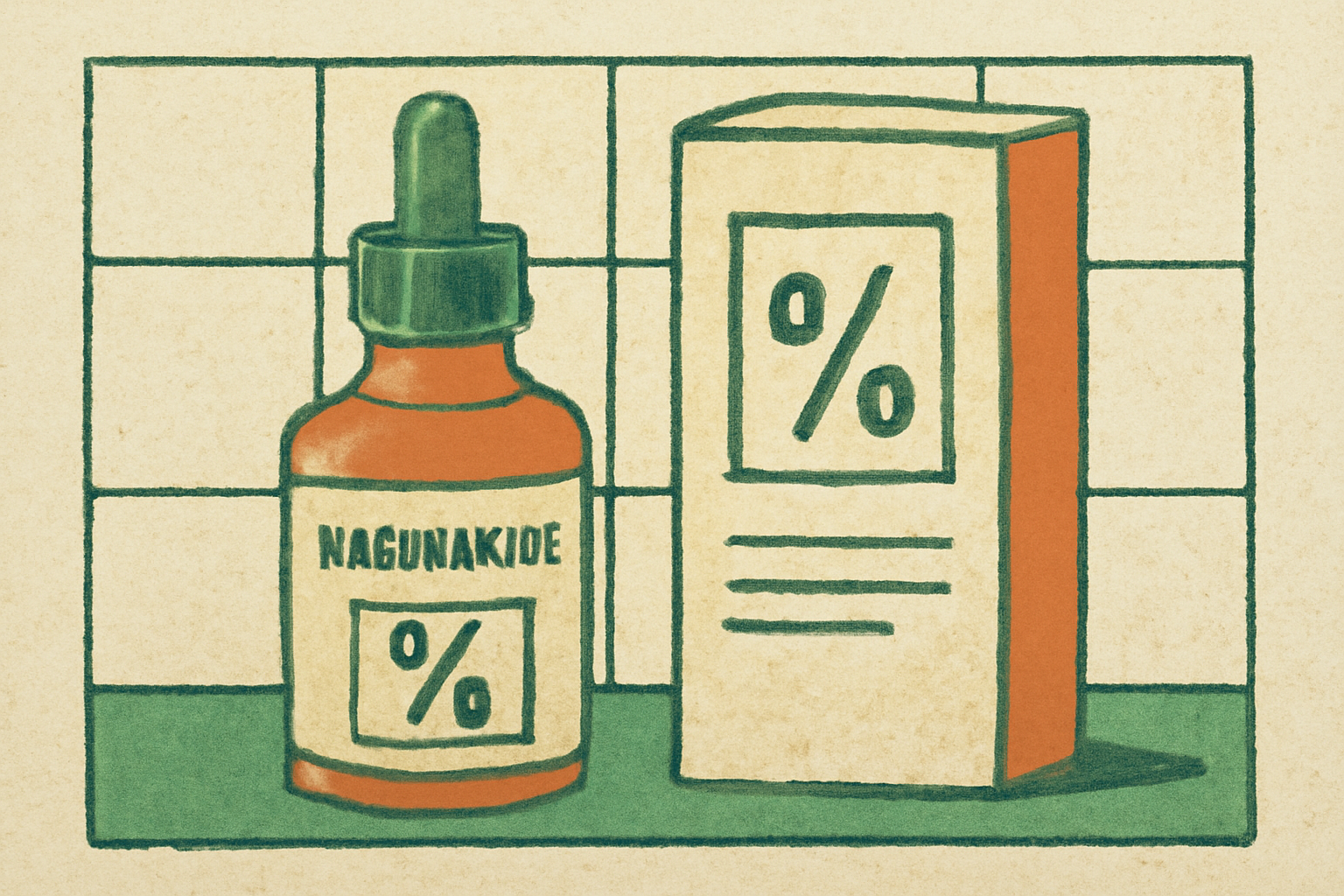
The number on the front of the bottle is a concentration. A 5% niacinamide serum contains 5 parts niacinamide in every 100 parts of the formula. That is usually measured by weight.
The rest of the bottle is water, other actives, soothing ingredients, texture agents and preservatives. So a 10% serum is not “twice as strong” in a simple way. It depends on the other ingredients, the pH and how the formula is built.
There are two things the percentage does not tell you. First, it does not tell you how gentle the formula is. Second, it does not tell you how well the product suits your skin type.
Also note that a percentage on the box is a brand claim. In Korea, brands set their own marketing language within local advertising rules. If a number matters to you, check the full ingredient list and the brand’s official product page.
Common percentage ranges in Korean serums
Korean brands sell niacinamide serums across a wide range. The ranges below are general patterns, not fixed rules. Brands change formulas often, so always check the current label.
Low range: about 2% to 4%. These formulas often combine niacinamide with soothing or hydrating ingredients. They suit people with sensitive or reactive skin. They also suit anyone new to niacinamide.
Middle range: about 5% to 7%. This is a very popular zone. Many people find it a balanced starting point for daily use. Lots of widely sold serums fall here, though I cannot give you an exact market share.
High range: about 10% and above. These are often marketed for visible pores, uneven tone or oiliness. Some people find high percentages irritating. Common reports include redness, tingling or a flushed feeling. Reactions vary from person to person.
Many Korean products also sit at odd numbers, such as 3% or 8%. Do not worry about these. The number is just the brand’s chosen formula.
One more point matters here. Some Korean serums list niacinamide as one of several “multi-actives.” The headline number may refer only to niacinamide. Other actives in the bottle can add to irritation risk.
How to read a Korean label step by step
Here is a simple process. Follow it in a shop or while browsing online.
- Find the headline number. Look for a percentage on the front of the bottle or box. Note that it may be written as “나이아신아마이드 5%” in Korean.
- Find the ingredient list. Korean products list ingredients on the back or on the carton. Look for “Niacinamide” or “나이아신아마이드.”
- Check the position. Ingredients are generally listed from highest to lowest concentration. Niacinamide near the top suggests a meaningful amount. This is a general guide only.
- Scan for other actives. Look for acids, retinol, vitamin C or strong plant extracts. More actives can mean more chance of irritation.
- Check for fragrance and alcohol. If your skin is sensitive, these can matter. Look at the full list, not just the front.
- Check the product volume. A 50 ml bottle and a 30 ml bottle give different value. Compare price per ml, not just the sticker price.
A helpful Korean word is 함량 (hamryang). It means “content” or “amount.” You may see it near the percentage. The word 순한 (sunhan) means “mild.” You will see it on products marketed as gentle.
If the label is hard to read, use the brand’s official website. Many Korean brands post the full ingredient list online.
Choosing a percentage and using it well
This section gives general cosmetic guidance. It is not medical advice. If you have a skin condition, speak to a qualified professional.
Start low if you are new. A 2% to 5% serum is a gentle place to begin. You can move up later if your skin is comfortable.
Always patch test. Apply a small amount to a discreet area, such as behind the ear or along the jaw. Wait at least 24 hours. If you see redness, itching or discomfort, stop using it.
Introduce it slowly. Try it a few times a week at first. Then build up if your skin stays calm. Do not add several new products at once. If something goes wrong, you will not know the cause.
Layer it sensibly. Niacinamide serums are usually used after cleansing and toner, and before moisturizer. Follow the instructions on your specific product.
Use sunscreen in the morning. This is good practice with any active routine. Korean sunscreens are widely available and come in many textures.
Watch your total routine. A 10% niacinamide serum plus strong exfoliating acids may be too much for some skin. If you feel stinging, simplify.
You may have read that niacinamide and vitamin C “cannot” be used together. This is an old claim that is often repeated. Evidence and expert views differ, and many modern formulas combine them. If you are unsure, use them at different times of day, and check the product guidance.
Lastly, be patient. Skincare changes are usually gradual. Judging a serum after a few days is rarely fair. Many brands suggest several weeks of consistent use. Check each brand’s own directions.
Comparison: low, mid and high percentage serums
The table below shows typical patterns, not specific products. Prices are rough illustrations of what shoppers often see for a 30 to 50 ml serum in Korea. Actual prices vary by brand, shop and sale. Check the official brand site or store for current prices. Exchange rates change, so the USD figures are approximate.
| Feature | Low (about 2-4%) | Middle (about 5-7%) | High (about 10%+) |
|---|---|---|---|
| Typical goal | Gentle daily care, first-time use | Balanced everyday serum | Targeting pores, oil, uneven tone |
| Often suits | Sensitive or reactive skin | Most skin types | Experienced users with tolerant skin |
| Irritation chance | Lower | Moderate | Higher for some people |
| Common texture | Watery or light gel | Light gel or essence | Gel or lightweight lotion |
| Illustrative price range | about $10-18 / 13,000-24,000 KRW | about $12-25 / 16,000-33,000 KRW | about $12-28 / 16,000-37,000 KRW |
| Best tip | Easy to layer with other steps | Start here if unsure | Introduce slowly and patch test |
Notice that price does not rise neatly with percentage. A well-made 5% serum can cost more than a basic 10% one. Formula quality, packaging and brand positioning all affect the price.
Many shoppers buy Korean skincare at drugstore-style beauty chains, department stores or online. Prices and promotions change often. Confirm on the retailer’s official site before you buy.
FAQ
Is a higher niacinamide percentage always better?
No. Higher concentrations can irritate some skin. Many people do well with 2% to 7%. The best percentage is the one your skin tolerates and that you can use consistently.
What niacinamide percentage should a beginner start with?
A lower range, around 2% to 5%, is a common starting point. Patch test first. Introduce the serum a few times a week, then increase if your skin stays comfortable.
Can I use a Korean niacinamide serum every day?
Many people do, but it depends on the formula and your skin. Start slowly and watch for redness or stinging. If irritation appears, reduce how often you use it or stop. Follow the product’s own directions.
Does the percentage on the bottle guarantee the amount of niacinamide?
The figure is the brand’s stated concentration. Check the ingredient list and the brand’s official product page for details. If you have concerns, contact the brand directly.
Sources
- Ministry of Food and Drug Safety (MFDS), Republic of Korea, cosmetics regulation: https://www.mfds.go.kr/
- U.S. Food and Drug Administration (FDA), cosmetics information: https://www.fda.gov/
- American Academy of Dermatology, skin care resources: https://www.aad.org/
- Official brand websites: check the ingredient list and current price for any product you plan to buy.

Leave a Reply