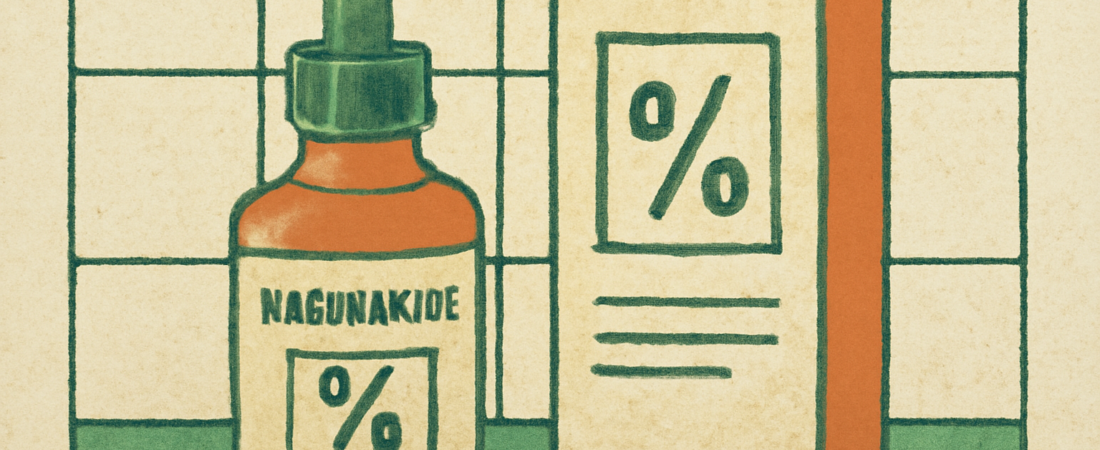
The percentage on a niacinamide serum is the share of that ingredient in the formula, usually by weight. Most Korean serums sit between 2% and 10%. Higher is not automatically better. Many people do well at 2-5%, and a 10% serum can irritate some skin types. Patch test first and check the label.
Last checked: 2026-11-05
- What the percentage actually means
- Common percentage ranges in Korean serums
- How to choose a strength step by step
- How to read a Korean label
- Comparison of strength tiers
- FAQ
- Sources
- Related guides
What the percentage actually means
You searched for what the number on the bottle means. Here is the plain answer.
A niacinamide percentage tells you how much of the formula is niacinamide. A 5% serum is five parts niacinamide in every one hundred parts of the product. Brands usually measure this by weight.
Niacinamide is a form of vitamin B3. It is a common ingredient in serums, toners, and creams. People use it for the look of uneven tone, visible pores, and oily-looking skin.
The percentage does not tell you everything. It does not tell you how well the formula is made. It does not show how stable the ingredient is. It does not show what else is in the bottle.
Two serums can both say 5% and feel very different on skin. One may be a light water-like gel. Another may be a richer, stickier lotion. The other ingredients change how the product behaves.
Percentages also describe the product in the bottle, not what reaches your skin. Skin absorbs only part of what you apply. So the label number is a guide, not a promise of results.
Common percentage ranges in Korean serums
Korean brands sell niacinamide serums across a wide range. You will often see the number printed right on the front of the box. Korean brands tend to be open about this.
Here are the ranges you will most often meet.
Around 2% to 4%. This is a gentle range. Many toners, essences, and daily serums fall here. It suits beginners and sensitive-leaning skin.
Around 5%. This is a very common middle point. Many people treat it as a reasonable everyday strength. It is a popular starting point for serums.
Around 10%. This is a high-strength tier. Some Korean serums are built around this number. It can work well for some people. It can also cause redness, stinging, or a tight feeling for others.
Above 10%. This is less common and harder to justify. Reputable sources generally note that higher amounts do not always give better results. Check the brand’s own guidance if you see a number above 10%.
Formulas change over time. Brands reformulate products and rename lines. Treat any range here as a general guide. Always confirm the exact figure on the current product page or box.
How to choose a strength step by step
Follow these steps. They work for most skin types.
Step 1: Know your skin’s mood. Is your skin easily irritated? Does it sting with new products? If yes, start low. If your skin is very tolerant, you have more room to try higher strengths.
Step 2: Start at the low end. Pick a serum around 2-5%. This lets your skin adjust. You can always move up later.
Step 3: Patch test. Put a small amount on your inner forearm or behind your ear. Wait 24 hours. Look for redness, itching, or bumps. Stop if you see any of these.
Step 4: Use it once a day first. Apply after cleansing and toner, before moisturizer. Many people start with evenings. Go slowly for the first week or two.
Step 5: Watch for signs of too much. Warning signs include stinging, flushing, dry patches, or new breakouts. If these appear, cut back. Use it less often or switch to a lower percentage.
Step 6: Be patient. Skincare changes are slow. Give a new serum several weeks before judging it. Changing products too fast makes it hard to know what is working.
Step 7: Only then consider going higher. If your skin is calm after a month or two, you may try a stronger serum. Many people find they do not need to.
If you have a skin condition, are pregnant, or are unsure, ask a dermatologist or pharmacist. This article is general information, not medical advice.
How to read a Korean label
If you shop in Korea or order from Korean shops, the box can look confusing. Here is how to find what you need.
Look for the number first. Brands often print the percentage on the front, such as “5%” or “10%”. It usually sits near the ingredient name. The Korean word for niacinamide is 나이아신아마이드 (naiasin-amaideu).
Check the ingredient list. Ingredients are listed from highest amount to lowest. If niacinamide appears near the top, the amount is likely meaningful. If it sits near the end, the amount is probably small.
Know the limits of that trick. Order helps, but it is not exact. Below 1%, ingredients can appear in any order. So the list cannot confirm the exact strength.
Look at the full ingredient list for irritants. Alcohol, strong fragrance, and essential oils can bother sensitive skin. A low-percentage serum with irritating extras may feel worse than a clean 5% one.
Check the date and the size. Korean products show a manufacturing date or an expiry mark. Many show a symbol that tells you how many months the product lasts after opening. Look for it on the box or bottle. If you cannot read it, check the brand’s official site.
Be careful with unverified claims. Some sellers use bold marketing words. A big number or dramatic wording does not prove results. Compare against the ingredient list and the brand’s own site.
Comparison of strength tiers
The table below compares general strength tiers. Prices are rough ranges, not exact quotes. They vary by brand, size, store, and sale. Check current prices on the brand’s official shop or a trusted retailer before you buy.
| Strength tier | Typical use | Who it often suits | Rough price range (USD / KRW) |
|---|---|---|---|
| 2-4% (gentle) | Toners, essences, daily serums | Beginners, sensitive-leaning skin | About $8-20 / 10,500-26,000 KRW |
| 5% (middle) | Everyday serum | Most skin types as a starting point | About $10-25 / 13,000-32,500 KRW |
| 10% (high) | Targeted serum | Tolerant skin that has adjusted | About $12-30 / 15,500-39,000 KRW |
| Above 10% (very high) | Specialty products | Confirm with a professional first | Varies widely; verify on the official site |
These prices use an approximate rate of $1 to 1,300 KRW. The exchange rate moves daily. Please check a live rate and the current shelf price.
Price does not reliably match strength or quality. A cheaper serum can be a good choice. An expensive one is not guaranteed to work better. Focus on the full formula, your skin, and how you tolerate it.
FAQ
Is a higher niacinamide percentage always better?
No. More is not always better. Higher strengths can cause redness, stinging, or dryness in some people. Many do well at 2-5%. Start low and only move up if your skin stays calm.
Can I use niacinamide every day?
Many people use it daily. Start once a day and watch how your skin reacts. If you see irritation, use it less often. Check the product’s own directions and ask a professional if unsure.
Can I layer niacinamide with other serums?
Often yes, but go slowly. Add one new product at a time. That way you can tell what causes a reaction. If you use strong actives, introduce them on different days or ask a dermatologist for advice.
How long until I see a difference?
Skincare is slow. Many people judge a product after several weeks of steady use. Results vary by person, skin type, and formula. This article makes no promise of specific results.
Where can I check a Korean product is real and current?
Use the brand’s official website or official store. Check the batch details and expiry date on your box. If a price looks too low, be cautious. Buying from the brand or an authorized retailer lowers your risk.
Sources
- Ministry of Food and Drug Safety (MFDS), Korea: https://www.mfds.go.kr/
- American Academy of Dermatology Association: https://www.aad.org/
- U.S. Food and Drug Administration, cosmetics information: https://www.fda.gov/
- National Library of Medicine (PubMed), for primary research on niacinamide: https://pubmed.ncbi.nlm.nih.gov/
Always confirm the exact percentage, ingredients, and price on the brand’s official product page.


Leave a Reply