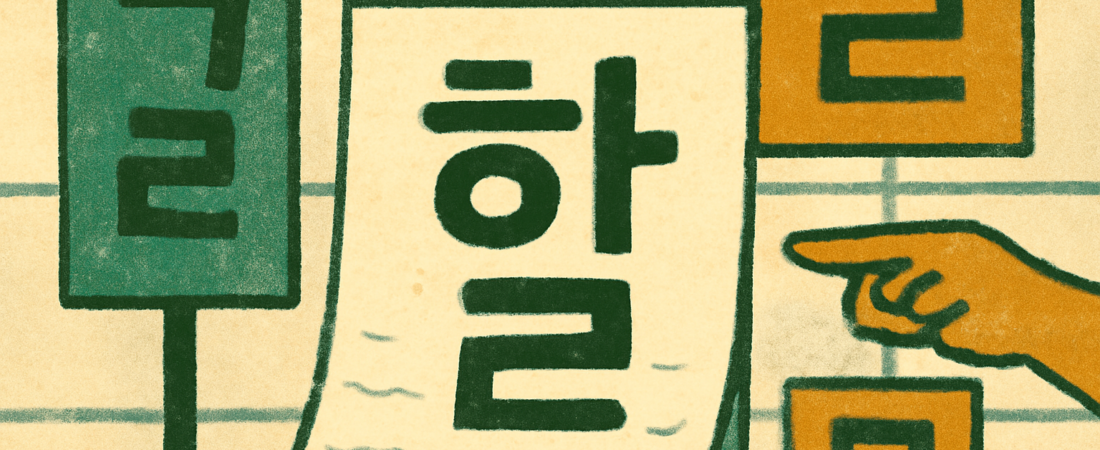
Hangul is a phonetic alphabet of 14 basic consonants and 10 basic vowels. Each syllable sits in a neat block, so you can sound out signs without knowing any words. Learn the shapes of a few dozen letters, practice on real menus and subway signs, and you can read most Korean text aloud in about twenty minutes.
Last checked: 2026-11-15
- Why Hangul is so quick to learn
- The consonants you will see most
- Vowels: lines and dots
- Building syllable blocks
- Practice with real signs and menus
- FAQ
- Sources
- Related guides
Why Hangul is so quick to learn
Hangul was created in the 15th century under King Sejong. It was designed to be easy to learn. Most consonant shapes echo the mouth or tongue position used to say them.
That is why it feels more logical than many writing systems. You are not memorizing thousands of characters. You are learning a small set of shapes and a simple stacking rule.
Twenty minutes will not make you fluent. It will let you sound out signs, station names and menu items. You will often not know the meaning, but you will know the sound. That alone helps you search, ask and recognize words.
The consonants you will see most
Start with these. Say each sound aloud as you read it.
- ㄱ sounds like g or k.
- ㄴ sounds like n.
- ㄷ sounds like d or t.
- ㄹ sounds between r and l.
- ㅁ sounds like m.
- ㅂ sounds like b or p.
- ㅅ sounds like s.
- ㅈ sounds like j.
- ㅎ sounds like h.
The letter ㅇ is special. At the start of a syllable it is silent. It just holds the place for a vowel. At the end of a syllable it sounds like “ng.”
Korean also has “tense” and “aspirated” versions of some consonants, such as ㄲ, ㅃ, ㅋ and ㅍ. Learn them after the basics. Romanization is inconsistent for these sounds, so listening to a native speaker helps more than any chart.
Vowels: lines and dots
Vowels are built from a long line plus short strokes. A short stroke pointing right or up often gives a brighter sound. A short stroke pointing left or down gives a darker one.
- ㅏ sounds like “ah.”
- ㅓ sounds like “uh” (as in “above”).
- ㅗ sounds like “oh.”
- ㅜ sounds like “oo.”
- ㅡ sounds like a flat “eu,” with spread lips.
- ㅣ sounds like “ee.”
Add a second short stroke and you get a “y” sound, as in ㅑ (ya) and ㅕ (yeo). This pattern covers many vowels at once.
Building syllable blocks
Letters are never written in a straight line. They are stacked into square blocks, one block per syllable. Each block follows one of two layouts.
- A vertical vowel (like ㅏ or ㅣ) goes to the right of the consonant.
- A horizontal vowel (like ㅗ or ㅜ) goes underneath the consonant.
So ㄱ + ㅏ becomes 가 (ga). ㄱ + ㅗ becomes 고 (go). A final consonant, called a batchim, sits at the bottom of the block. Add ㅁ under 가 and you get 감 (gam).
Read blocks left to right, top to bottom. For each block, say the starting consonant, then the vowel, then any bottom consonant.
Practice with real signs and menus
Practice on real text, because that is where it sticks. Here are common words you can try to sound out before checking the answer.
| Hangul | Sounds like | Where you see it | Meaning |
|---|---|---|---|
| 커피 | keo-pi | Cafes | Coffee |
| 김밥 | gim-bap | Snack shops | Rice roll |
| 출구 | chul-gu | Subway | Exit |
| 화장실 | hwa-jang-sil | Everywhere | Restroom |
| 편의점 | pyeon-ui-jeom | Streets | Convenience store |
| 입구 | ip-gu | Buildings | Entrance |
Notice that 커피 is simply “coffee” in Korean sounds. Many loanwords work this way, including 아이스크림 (ice cream) and 택시 (taxi). They are an easy first win.
What people in Korea actually read and search
Everyday Hangul shows up in a few predictable places. These are good places to look for real examples:
- Search and map apps. Korean map apps are searched mostly in Hangul. Typing a place name in Korean often returns better results than English.
- Delivery and shopping apps. Menus and product labels use Hangul first, with English sometimes missing.
- Public transit signs. Station names usually appear in Hangul, English and sometimes Chinese characters.
To see what people currently search for, look at the keyword and trend tools published by major Korean portals, or national statistics from Statistics Korea (KOSTAT). Numbers change often. Check the current figures on those official sites rather than relying on any article.
FAQ
Can I really learn Hangul in twenty minutes?
You can learn the basic shapes and the stacking rule in about that time. Reading smoothly takes more practice. Plan a few short sessions over a week to make it stick.
Do I need to know Korean words to read signs?
No. Hangul is phonetic, so you can sound out words you have never seen. Understanding meaning is a separate step, but sounding words out helps you search for them.
Is romanization good enough for travel?
It helps, but it is inconsistent. One name can be spelled several ways in English. Knowing Hangul lets you match what you see on the sign to what you search for.
Why does the same letter sound different sometimes?
Some consonants change depending on position. ㄱ can sound like g or k, and ㅂ like b or p. Listening to native audio is the best way to hear these shifts.
Sources
- National Institute of Korean Language: https://www.korean.go.kr/
- King Sejong Institute Foundation: https://www.ksif.or.kr/
- Statistics Korea (KOSTAT): https://kostat.go.kr/
- Korea Tourism Organization (Visit Korea): https://english.visitkorea.or.kr/



Leave a Reply