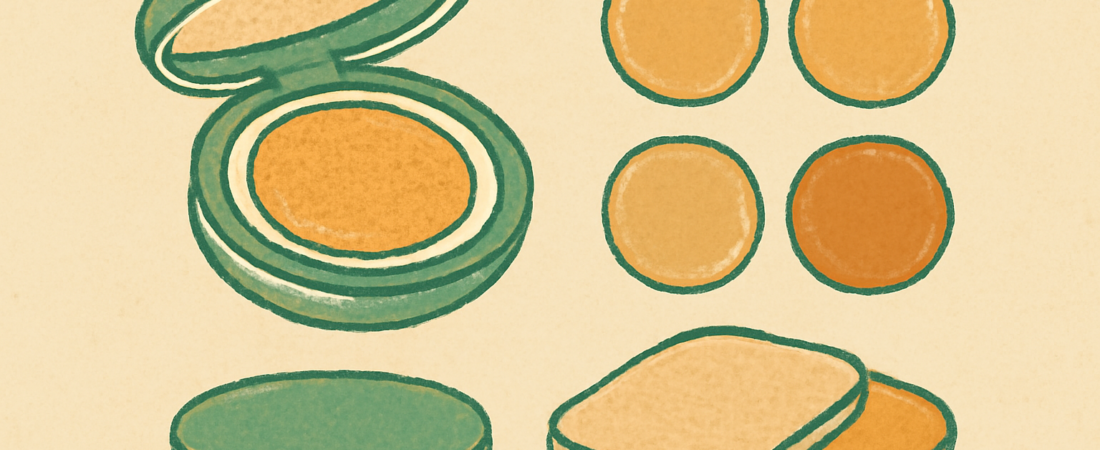
A Korean cushion foundation is a compact with a sponge soaked in liquid foundation, applied with a puff. Most brands offer fewer shades than Western ranges, often clustered in light-to-medium tones. Coverage ranges from sheer to full. Most compacts are refillable, so buy the case once and replace the inner refill.
Last checked: 2026-11-16
- What a cushion foundation is
- Shade ranges: what to expect
- Coverage and finish, step by step
- How refills work
- Buying in Korea: a comparison
- FAQ
- Sources
- Related guides
What a cushion foundation is
A cushion foundation looks like a pressed powder compact. Inside, though, there is no powder. There is a sponge soaked in liquid foundation.
You press a puff into the sponge. The puff picks up a small amount of product. You then pat it onto your face.
The format became popular in Korea in the early 2010s. Many brands now sell their own version. Most cushions combine base makeup with sun protection, usually listed as an SPF and PA rating on the case. Check the exact rating on the product you buy.
Here are the main parts of a cushion compact:
- The case: a hinged compact with a mirror, often reusable.
- The refill: the sponge and liquid inside a tray, which you replace when empty.
- The puff: a flat sponge applicator, usually included in the case.
- The inner lid: a seal that helps keep the liquid from drying out.
The main appeal is convenience. You can touch up makeup quickly, with no brush or blender needed. It is also easy to carry in a small bag.
Shade ranges: what to expect
This is the part many overseas shoppers care about most. It deserves honest caution.
Traditionally, Korean cushions were made for the local market. Many brands launched with only two or three shades. These often sat in the light-to-medium range, with pink, neutral or yellow undertones.
Some brands have since widened their lines. Others have not. Ranges change often, and they differ between brands and even between product lines. I cannot give you a reliable shade count for any brand here. Check the brand’s own site or the product page for the current list.
Here is how to read Korean shade names and numbers:
- Look for numbers. Many brands use a number system, such as 13, 21 and 23. Lower numbers tend to be lighter.
- Look for undertone letters or words. You may see “pink,” “neutral,” “natural” or “beige.” Meanings vary by brand.
- Compare across brands with care. A “21” at one brand may not match a “21” at another.
If you have a deeper skin tone, research before you buy. Search for reviews from people with a similar skin tone. Look at photos in natural light, not only brand images. Ask in-store staff for tester options if you are in Korea.
If you are between shades, a slightly lighter shade can look chalky. A slightly darker one can look muddy. Test on your jawline, not your hand, and check it in daylight.
Coverage and finish, step by step
Cushions are often thought of as light, dewy and natural. That is a common style, but not a rule. Coverage and finish vary a lot by product.
Use these steps to judge whether a cushion suits you:
- Read the product description. Words like “glow,” “dewy” or “skin-like” often point to a lighter, shinier finish. Words like “matte,” “velvet” or “long-wear” suggest more coverage.
- Check the claimed coverage level. Some brands label this clearly. Others do not, so rely on reviews.
- Test on bare skin. Apply one thin layer. Wait a few minutes. Look at it in daylight.
- Build up slowly. Add a second layer only where you need it, such as around the nose or on blemishes.
- Set it if needed. A light dusting of powder can calm shine. This depends on your skin type and the finish you want.
A few practical tips help the formula wear better:
- Start with moisturized skin, and let your skincare sink in first.
- Pat the puff, do not drag it. Patting gives a smoother look.
- Use small amounts. The sponge holds plenty of liquid.
- Wash the puff regularly. A dirty puff can hold oil and bacteria.
If you have very dry or very oily skin, test a sample first. Many Korean stores offer samples or testers. Always patch test if you have sensitive skin or allergies, and check the ingredient list.
How refills work
The refill system is one of the best parts of cushion foundation. It can save money and reduce waste.
When you buy a cushion, the set usually includes the case and one refill. Often it includes a second refill too. When the first one runs out, you swap in the new one.
Follow these steps to change a refill:
- Open the case and remove the puff.
- Lift out the empty refill tray. It often clips in or sits in a recess. Some cases need a gentle pull at the edge.
- Wipe the case with a clean tissue to remove old residue.
- Peel the seal off the new refill, if it has one.
- Press the new refill into the case until it sits flat.
- Use a fresh puff if your set includes one.
A few cautions apply here. Refills are not always interchangeable between brands or even between product lines. Make sure the refill matches your exact case and shade. Check the product page or ask staff.
Also keep the lid closed when you are not using it. This helps stop the liquid from drying out. Most brands suggest using the product within a set time after opening. Look for the small open-jar symbol on the packaging, which shows the recommended months of use.
Buying in Korea: a comparison
You can buy cushions in several types of stores in Korea. Prices vary by brand, store and promotion. The figures below are rough ranges only, not current quotes. Check the official site or store for today’s price.
| Where to buy | Typical price range (case + refill) | Shade testing | Good to know |
|---|---|---|---|
| Drugstore-style beauty chains (e.g. Olive Young) | About $15-$35 / 20,000-48,000 KRW | Testers often available | Frequent sales and bundles; staff can help with shades |
| Brand flagship or road shops | About $20-$45 / 27,000-60,000 KRW | Full tester range, often with a consultation | Best for the brand’s full shade list |
| Department store counters | About $30-$70 / 40,000-95,000 KRW | Staff assistance common | Higher-end lines; some offer tax refund support |
| Duty-free shops | Varies widely | Limited testing | Stock and shade ranges can be narrower; check ahead |
| Official brand websites | Varies by brand | No in-person test | Reliable for shade lists and refill compatibility |
These ranges are estimates based on general market patterns. They are not guaranteed prices. Exchange rates shift too, so the USD figures are approximate.
Here is a simple plan for buying in person:
- Visit in daylight if you can. Store lighting can change how a shade looks.
- Ask for a tester. Staff can often help you match your shade.
- Try before you commit. Wear a swatch for a short while and check it again.
- Ask about refills. Confirm that a refill is sold separately and whether it fits your case.
- Keep your receipt. Return rules differ by store, so ask before you buy.
If you are a tourist, ask staff about tax refund options. Rules and minimum spend change, so verify with the store and official tax refund sources.
FAQ
Do Korean cushion foundations come in dark shades?
Some do, but many brands focus on light-to-medium tones. Ranges change often and differ by brand. Check each brand’s official site for the current shade list, and read reviews from people with a similar skin tone before buying.
Can I buy just the refill and reuse the case?
Often yes. Most cushion sets are designed around a reusable case and replaceable refill. But refills are not always interchangeable across brands or product lines. Confirm that the refill matches your exact case and shade before you buy.
Is cushion foundation full coverage?
It depends on the product. Many cushions give light to medium coverage with a natural finish. Some are made for higher coverage. Read the product description and reviews, and build up thin layers for more coverage.
How long does a cushion last after opening?
Look for the open-jar symbol on the packaging, which shows the suggested months of use after opening. Keep the lid closed and wash the puff often. If the product smells odd or changes texture, stop using it.
Sources
- Olive Young (retailer): https://global.oliveyoung.com/
- Ministry of Food and Drug Safety, Korea (cosmetics regulation): https://www.mfds.go.kr/eng/index.do
- Korea Customs Service (tax and customs information for travelers): https://www.customs.go.kr/english/main.do
- Individual brand websites: always check the maker’s own official site for current shade lists, ingredients and refill details.
Leave a Reply