Table of Contents
Who watches the watchdog? That question hung over the National Assembly this week, as lawmakers grilled officials from the National Election Commission over years of unchecked internal problems. You expect an election authority to be beyond reproach. But the first hearing of a special parliamentary investigation committee suggests something very different has been happening behind closed doors.
Both ruling and opposition lawmakers rarely agree on much these days. Yet at this hearing, they found common ground fast. Their shared message was blunt: the National Election Commission has operated with almost no outside oversight for far too long.
A Hearing That Shook Public Trust
The National Assembly’s special investigation committee held its first public hearing this week. Its target was the National Election Commission, an institution most Koreans assume runs with strict neutrality. What lawmakers uncovered instead was a pattern of loose internal controls and weak accountability.
Why does this matter so much? Election commissions are supposed to be the referees of democracy. If the referee’s own house is disorganized, how much confidence should voters have in the game itself?
Committee members from both major parties criticized the commission’s disciplinary system directly. They pointed to a troubling trend: staff members who broke internal rules often received reduced punishments rather than real consequences. Lawmakers described this as a culture of leniency that quietly grew over time, largely because no external body regularly checked the commission’s internal decisions.
This is not just a bureaucratic footnote. The National Election Commission holds enormous responsibility. It manages voter rolls, certifies results, and settles disputes after elections end. When an institution with this much power faces almost no independent scrutiny, small problems can grow into systemic ones. That is exactly what this hearing revealed.
Why the National Election Commission Became a Watchdog Blind Spot

Korea’s constitution grants the National Election Commission a special kind of independence. This independence protects elections from political interference. But independence without oversight can create a dangerous gap.
Lawmakers at the hearing argued that this gap became a genuine blind spot. Other government agencies face regular audits from the Board of Audit and Inspection. Reports for this piece cite testimony suggesting the National Election Commission avoided the same level of scrutiny for years, partly because of its constitutionally protected status.
Think about what that means in practice. An agency can claim independence to protect democracy, yet use that same independence to shield itself from accountability. Isn’t that a contradiction lawmakers should have caught much earlier?
The committee specifically criticized how disciplinary cases were handled internally. Multiple cases showed a pattern: initial punishments got reduced through internal appeals processes, with little outside review of whether those reductions were justified. Legislators from both parties called this a systemic weakness that eroded public confidence, not an isolated mistake.
This finding lands at a sensitive moment for Korean democracy. Trust in electoral institutions has already faced pressure in recent years, driven by disputed vote counts and online misinformation. A commission perceived as lax on internal discipline adds fuel to that fire, whether the underlying facts are fully proven or not.
Jobs for Insiders? The Procurement Scandal Explained

Perhaps the most explosive revelation involved money, not politics. Lawmakers alleged that the National Election Commission signed large-scale no-bid contracts with companies connected to former employees and their family members. In Korean, this practice is often called “ilgam mollajugi,” a phrase meaning work handed out to insiders rather than earned through open competition.
Why should you care about contract paperwork? Because public procurement rules exist precisely to prevent favoritism. When a public institution repeatedly awards contracts to insider-connected firms without competitive bidding, taxpayers lose out twice. They lose fair pricing, and they lose confidence that public money is spent honestly.
According to testimony reviewed during the hearing, the scale of these contracts was not small. Lawmakers described a recurring pattern spanning multiple years, involving former National Election Commission staff who moved into private companies and then received contracts from their former employer. This raises an obvious question: did internal compliance officers ever flag these relationships, or did everyone simply look away?
Opposition and ruling party members alike demanded a full account of every no-bid contract signed over the past several years. They want to know how many companies had direct personal ties to current or former staff. For readers wanting deeper background on Korea’s public procurement oversight system, outlets like Korea Daily Life News have tracked similar controversies across other government agencies.
This is not the first time a Korean public institution has faced insider-contract allegations. But when the institution in question runs the nation’s elections, the stakes rise considerably. Public trust in electoral fairness depends on believing the referee has no hidden financial motives.
Independence, Twin Votes, and What Comes Next
Beyond discipline and contracts, lawmakers raised a third concern: the National Election Commission’s handling of election-related appeals, known as “seongeo socheong.” These are formal complaints voters or candidates file when they suspect vote-counting errors or procedural violations. Legislators worried that the commission’s internal review process for these complaints lacks true independence.
Here’s the problem in plain terms. If the same body that runs an election also judges complaints about that election, can the process ever feel fully fair? Even if every decision were correct, the appearance of a conflict of interest damages public confidence just as much as an actual error would.
The hearing also revisited the so-called “twin vote count” controversy, a case where identical or suspiciously similar vote tallies appeared across different ballot boxes. This anomaly has fueled conspiracy theories among some voters for years. Lawmakers pressed National Election Commission officials for a clear technical explanation, though testimony reportedly remained incomplete on this point.
Recount procedures and compensation disputes rounded out the hearing’s agenda. When ballots are recounted after a contested race, who pays the cost? And if errors are found, who compensates affected candidates or parties?
These questions may sound technical. But they touch the heart of electoral legitimacy in any democracy. The National Election Commission’s answers, or lack of clear answers, will shape how this investigation proceeds in coming weeks.
So where does this leave Korean democracy? The special investigation committee has only completed its first hearing, with more sessions expected. Lawmakers on both sides signaled they intend to keep pressing the National Election Commission for documentation on contracts, disciplinary records, and appeal procedures.
This moment offers Korea a real opportunity. A transparent, thorough investigation could strengthen public trust in the National Election Commission for years to come. A rushed or partisan process, however, risks deepening the very distrust lawmakers claim they want to fix.
Institutional reform rarely happens quickly, and Korea’s history shows this clearly. After past corruption scandals at other public agencies, meaningful change often took years of sustained pressure, not a single hearing. The real test will be whether this investigation produces concrete reforms, like mandatory external audits or transparent contract bidding rules, rather than fading from headlines once political attention shifts elsewhere.
What do you think? Should an election authority with constitutional independence still face the same external audits as any other government agency?
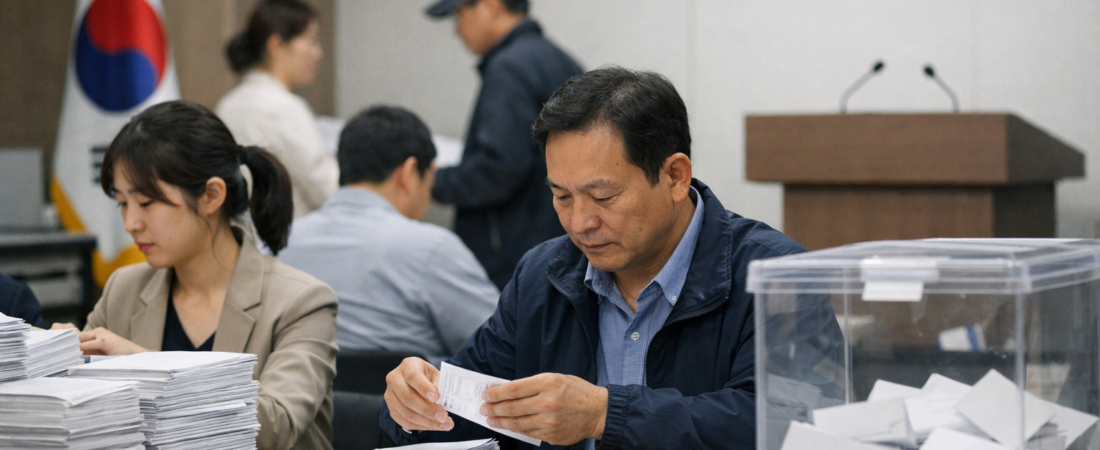
AI-Generated Photorealistic Image — All people, scenes, and details in this image are entirely AI-generated and fictional. Not a real photograph of an actual person or event. 이 이미지는 AI로 생성된 가상 이미지입니다.
Leave a Reply