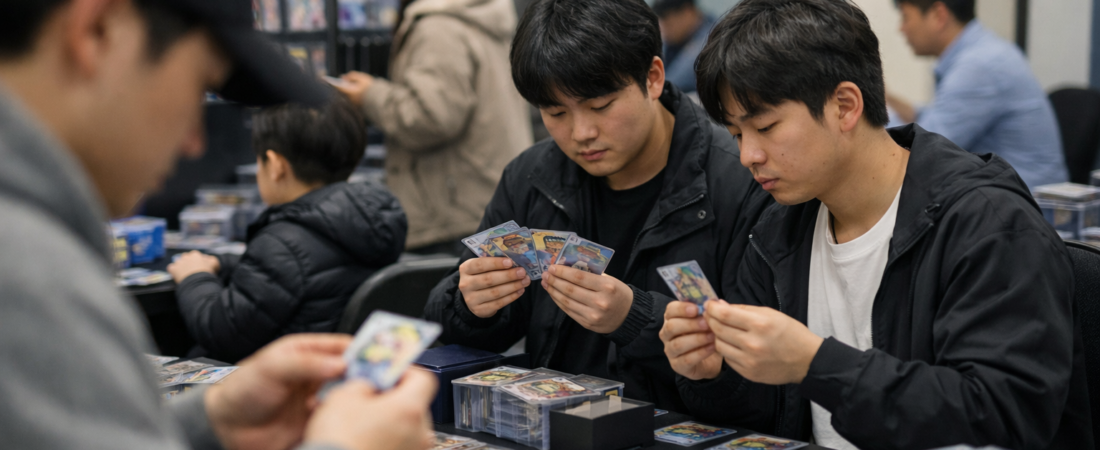
Pokemon Cards Are Now a Serious Investment
A single rare Pokemon card recently sold for 3.2 million won, and one landmark auction reached roughly 23 billion won. Pokemon cards have moved far beyond childhood nostalgia. They now sit alongside real estate and stocks as a legitimate collector’s asset in Korea.
Sound surprising? It shouldn’t. Trading cards have quietly become one of the most talked-about alternative investments among Korean collectors this year, and Pokemon cards lead the pack.
Celebrities have joined the trend too, turning what was once a kids’ hobby into a public flex. Idol photo cards already command high prices among fans. Now Pokemon cards are earning the same treatment, based on rarity and condition rather than star power.
Table of Contents
Why Pokemon Card Prices Are Skyrocketing
Why would a small piece of cardboard sell for hundreds of thousands of dollars? Scarcity is the answer. Certain Pokemon cards were printed in extremely limited runs, and mint condition copies are almost impossible to find decades later.
Grading agencies now assess condition on a strict numerical scale, and even tiny scratches can cut a card’s value dramatically. This system gives buyers confidence. It also turns collecting into something closer to trading stocks, where precise standards determine price.
Korea’s collectible market has grown fast alongside this global trend. According to Maeil Business Newspaper, record-breaking Pokemon card sales have pushed the hobby into mainstream financial conversation. Younger investors, tired of volatile stock markets, see tangible collectibles as a different kind of asset.
Is this just hype, or a lasting shift? Probably both. Some of the demand is speculative, driven by headlines about huge auction prices.
But the underlying appeal is real. Pokemon cards connect nostalgia, scarcity, and global fandom in a way few other collectibles can match.
Celebrities and the New Collector Culture
Korean celebrities collecting Pokemon cards is not entirely new, but the scale has changed. Stars once known for luxury bags and watches are now showing off card collections on social media. This shift matters because it signals status differently.
Owning a rare Pokemon card now carries the same social weight as owning a designer handbag. Think about that for a second. A cartoon lightning-bolt mouse from the 1990s is now competing with luxury brands for bragging rights.
This overlap between idol culture and Pokemon collecting makes sense in Korea. Fan culture already trains people to value rarity, condition, and provenance through photo card trading. Applying those same instincts to Pokemon cards was a natural next step.
Auction houses have noticed the shift too. Some now hold themed sales mixing idol memorabilia with vintage trading cards, treating both as serious collectibles. That blending reflects a broader change in how young Koreans define value.
What This Means for Everyday Collectors
Here is the honest part. Not every Pokemon card is a winning ticket, and treating collecting purely as investment can backfire. Prices can swing sharply, and rarity alone does not guarantee long-term value.
Still, there is something worth admiring here. People are finding joy in objects tied to childhood memory, not just financial return.
That blend of sentiment and speculation says something about how we cope with uncertain economic times. Chasing quick profit through rare cards can lead to disappointment, and stories of overpaying for damaged goods are common. Yet the same hobby also builds genuine community, connecting strangers through shared memory rather than pure transaction.
The healthiest collectors seem to hold both truths at once: enjoy the nostalgia, but stay realistic about risk. Balance, it turns out, matters more in Pokemon card collecting than any single grading score.
Korea’s collectible market will likely keep growing as younger generations look for assets that feel personal, not just profitable. Pokemon cards may not replace stocks or property, but they offer something those markets rarely provide: a direct link to memory. What do you think about turning childhood collectibles into serious financial assets?
AI-Generated Photorealistic Image — All people, scenes, and details in this image are entirely AI-generated and fictional. Not a real photograph of an actual person or event. 이 이미지는 AI로 생성된 가상 이미지입니다.




Leave a Reply