
Table of Contents
RBW, the agency behind Mamamoo, has relocated its headquarters from Gangnam to Jayang-dong in eastern Seoul. This move reflects a broader trend among K-pop agencies, who are leaving Korea’s famous entertainment district for cheaper, more practical neighborhoods. Rising costs and changing business needs are rewriting the industry’s map.
Is Gangnam losing its grip on K-pop? That question feels almost unthinkable, given how closely the district has been tied to the industry’s image for over a decade.
But RBW’s quiet move tells a different story. It is one worth paying attention to, especially if you care about where K-pop is headed next.
RBW Leaves Gangnam for Jayang-dong
Mamamoo recently reunited after four years apart, touring the world together again. During a livestream, member Wheein broke down in tears, admitting she missed the group’s toughest, most formative years.
That same emotional thread runs through RBW’s own story. The agency that built Mamamoo from the ground up has transformed its physical identity too.
A visit to the Guui Station area now reveals RBW’s new headquarters. The building is impressive, but its location surprises many industry watchers.
It sits outside Gangnam. It also sits outside Hongdae, the neighborhood long favored by younger musicians and indie acts.
Instead, RBW chose Jayang-dong in Gwangjin District, a part of eastern Seoul rarely associated with entertainment business. You might ask why a major K-pop agency would pick such an unexpected spot.
The answer has less to do with prestige and more to do with practicality. K-pop agencies across Seoul are facing similar pressures, and RBW is far from alone in making this kind of move.
Why K-pop Agencies Are Rethinking Gangnam
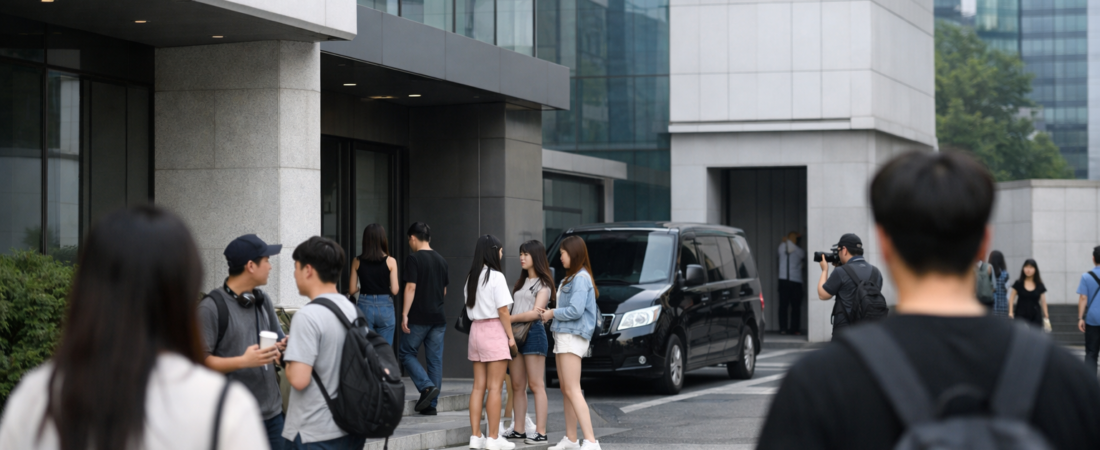
For years, Gangnam was the undisputed address for ambition in Korean entertainment. SM Entertainment, JYP, and countless smaller labels built their identities around its glossy streets.
Gangnam meant status. It signaled to artists, investors, and fans that a company had arrived.
But that symbolic value has come at a steep financial cost. Commercial real estate in Gangnam remains among the most expensive in all of Seoul, and prices have only climbed further in recent years.
For growing K-pop agencies managing trainees, production teams, and tour logistics, that expense adds up fast. Smaller and mid-sized K-pop agencies in particular feel this squeeze.
Unlike the largest conglomerates, they cannot absorb rising rent without affecting their bottom line. Leaving Gangnam becomes less a loss of identity and more a matter of survival.
Is the Gangnam name still worth the price tag? For a growing number of K-pop agencies, the honest answer seems to be no.
Industry observers have noted similar relocation patterns in reports from Korea Times, pointing to a quiet but steady redistribution of entertainment business across Seoul.
Real Estate, Space, and the New Idol Economy

Modern K-pop operations need more than a stylish office near a subway exit. They need rehearsal studios, recording rooms, wardrobe storage, and space for growing content teams.
Gangnam real estate rarely offers that kind of square footage at a reasonable price. Eastern Seoul districts like Gwangjin, by contrast, offer larger buildings for lower cost per square meter.
That trade-off matters more than brand prestige once a company matures past its startup phase. Think of it like outgrowing a trendy downtown apartment for a bigger house with an actual driveway — less glamorous, but far more livable.
There’s also a generational shift happening inside the industry itself. Many K-pop agencies now produce their own music videos, variety content, and livestreams in-house, which demands dedicated production facilities rather than rented studio time.
Jayang-dong and similar neighborhoods offer exactly that kind of flexible, larger-scale space. Several former office and legal buildings in these districts have already been converted for entertainment use, according to industry reports.
This pattern suggests the shift is structural, not accidental. K-pop agencies are not abandoning ambition — they are adapting their physical footprint to match a more complex, content-heavy business model.
What This Shift Means for K-pop’s Future
Where should fans look next, if not only to Gangnam, when tracking the next big K-pop agency? That question may sound trivial, but it hints at something larger about how the industry defines success.
For years, address was shorthand for achievement. A Gangnam office implied financial strength and insider status within Korea’s competitive entertainment world.
RBW’s move challenges that assumption directly. Mamamoo’s global tour proves an agency can maintain international relevance without a prestigious zip code.
There is something worth sitting with here, beyond real estate and square meters. Korean entertainment has long prized visible markers of status — the right neighborhood, the right building, the right image.
Yet genuine creative output, the kind that fills stadiums on four continents, often grows in less polished, more practical spaces. That tension between appearance and substance is not unique to K-pop; it shows up in any industry built partly on image.
The hopeful part is that talent and connection with audiences, not real estate addresses, ultimately decide who lasts in this business. Mamamoo’s emotional reunion, tears and all, proves that the bond between artist and fan survives long after a company changes its mailing address.
Looking ahead, expect more K-pop agencies to follow RBW’s lead as rents keep climbing and production needs keep growing. The map of Korean entertainment is being redrawn block by block, away from Gangnam’s gravitational pull.
What do you think — does an agency’s address still matter to how you see a K-pop group, or is the music the only address that counts?
AI-Generated Photorealistic Image — All people, scenes, and details in this image are entirely AI-generated and fictional. Not a real photograph of an actual person or event. 이 이미지는 AI로 생성된 가상 이미지입니다.




Leave a Reply