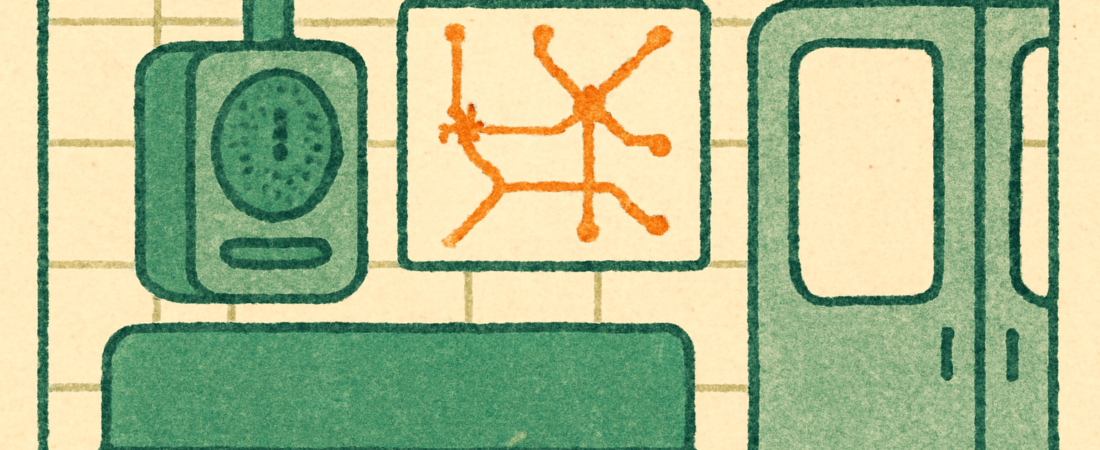
Korean subway announcements are short and predictable. You will hear the next station, the exit side for the doors, a transfer notice, and the terminal stop. Learn about eight key phrases, such as “Isin yeogeun” (this station is), “naerineun mun” (exit doors), and “hwansung” (transfer). That is enough to follow almost any ride.
Last checked: 2026-11-13
- Why the announcements are so predictable
- The core phrases, decoded
- Doors, safety and courtesy notices
- Which languages you will hear
- Quick comparison table
- FAQ
- Sources
- Related guides
Why the announcements are so predictable
Subway systems in Korea run on fixed scripts. Each station announcement follows the same order. The voice names the station, then says which side the doors open, then mentions transfers.
This is good news for learners. You do not need to understand every word. You only need to catch a few repeating patterns.
The data behind this is public. Operators such as Seoul Metro publish station names, line maps and transfer details on their official sites. For current station lists and any changes, check the operator site directly. Line layouts and station names can change over time.
The core phrases, decoded
Here are the phrases you will hear most often. They are written in a simple romanization to make them easy to say aloud.
- “Isin yeogeun…” means “This station is…”. The station name follows.
- “Dasum yeogeun…” means “The next station is…”. Listen for the name right after.
- “Naeril mun-eun oreun-jjok / oen-jjok” means the exit doors are on the right or left side.
- “Hwansung” means transfer. You will hear it with a line number.
- “Jonggak yeok” style endings simply mean a station name. Treat “yeok” as the word for station.
The word “yeok” (station) is the key. Almost every station name ends with it. Hearing “yeok” tells you a name just ended.
Doors, safety and courtesy notices
Besides station names, you will hear short reminders. Many are about doors and manners.
- A warning about the gap between the train and platform. Look for the phrase about “watching your step.”
- Reminders to leave priority seats for older riders, pregnant riders and others who need them.
- Requests to use headphones for music and videos.
- A note to take your belongings when you leave the train.
The exact wording differs by operator and line. Treat the examples above as general patterns, not exact quotes. For official rules on etiquette and fares, read the operator’s own pages.
Which languages you will hear
Most announcements play in Korean first. Many lines then repeat key information in English. Some stations also add Japanese or Chinese, especially in busy tourist areas.
Not every line or station offers every language. Coverage varies by operator and may change. Visitors should check the operator’s English page for current language support.
On many trains, a screen above the doors also shows the next station in several scripts. If you miss the audio, look up. The display is often your best backup.
Quick comparison table
This table matches each Korean phrase with its meaning and when you hear it. No fares are listed here, since prices vary by operator and distance. Check current fares on the official site, which usually lists them in KRW. Convert to USD with a live exchange rate.
| Korean phrase (romanized) | Meaning | When you hear it |
|---|---|---|
| Isin yeogeun… | This station is… | As the train arrives |
| Dasum yeogeun… | The next station is… | Just after departure |
| Naeril mun-eun… | Exit doors are on the… | Before doors open |
| Hwansung | Transfer | At interchange stations |
| Jonggeom / jongchak | Terminal or final stop | Near the end of a line |
Note: the last row is a general pattern for terminal stops. Wording varies, so treat it as a rough guide.
FAQ
Do I need to speak Korean to ride the subway?
No. Many lines use English announcements and bilingual screens. Learning a few phrases still helps you feel more confident.
What is the most useful word to learn first?
“Yeok” (station) is a strong start. It also helps to know “hwansung” (transfer), since it signals when to change lines.
Are the announcements the same on every line?
The structure is very similar. Exact wording, languages and extra notices vary by operator and line. Check the operator’s official site for specifics.
What if I miss the announcement?
Look at the screen above the doors or the line map in the car. Most show the next station clearly.
Sources
- Seoul Metro (official operator): http://www.seoulmetro.co.kr/
- Korea Tourism Organization (official): https://english.visitkorea.or.kr/
- National Institute of Korean Language (romanization standards): https://www.korean.go.kr/
Always check these sites for current station lists, fares and language support before you travel.



Leave a Reply