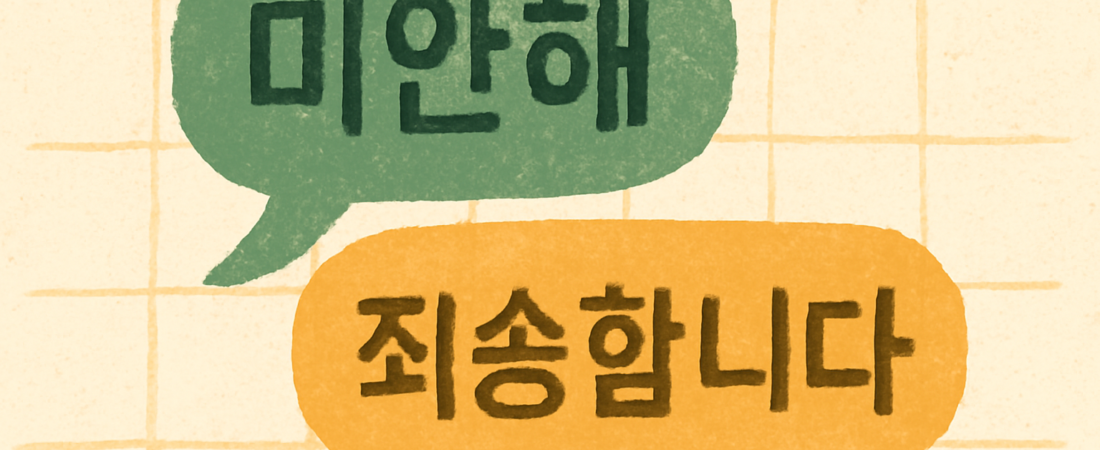
Use mianhae (미안해) with close friends, partners, and younger people. Use joesonghamnida (죄송합니다) with strangers, bosses, shop staff, and elders. Both mean “I’m sorry.” The difference is politeness level. When unsure, choose joesonghamnida. It is almost never wrong.
Last checked: 2026-11-11
- The core difference
- How to say each phrase
- Quick comparison table
- How to choose in real life
- Other useful apology phrases
- FAQ
The core difference
Korean grammar changes with the listener. Speech levels show respect, closeness, and age. Apologies follow the same rules.
Mianhae is casual speech, called banmal. It sounds warm between equals. It can sound rude to someone older or senior.
Joesonghamnida is formal speech. It sounds respectful and serious. It suits work, service, and first meetings.
A small nuance: joesonghamnida carries a heavier tone than mianhamnida. Some speakers use it for more serious mistakes. Others use both almost interchangeably in daily life.
How to say each phrase
Here are the romanized sounds. Pronunciation varies a little by speaker.
- Mianhae (미안해): mee-AH-neh. Casual.
- Mianhaeyo (미안해요): mee-AH-neh-yo. Polite, but softer.
- Mianhamnida (미안합니다): mee-AH-nam-nee-da. Formal.
- Joesonghaeyo (죄송해요): jweh-SONG-heh-yo. Polite and common.
- Joesonghamnida (죄송합니다): jweh-SONG-ham-nee-da. Most formal.
The “-yo” ending is the middle level. It works for most everyday situations with people you do not know well.
Quick comparison table
This table compares the common forms. No prices apply to words, so the cost column shows the real cost of getting it wrong: nothing, but awkwardness.
| Phrase | Level | Best for | Avoid with | Cost to use ($ / KRW) |
|---|---|---|---|---|
| Mianhae | Casual | Close friends, partner, younger siblings | Elders, bosses, strangers | $0 / 0 KRW |
| Mianhaeyo | Polite, soft | Peers, acquaintances | Very formal settings | $0 / 0 KRW |
| Joesonghaeyo | Polite | Shop staff, coworkers, new people | Very close friends (sounds stiff) | $0 / 0 KRW |
| Joesonghamnida | Formal | Bosses, elders, customer service, serious errors | Casual chats with friends | $0 / 0 KRW |
How to choose in real life
Follow these steps when you need to apologize.
- Check the relationship. Is the person a friend, a stranger, or someone senior?
- Check the age gap. Older people usually get a more formal form.
- Check the setting. Offices, hospitals, and stores call for formal speech.
- Check the seriousness. A big mistake needs a stronger apology.
- Still unsure? Default to joesonghamnida. Being too polite rarely causes offense.
Tone and body language matter too. Many Koreans pair a verbal apology with a slight bow. A deeper bow shows more sincerity. Keep it natural, not theatrical.
Other useful apology phrases
You may not always need a full apology. Korean has lighter options too.
- Sillyehamnida (실례합니다): “Excuse me.” Good for squeezing past someone.
- Jamsiman-yo (잠시만요): “Just a moment.” Common on crowded subways.
- Gwaenchanayo (괜찮아요): “It’s okay.” Useful when someone apologizes to you.
- Jeongmal mianhae (정말 미안해): “I’m really sorry.” Casual and heartfelt.
- Jeongmal joesonghamnida (정말 죄송합니다): “I’m truly sorry.” Formal and sincere.
Adding jeongmal (“really”) strengthens any apology.
FAQ
Can I use mianhae with my Korean boyfriend or girlfriend?
Yes, usually. Mianhae is natural between partners of similar age. If your partner is notably older, they may still prefer it, but ask or listen to how they speak to you.
Is joesonghamnida too formal for a café or shop?
No. It is widely used in service settings. If you bump into someone or make a small mistake, joesonghaeyo or joesonghamnida both work well.
What is the difference between mianhamnida and joesonghamnida?
Both are formal. Joesonghamnida often sounds more deferential. Some people use it for more serious situations. In everyday use, many speakers treat them as close in meaning.
Should I bow when I apologize in Korea?
A slight nod or bow is common and appreciated, especially in formal situations. You do not need a deep bow for small slips. Follow the other person’s lead.
Sources
- National Institute of Korean Language (국립국어원): https://www.korean.go.kr
- King Sejong Institute Foundation: https://www.ksif.or.kr
- Official Korea Tourism Organization (Visit Korea): https://english.visitkorea.or.kr
Usage can vary by region, age, and personal habit. For exact grammar rules, check the official dictionary and language resources above.


Leave a Reply