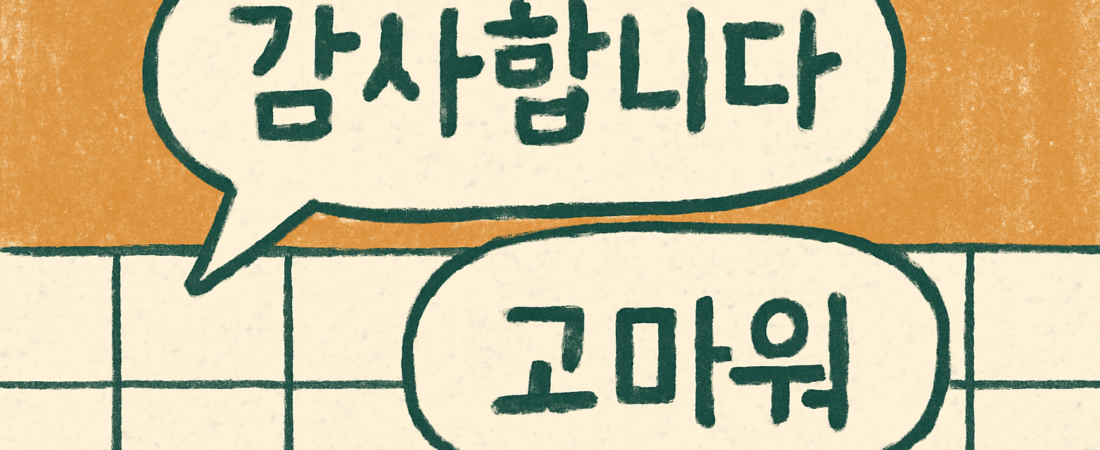
Gamsahamnida (감사합니다) is the polite, formal way to say thank you in Korean. Gomawo (고마워) is casual and best for close friends or younger people. If you are unsure, choose gamsahamnida or its softer cousin gomawoyo. It is almost never wrong, even with strangers.
Last checked: 2026-11-10
- The quick difference
- How to pronounce each phrase
- When to use which one
- The middle option: gomawoyo
- Side-by-side comparison
- FAQ
- Sources
- Related guides
The quick difference
Korean has speech levels. The level you choose shows respect and closeness.
Gamsahamnida sits in the formal level. You hear it in shops, restaurants, offices and on public transport.
Gomawo sits in the casual level. You use it with close friends, siblings and people clearly younger than you.
Both mean “thank you.” The difference is tone, not meaning.
How to pronounce each phrase
Here is a simple guide to saying each one out loud.
- Gamsahamnida: say “gahm-sah-hahm-nee-dah.” Keep every syllable even and calm.
- Gomawo: say “goh-mah-woh.” It is short and soft.
- Gomawoyo: say “goh-mah-woh-yoh.” It is gomawo plus a polite ending.
Romanization varies between sources. You may also see “kamsahamnida” or “komawo.” These are the same words. The official Korean spelling system is described by the National Institute of Korean Language.
When to use which one
Use this step-by-step check.
- Ask who you are speaking to. A stranger, shop staff or an older person calls for gamsahamnida.
- Think about the setting. Work, a clinic or a formal event calls for gamsahamnida.
- Check your closeness. A good friend your age can hear gomawo.
- Consider age. Someone younger and close to you can hear gomawo. Someone older should hear a polite form.
- Still unsure? Pick gamsahamnida. A formal thank you rarely offends anyone.
Be careful with gomawo and new acquaintances. It can sound too familiar, even rude, if you have not built that closeness yet.
The middle option: gomawoyo
Many learners skip this one, but it is very handy. Gomawoyo (고마워요) adds the polite “yo” ending to gomawo.
It sounds warm and friendly, but still respectful. It fits coworkers you like, café staff you chat with, or friends who are slightly older.
Think of it as a relaxed polite level. It sits between formal gamsahamnida and casual gomawo.
You can also add context. Try “jeongmal gamsahamnida” (정말 감사합니다) for “thank you so much.” The word jeongmal means “really.”
Side-by-side comparison
| Phrase | Hangul | Level | Best for | Safe with strangers? |
|---|---|---|---|---|
| Gamsahamnida | 감사합니다 | Formal | Shops, work, elders, first meetings | Yes |
| Gomawoyo | 고마워요 | Polite, relaxed | Friendly coworkers, slightly older friends | Usually yes |
| Gomawo | 고마워 | Casual | Close friends, younger people | No |
No prices apply here, since these are simply phrases. Learning them costs $0 / 0 KRW.
FAQ
Is gamsahamnida too formal for everyday use?
No. Koreans say it constantly in daily life. It is normal in shops, taxis and restaurants, so you will not sound stiff.
Can I say gomawo to a Korean friend I just met?
It is better to wait. Start with gomawoyo or gamsahamnida. Switch to gomawo once you are clearly close, or when your friend uses casual speech with you.
What is the difference between gamsahamnida and gomapseumnida?
Both are formal. Gamsahamnida comes from Sino-Korean roots, while gomapseumnida (고맙습니다) comes from the native word behind gomawo. Both are polite. Usage can vary by person and setting, so listen to locals.
Should I bow when I say thank you?
A small nod or light bow is common and polite. How deep it goes depends on the situation. A slight nod is fine for everyday thanks.
Sources
- National Institute of Korean Language: https://www.korean.go.kr
- King Sejong Institute Foundation: https://www.ksif.or.kr
Language use changes over time and by region. Please verify spelling and usage on the official sites above.



Leave a Reply