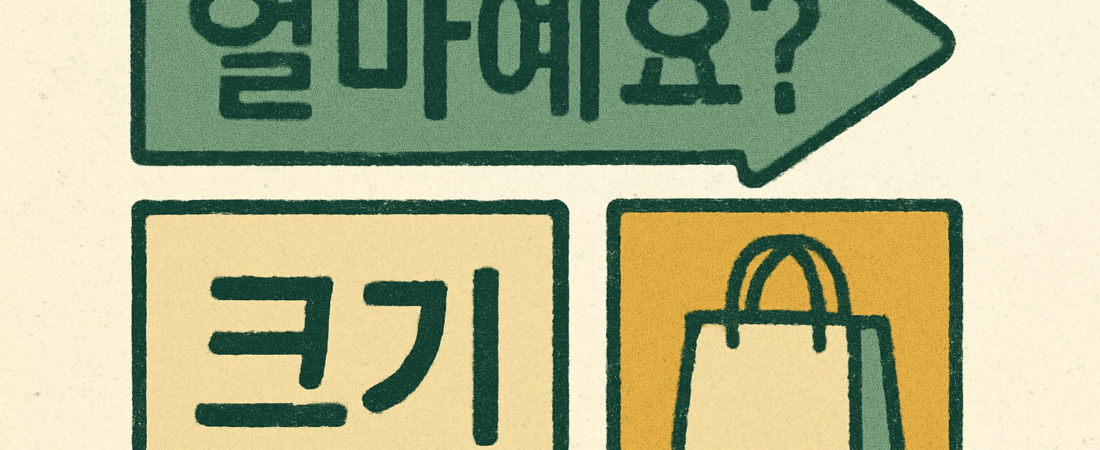
In Korean shops, three phrases cover most needs: “Eolmayeyo?” (How much is it?), “Isa-iju isseoyo?” (Do you have a different size?), and “Bongtu juseyo” (A bag, please). Learn the number words too. Prices are spoken in Sino-Korean numbers, so you can say, hear and confirm any amount without pointing.
Last checked: 2026-11-11
- Why a few phrases beat pointing
- Asking the price
- Asking about size and options
- Asking for a bag
- Quick comparison table
Why a few phrases beat pointing
Many Korean shops, convenience stores and market stalls are quick and busy. Staff often speak a little English. Still, a short Korean phrase makes things smoother.
This is a data-explainer, so here is the evidence base. Korea’s national statistics office, Statistics Korea (KOSTAT), publishes household spending data. It shows how much daily life runs through small retail purchases. The Korea Tourism Organization (KTO) also publishes visitor surveys on shopping habits. Numbers change each year. Check the current releases on their official sites rather than trusting any figure quoted second-hand.
The takeaway for you is practical. Small purchases are routine, so a few phrases get used again and again.
Asking the price
The key phrase is “Eolmayeyo?” It means “How much is it?” Say it while holding the item. It is polite and works almost everywhere.
The answer will use Sino-Korean numbers. Here are the useful ones:
- Cheon (1,000)
- Man (10,000)
- Iman (20,000)
- Oman (50,000)
So “ocheon won” is 5,000 won. That is about $3.70 at a rate of roughly 1,350 won to the dollar. “Iman won” is 20,000 won, or about $14.80. Exchange rates move daily, so check a current rate before you travel.
Prices are often shown as “5,000” without the word won. Many shops also display a number with a “0” dropped. Always confirm the total at the register screen.
If you do not catch the number, say “Dasi malhae juseyo.” It means “Please say it again.” You can also ask them to type it on the register or a phone.
Asking about size and options
In clothing shops, the useful question is “Isa-iju isseoyo?” It means “Do you have this in a different size?” You can also say “Keun sa-iju isseoyo?” for a bigger size. For a smaller one, say “Jageun sa-iju isseoyo?”
Korean sizing can run smaller than North American sizing. Many items are sold as free size. Brands differ, so do not rely on a size chart from another country. Try things on where you can. Ask “Ibeo bwado dwaeyo?” (May I try this on?).
For colour, ask “Dareun saek isseoyo?” (Do you have other colours?). For stock, ask “Jaego isseoyo?” (Is it in stock?). Staff may check the back room or another branch.
Return and exchange rules vary by shop. Ask before you pay, and check the store’s posted policy. Tax-free refund rules for visitors also change. Verify them on the official Korea Customs Service site.
Asking for a bag
Korea requires shops to charge for plastic bags in many settings. This is part of national waste-reduction rules. Convenience stores and supermarkets often sell bags for a small fee. The amount varies by shop and bag size. Treat any price you hear as a guide and check at the counter.
A common fee is 100 to 500 won, or roughly $0.07 to $0.37. Larger reusable-style bags can cost more. Some shops use paper or compostable bags with their own pricing.
Say “Bongtu juseyo” to ask for a bag. Say “Bongtu piryo eopseoyo” if you do not need one. The word “bongtu” can mean a plastic bag or a paper bag.
Carrying your own tote avoids the fee. Many locals do this. It also saves you a phrase to remember.
Quick comparison table
| What you want | Korean phrase | Meaning | Typical cost note |
|---|---|---|---|
| Ask the price | Eolmayeyo? | How much is it? | Example: 5,000 won = about $3.70 |
| Hear a larger amount | Iman won | 20,000 won | About $14.80 |
| Ask for another size | Isa-iju isseoyo? | Do you have a different size? | No extra cost |
| Try it on | Ibeo bwado dwaeyo? | May I try this on? | No extra cost |
| Ask for a bag | Bongtu juseyo | A bag, please | Often 100 to 500 won ($0.07 to $0.37); verify in store |
| Decline a bag | Bongtu piryo eopseoyo | I do not need a bag | Saves the fee |
USD figures use an approximate rate of 1,350 won to the dollar. Please check the current rate on your bank or card app.
FAQ
Is “Eolmayeyo” polite enough for every shop?
Yes. It uses the polite “-yo” ending. It suits convenience stores, markets, cafes and clothing shops. Adding “juseyo” to a request also keeps your tone polite.
Do I have to pay for a bag in Korea?
Often, yes. Many shops charge a small fee for plastic bags. Fees and rules vary by shop type and over time. Bring a tote if you want to avoid it, and check at the counter.
What if I cannot understand the price I hear?
Ask “Dasi malhae juseyo” for a repeat. You can also ask staff to show the number on the register or type it on a phone. Confirming the screen total is always safe.
Can I use these phrases at traditional markets too?
Yes. They work at stalls and markets. Prices at some stalls are flexible, but do not assume haggling is welcome everywhere. Follow the vendor’s lead.
Sources
- Statistics Korea (KOSTAT): https://kostat.go.kr
- Korea Tourism Organization (KTO): https://knto.or.kr
- Korea Customs Service: https://www.customs.go.kr
- Ministry of Environment, Republic of Korea: https://www.me.go.kr
Leave a Reply