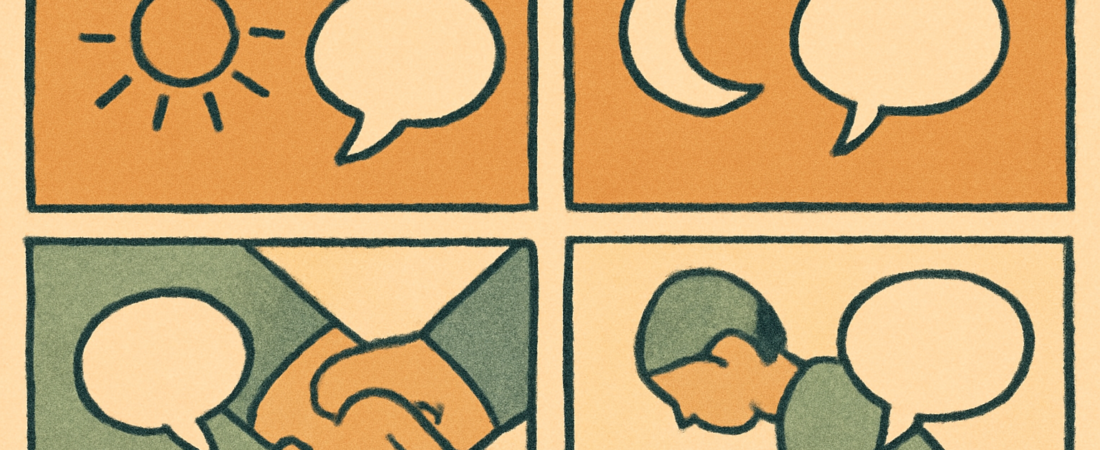
Korean has no separate “good morning” or “good evening” in daily speech. Most people use 안녕하세요 (annyeonghaseyo) at any hour. Add situation-specific phrases for meals, leaving, and meeting someone new. Use 안녕 (annyeong) only with close friends or younger people. When unsure, choose the polite form and a small bow.
Last checked: 2026-11-16
- The all-day greeting
- Morning, evening and night phrases
- Greetings by situation
- Polite or casual: how to choose
- Quick comparison table
- FAQ
- Sources
- Related guides
The all-day greeting
Start with 안녕하세요 (annyeonghaseyo). It means “hello” and works morning, noon, and night.
Say it when you enter a shop, meet a neighbor, or answer a stranger. Pair it with a slight nod. Staff in cafes and stores will often greet you first.
Here is how to say it aloud: ahn-nyung-ha-seh-yo. Keep the pace even. Do not stress one syllable.
Morning, evening and night phrases
Korean does not split greetings neatly by clock time. Instead, people use set phrases for certain moments.
Morning. Koreans usually just say 안녕하세요. Some people say 좋은 아침이에요 (joeun achimieyo), meaning “it’s a good morning.” It sounds a little translated. Most locals use it rarely, so treat it as optional.
Afternoon and evening. Again, 안녕하세요 is the normal choice. There is no everyday “good afternoon.”
Night. Use 안녕히 주무세요 (annyeonghi jumuseyo) before someone goes to sleep. It means “sleep well.” Use 잘 자요 (jal jayo) with friends and family. Neither is a hello. Both are goodnight phrases.
Greetings by situation
Situation often matters more than time of day. Follow these steps.
- Meeting someone new. Say 안녕하세요, then 만나서 반갑습니다 (mannaseo bangapseumnida). It means “nice to meet you.”
- Before a meal. Say 잘 먹겠습니다 (jal meokgetseumnida), meaning “I will eat well.” Say it to the host or the person paying.
- After a meal. Say 잘 먹었습니다 (jal meogeotseumnida), meaning “I ate well.” It thanks the cook or host.
- Leaving, you stay. If the other person stays, say 안녕히 계세요 (annyeonghi gyeseyo). It means “stay well.”
- Leaving, they stay. If you stay and they go, say 안녕히 가세요 (annyeonghi gaseyo). It means “go well.”
- Both leaving. Many people say 안녕히 가세요 to each other, or just 들어가세요 (deureogaseyo) at a doorway.
- Saying thanks. Say 감사합니다 (gamsahamnida) in most settings.
The “stay” versus “go” split trips up many learners. Think of who is physically leaving the spot.
Polite or casual: how to choose
Korean has speech levels. Your choice shows respect, so pick carefully.
Use polite forms with strangers, older people, coworkers, and staff. Forms ending in -요 (-yo) or -습니다 (-seumnida) are safe.
Use 안녕 only with close friends your age or younger. It means both “hi” and “bye” in casual speech.
If you are a visitor, polite speech is the safest default. Nobody expects perfect grammar. A clear, friendly 안녕하세요 earns goodwill quickly.
Bowing is common but small. A light nod of the head is enough in daily life. A deeper bow appears in formal or business settings.
Quick comparison table
No prices apply to greetings, so this table compares phrase, meaning, and formality.
| Moment | Korean (romanization) | Meaning | Formality | Cost |
|---|---|---|---|---|
| Any time hello | 안녕하세요 (annyeonghaseyo) | Hello | Polite | $0 / 0 KRW |
| Casual hello | 안녕 (annyeong) | Hi / bye | Casual | $0 / 0 KRW |
| Meeting someone | 만나서 반갑습니다 | Nice to meet you | Formal polite | $0 / 0 KRW |
| Before eating | 잘 먹겠습니다 | I will eat well | Formal polite | $0 / 0 KRW |
| You leave | 안녕히 계세요 | Stay well | Polite | $0 / 0 KRW |
| They leave | 안녕히 가세요 | Go well | Polite | $0 / 0 KRW |
| Bedtime | 안녕히 주무세요 | Sleep well | Honorific | $0 / 0 KRW |
FAQ
Is there a Korean word for “good morning”?
There is 좋은 아침이에요, but it is not common in daily talk. Most people simply say 안녕하세요 in the morning. You can use it safely at any hour.
What is the difference between 안녕히 가세요 and 안녕히 계세요?
Use 안녕히 가세요 when the other person is leaving. Use 안녕히 계세요 when you are leaving and they stay. If you both leave, either works.
Can I say 안녕 to anyone?
No. 안녕 is casual. Use it only with close friends or younger people. With strangers or elders, say 안녕하세요 instead.
Do I need to bow when I greet someone?
A small nod is enough in everyday life. Deeper bows appear in formal or business settings. If unsure, nod slightly and smile.
Sources
- National Institute of Korean Language (국립국어원): https://www.korean.go.kr/
- King Sejong Institute Foundation: https://www.ksif.or.kr/
- Korea Tourism Organization (VisitKorea): https://english.visitkorea.or.kr/
Usage varies by region, age, and setting. If you need exact phrasing for a formal situation, check with the official language resources above.

Leave a Reply