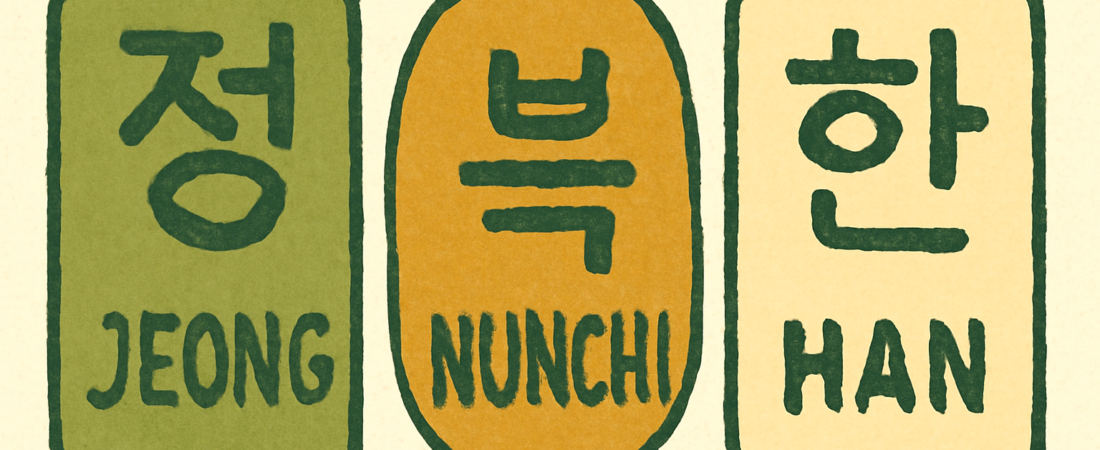
Jeong, nunchi and han are Korean ideas with no tidy one-word English match. Jeong is deep, lasting affection. Nunchi is reading a room quickly. Han is a heavy mix of sorrow and resilience. To see how people use them today, check Korean dictionary data and corpus tools, and verify current figures yourself.
Last checked: 2026-11-27
- Why these words resist translation
- Jeong: affection that builds over time
- Nunchi: the skill of reading a room
- Han: sorrow with staying power
- How to see what people say right now
- FAQ
Why these words resist translation
Some words carry a whole social habit inside them. English has “love,” “tact” and “grief.” Each one is close, but none is exact.
Korean speakers use these three words in everyday talk. They show up in conversation, in drama, and in songs and essays. Because of that, they are a good window into how people think about relationships.
A quick caution: any claim about how “all Koreans” feel is a generalization. Treat these words as common cultural vocabulary, not as rules for every person.
Jeong: affection that builds over time
Jeong (정) is a bond that grows through shared time. It can form between friends, neighbors, family and even customers and shopkeepers.
It is not quite romance. It is closer to warm attachment. You can feel jeong for a place, a routine or a person you argue with.
A common example is a restaurant owner adding extra side dishes. People often describe that as jeong, though the word itself is not limited to food.
People also say “jeong tteoreojida,” roughly meaning the bond has worn away. That phrase shows how jeong is treated as something you can gain or lose.
Nunchi: the skill of reading a room
Nunchi (눈치) literally combines “eye” and “measure.” It means sensing what others feel without being told.
Someone with quick nunchi notices when a mood shifts. Someone with slow nunchi may miss hints. You will hear both described in daily talk.
English “tact” overlaps a little. But nunchi is more about perception first, and action second. It is the quiet read before you speak.
Nunchi is also learned. Many language learners find it helps to watch pauses, tone and who speaks first in a group.
Han: sorrow with staying power
Han (한) is the hardest of the three to pin down. It is often described as lingering sorrow, grievance or longing that does not fully resolve.
Many writers link it to resilience, not only sadness. The idea is that pain can be carried and shaped into strength or art.
Scholars disagree on its exact meaning and origins. If you cite it, say “often described as,” and avoid presenting one definition as final.
Han appears in discussions of Korean history, film and literature. It is a theme, not a mood you can simply switch on.
| Word | Hangul | Closest English idea | What it adds | Where you may hear it |
|---|---|---|---|---|
| Jeong | 정 | Deep affection | Bond built over shared time | Friends, neighbors, shops |
| Nunchi | 눈치 | Tact, social awareness | Sensing mood before speaking | Work, school, group meals |
| Han | 한 | Sorrow, grievance | Lingering pain tied to resilience | Film, literature, history talk |
This table has no prices because these are ideas, not products. Any book or class you buy to study them will vary in cost, so check the seller’s current price in USD and KRW.
How to see what people say right now
You do not need to guess how common a word is. Several official or primary Korean sources let you check.
- The National Institute of Korean Language runs the Standard Korean Language Dictionary and the Urimalsaem open dictionary. Both give definitions and example sentences.
- Corpus tools from the same institute let you search real written and spoken Korean for word usage.
- Search trend data from Korean portals can show rising interest, but methods and availability change.
These sources update over time. Rankings, frequency counts and trend charts shift, so open the tool yourself and read the date on the results. We have not quoted any numbers here because we cannot verify current ones.
When you look up a word, compare several example sentences. Notice whether people use it warmly, jokingly or critically.
FAQ
Is jeong the same as love?
Not exactly. Jeong is a warm attachment that grows over time. It can exist without romance and can sit alongside frustration.
Can foreigners develop good nunchi?
Yes, with practice. Watching tone, pauses and group dynamics helps. Mistakes are usually forgiven when you are clearly trying.
Is han only a negative feeling?
Many descriptions include resilience as well as sorrow. Definitions vary among scholars, so treat any single summary as partial.
Where can I check how often these words are used?
Use the National Institute of Korean Language dictionary and corpus tools. Check the current results yourself, since figures change.
Sources
- National Institute of Korean Language (국립국어원): https://www.korean.go.kr/
- Standard Korean Language Dictionary (표준국어대사전), via the institute’s homepage: https://www.korean.go.kr/
- Urimalsaem open Korean dictionary (우리말샘), via the institute’s homepage: https://www.korean.go.kr/


Leave a Reply