Table of Contents
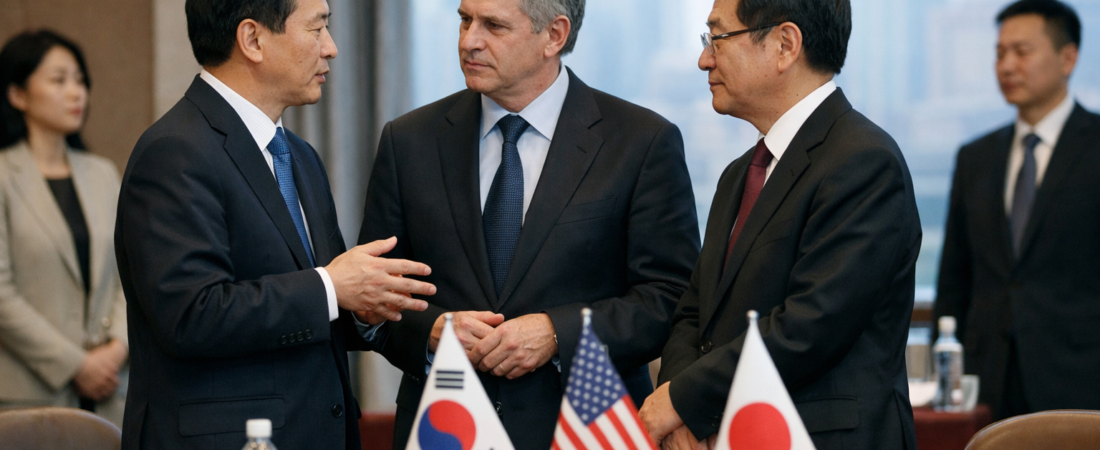
Can three countries really keep pace with North Korea’s shifting alliances? That question sits at the heart of the upcoming Korea-US-Japan foreign ministers meeting in Manila, Philippines. Foreign ministers from Seoul, Washington, and Tokyo plan to gather on the sidelines of the ASEAN Regional Forum (ARF) this month.
Their goal? Share intelligence on North Korea’s deepening ties with Russia and China. And figure out how to respond together, not separately.
Why This Korea-US-Japan Foreign Ministers Meeting Matters Now
Diplomacy rarely happens in isolation. The Korea-US-Japan foreign ministers meeting will take place alongside the ARF, a regional security forum that brings together nearly 30 countries across Asia-Pacific. Manila hosts this year’s gathering, giving the three allies a natural venue to sync their North Korea strategy.
Why hold a trilateral meeting inside a larger multilateral one? Simple. It saves time and signals unity without requiring a separate summit.
This pattern has repeated for years now. Whenever ASEAN-linked forums occur, Korea, the US, and Japan tend to schedule their own side conversations. It’s efficient diplomacy, and it sends a message to Pyongyang, Moscow, and Beijing: these three nations are watching closely, together.
The timing also matters for another reason. Tensions on the Korean Peninsula rarely stay static for long. Each Korea-US-Japan foreign ministers meeting becomes a checkpoint, a moment to recalibrate before things shift again.
You might wonder why this particular meeting draws so much attention. It’s because the stakes have changed. North Korea isn’t just testing missiles anymore.
It’s actively building relationships with Russia and China, and that changes the entire calculation for Seoul, Washington, and Tokyo.
North Korea’s Absence and the Russia-China Factor
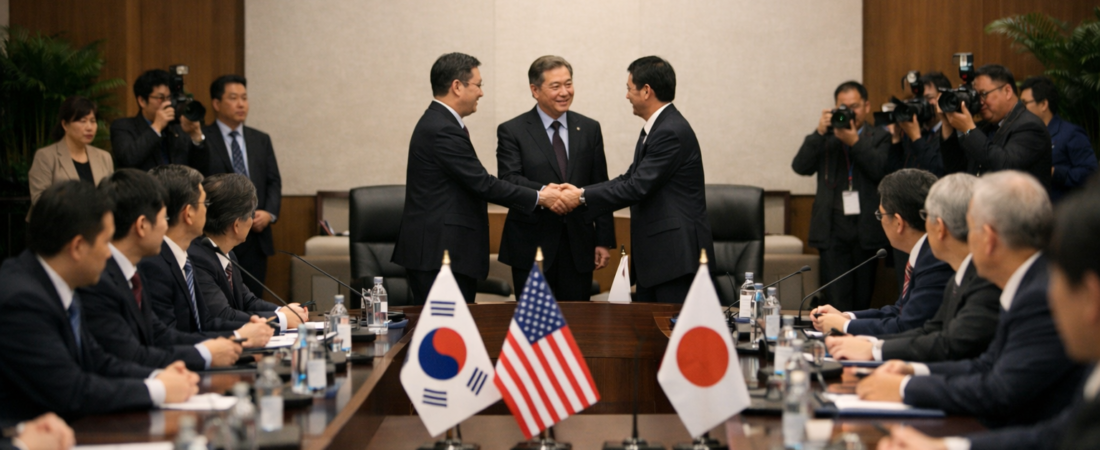
Here’s something worth noting. North Korea is expected to skip the ARF again this year. That’s not new; Pyongyang has stayed away from this forum for several years running.
But its absence from ARF doesn’t mean isolation. Quite the opposite, actually. North Korea has been strengthening bilateral ties with both Russia and China through separate diplomatic channels.
This is exactly what the Korea-US-Japan foreign ministers meeting aims to address. Officials plan to compare notes on North Korea-Russia exchanges and North Korea-China exchanges. Think of it as intelligence-sharing meets strategy session.
Why does this matter to you, even if you’re not in Korea? Because North Korea’s growing alignment with Moscow and Beijing reshapes the entire security balance in East Asia.
Weapons technology, energy resources, diplomatic cover at the UN. All of these become bargaining chips in a three-way relationship that bypasses Washington entirely.
The three foreign ministers will likely discuss how sanctions enforcement has weakened as North Korea finds alternative partners. Russia, isolated by its own war in Ukraine, has reportedly deepened cooperation with Pyongyang. China, meanwhile, continues its own quiet economic support.
Neither relationship gets discussed openly in Pyongyang’s state media. But regional intelligence agencies track these patterns closely, and that’s precisely what feeds into discussions at the Korea-US-Japan foreign ministers meeting.
Should this worry ordinary citizens in Seoul, Tokyo, or Washington? Perhaps not immediately. But strategic coordination among allies becomes more important as North Korea gains new economic lifelines outside traditional sanctions frameworks.
Beyond North Korea: A Crowded Regional Agenda
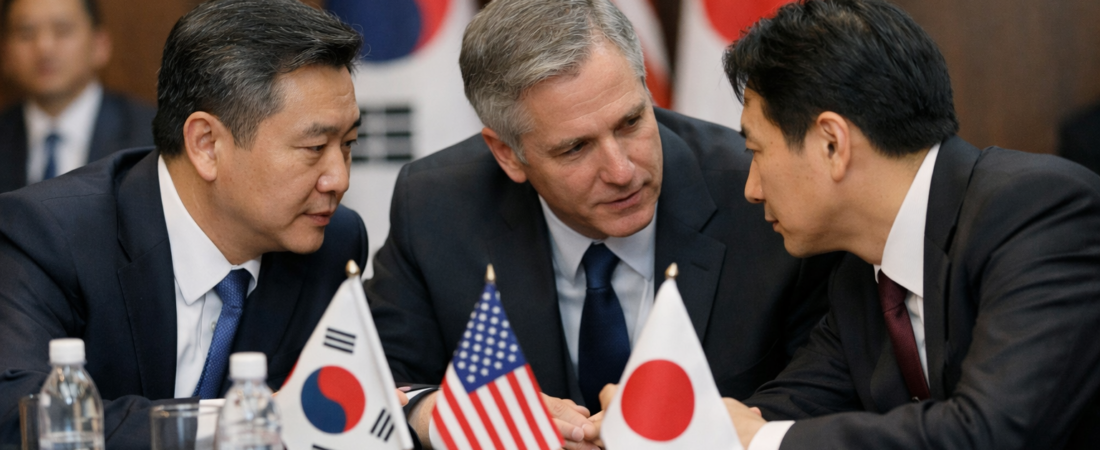
North Korea won’t be the only topic on the table. This year’s Korea-US-Japan foreign ministers meeting carries a surprisingly broad agenda. Middle East tensions, for one, will likely come up given ongoing instability in that region.
Economic security stands as another priority. Supply chains, semiconductor access, and critical minerals all fall under this umbrella term now.
Countries increasingly treat economic policy as a national security issue, not just a trade matter. That shift shapes how these three allies approach everything from technology exports to investment screening.
ASEAN cooperation also appears on the docket. Southeast Asia has become a critical battleground for influence between the US-aligned bloc and China. Neither Washington nor Seoul nor Tokyo wants to cede ground here without a coordinated approach.
Small Modular Reactor, or SMR, cooperation represents a newer but growing topic. Nuclear energy technology, especially smaller and more flexible reactor designs, has become a point of collaboration among these three nations. Energy security concerns have pushed SMR development higher on diplomatic agendas worldwide.
Then there’s cross-border online crime, an issue that rarely made headlines a decade ago. Now it demands serious attention. Cybercrime networks operate across borders with ease, and no single country can tackle them alone.
You can read more about how regional forums like ARF address these overlapping security challenges through resources like the Yonhap News Agency, which tracks diplomatic developments across Asia-Pacific.
This diverse agenda tells you something important. The Korea-US-Japan foreign ministers meeting isn’t just about North Korea anymore. It’s evolved into a broader platform for coordinating policy across multiple fronts simultaneously.
What This Trilateral Diplomacy Signals for 2026
Where does this leave us heading into 2026? Trilateral cooperation between Korea, the US, and Japan shows no signs of slowing down. If anything, the scope keeps expanding with each Korea-US-Japan foreign ministers meeting.
What started as North Korea-focused coordination has grown into something larger. Economic security, technology cooperation, regional stability across Southeast Asia. All of these now fall under the same diplomatic umbrella.
This expansion makes sense when you consider global trends. Traditional security threats and economic threats increasingly overlap. A country’s access to semiconductors matters as much as its military posture these days.
North Korea’s strategy also deserves a closer look here. By skipping ARF while deepening bilateral ties with Russia and China, Pyongyang plays a clever game. It avoids multilateral scrutiny while still gaining diplomatic and economic support through separate channels.
This approach lets North Korea maintain flexibility. It doesn’t have to answer to a room full of nations at once. Instead, it manages each relationship on its own terms, extracting benefits without multilateral accountability.
For Korea, the US, and Japan, this reality demands constant recalibration. Each Korea-US-Japan foreign ministers meeting becomes an opportunity to update shared intelligence and align next steps. Without this coordination, gaps emerge that adversaries can exploit.
History offers a useful comparison here. Trilateral cooperation among these three nations intensified significantly after North Korea’s nuclear and missile tests escalated throughout the 2010s. What began as reactive coordination has since become proactive, institutionalized diplomacy.
That evolution matters. It shows how crisis-driven partnerships can mature into lasting structures, provided all sides keep investing in them consistently.
Looking ahead, expect this pattern to continue. As North Korea’s relationships with Russia and China deepen, expect Korea, the US, and Japan to respond with even tighter coordination. Each Korea-US-Japan foreign ministers meeting adds another layer to this ongoing strategic dialogue.
Will this trilateral approach actually slow North Korea’s outreach to Moscow and Beijing? That remains uncertain. But without sustained diplomatic coordination, the alternative looks far riskier: three allies working separately against a rival bloc that’s increasingly unified.
What do you think about this three-way diplomatic balancing act between Korea, the US, and Japan? Does trilateral coordination like this actually shift North Korea’s calculations, or does Pyongyang simply adapt around it?
AI-Generated Photorealistic Image — All people, scenes, and details in this image are entirely AI-generated and fictional. Not a real photograph of an actual person or event. 이 이미지는 AI로 생성된 가상 이미지입니다.


Leave a Reply