
Table of Contents
A native Korean teacher who has spent ten years teaching foreign students shares one recurring reaction to her job: surprise. People hear “I teach Korean” and immediately assume she must be a foreigner, not a native Korean herself. Her new book unpacks a decade of 한국어교육 (Korean language education) through daily classroom stories.
Why does that surprise keep happening? Maybe because most people picture language teaching as something foreigners do abroad, not something Koreans do at home for foreigners.
This small mix-up actually opens a bigger conversation. It says a lot about how Korean language education has quietly grown into its own profession, its own community, and its own story worth telling.
One Question Every Korean Teacher Hears
The writer behind this book describes herself simply: she loves the letter K. K-pop, K-food, K-drama, K-webtoons, K-office workers — she enjoys attaching that single letter to everything Korean.
So it makes sense that she calls herself both a “Korean” teaching “Korean.” The wordplay is intentional, and honestly, a little charming (yes, the pun works in English too).
But here’s the twist people don’t expect. When she tells someone she teaches Korean, the near-automatic assumption is that she must be a native English speaker who picked up Korean as a second language.
In reality, she is a native-born Korean teacher — what the field calls a “native speaker instructor” of her own mother tongue. That distinction matters more than it sounds, and it shapes the entire structure of her book.
Ten Years Inside a Korean Language Classroom
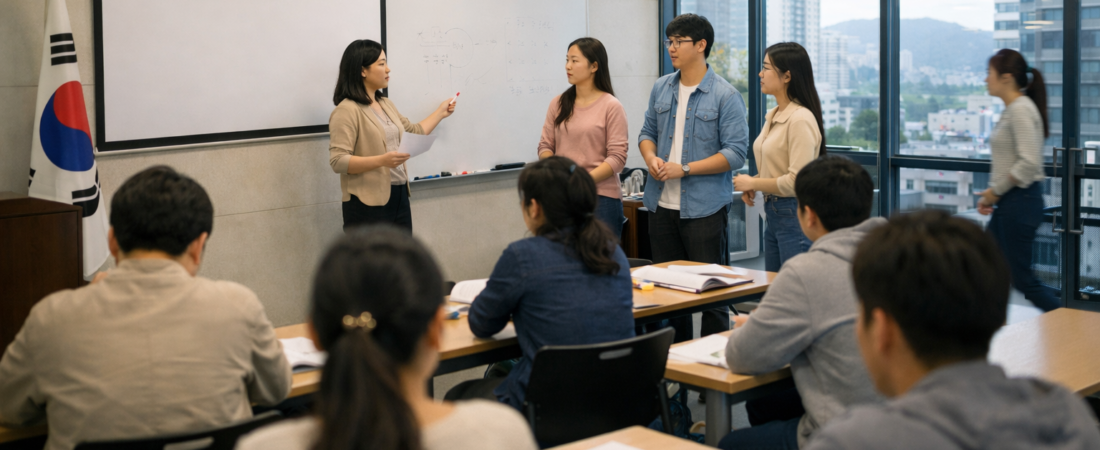
Her book is organized into five parts, but the first two set the emotional foundation. Part one covers ten straight years of teaching Korean, thinking in Korean, and living immersed in the language every single day.
What does a decade like that actually feel like? According to her account, it is less about grammar drills and more about identity — how a language slowly becomes the lens through which you see everything.
Part two shifts tone completely, moving into lighter, funnier classroom moments. These are the stories that make readers smile, the kind of surprising exchanges that feel almost too dramatic to be real, yet happened in an ordinary classroom.
Think about your own experience learning any new language. Small misunderstandings, unexpected questions, moments where a student’s logic makes you laugh and reconsider your own native tongue at the same time.
That is the texture this book captures — not textbook Korean, but lived, breathing Korean, filtered through years of patient teaching.
Why Korean Language Education Matters Beyond K-Pop

Korean language education has expanded dramatically over the past two decades. Global interest in Korean culture, from music to television to food, pushed thousands of learners toward formal Korean study.
But here’s a question worth sitting with: does global pop culture actually create lasting language learners, or just curious tourists of the language? The honest answer is probably both, and that tension is exactly what shapes classrooms like the one in this book.
Some students arrive chasing a K-drama fantasy and quit within months. Others, drawn in by the same spark, stay for years and build real fluency, real friendships, and real careers around Korean.
Teachers working in Korean language education sit at that crossroads every day, deciding how to turn fleeting curiosity into genuine competence. You can read more background on how Korean language programs have grown internationally through outlets like OhmyNews.
That responsibility is not glamorous, but it is foundational to why Korean language education continues to matter globally, well beyond any single cultural trend.
What This Teacher’s Story Tells Us About the Future
Stories like this one remind us that behind every trending Korean drama or chart-topping song, there is quiet, unglamorous work happening in classrooms. Someone is patiently correcting pronunciation, explaining particles for the hundredth time, and celebrating small victories most people never see.
That kind of dedication deserves honesty, not just admiration. Teaching any language for ten years brings real fatigue, moments of doubt, and days when even a beloved subject feels exhausting rather than joyful.
Yet within that same fatigue, something genuine keeps people going: a student’s breakthrough moment, an unexpected joke that finally lands in the right language, a small sign that connection across culture is actually possible. Korean language education, at its best, holds both of these truths together — the tiredness and the quiet reward, without pretending one erases the other.
Where does Korean language education go from here? As global interest keeps rising, more native teachers may step forward to share their own classroom stories, adding depth beyond the usual K-culture headlines.
What do you think draws so many people worldwide to start learning Korean in the first place?
AI-Generated Photorealistic Image — All people, scenes, and details in this image are entirely AI-generated and fictional. Not a real photograph of an actual person or event. 이 이미지는 AI로 생성된 가상 이미지입니다.




Leave a Reply