
Table of Contents
North Korea publicly displayed live-fire tests of its 600mm super-large multiple rocket launcher and suicide drone strikes this week. Kim Jong-un declared “power is peace” while touting his country’s edge in unmanned aerial technology. The exhibition comes as North Korea ignores Seoul’s recent proposal for military talks.
Is this just another show of force, or something more calculated? That question matters more than ever for anyone watching the Korean Peninsula.
North Korea’s timing, its messaging, and its choice of targets all tell a story. Let’s break down what actually happened and why it should concern you, wherever you’re reading this from.
North Korea’s Drone and Artillery Showcase
North Korea held an exhibition it called a showcase of “unmanned aerial technology development.” At the center of the event sat the 600mm super-large multiple rocket launcher, a weapon North Korea nicknames “the sniper.” More than ten rounds were fired at a target rock island, and each one landed with visible accuracy.
Kim Jong-un reportedly clapped and pumped his fist in approval while watching the test. That reaction alone tells you how seriously North Korea treats this capability.
But the artillery was only part of the spectacle. Suicide drones, resembling designs used by the United States and Israel, struck mock targets built to look like South Korean front-line guard posts, K9 self-propelled howitzers, and even American M1 tanks.
North Korea also revealed footage of missiles launched from reconnaissance drones, along with what officials claimed was 100 percent precision accuracy. Observers spotted what appeared to be a stealth-type drone, plus low-cost “cardboard drones” designed for cheap mass production. (Yes, cardboard — proof that even weapons programs love a budget option.)
South Korea’s military separately confirmed that North Korea fired more than ten ballistic missiles from the Wonsan area into the East Sea around the same period. Taken together, these events paint a picture of a coordinated demonstration, not a random test.
Why Kim Jong-un’s “Power Is Peace” Message Matters
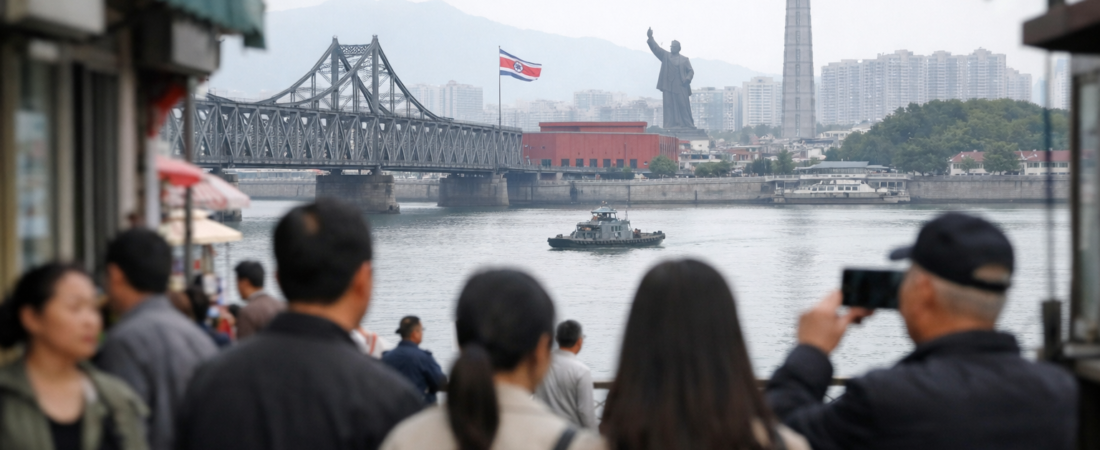
Kim Jong-un used his speech at the event to emphasize what he called North Korea’s “absolute superiority” in the drone field. His exact phrase, broadcast on North Korea’s state-run Korean Central Television, was striking: power is peace, and peace can only be guaranteed through power.
He called for “miraculous achievements” in unmanned aerial technology and defense artificial intelligence. That is not casual language.
It signals that North Korea sees drones and AI as the next major battlefield, not a side project. Why frame weapons development as a peace strategy?
Because it lets North Korea justify continued military buildup as defensive rather than aggressive. This rhetorical move isn’t new in North Korean messaging, but pairing it directly with drone footage striking South Korean and American equipment mock-ups sharpens the warning considerably.
North Korea wants Seoul and Washington to see these images and draw a specific conclusion: negotiating from a position of strength is the only option North Korea will accept. For readers tracking North Korea’s broader strategy, this exhibition fits a pattern of using public displays to shape diplomatic leverage rather than open genuine dialogue.
The Ukraine War Connection
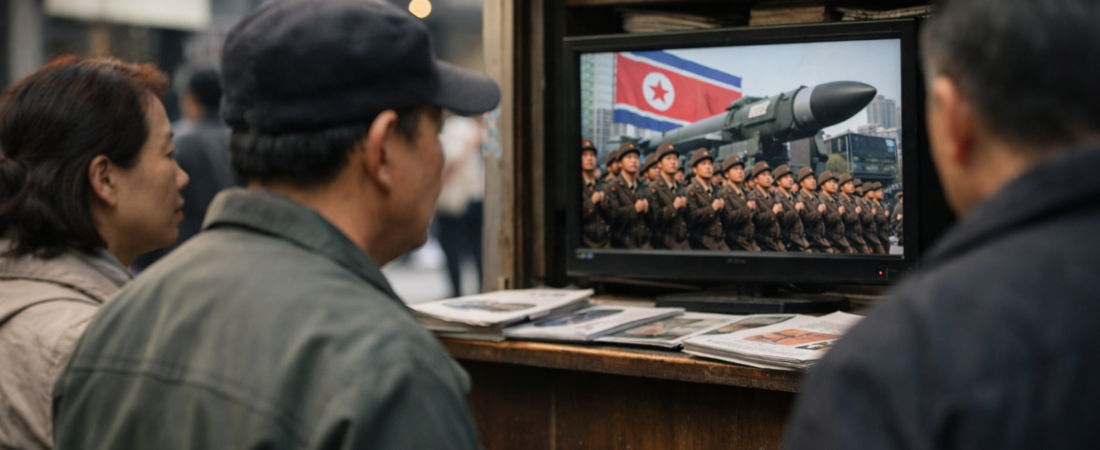
Where is North Korea getting this drone expertise so quickly? Experts point to one clear answer: North Korea’s troop deployment to support Russia in the Ukraine war.
That involvement has given North Korea direct exposure to modern drone warfare and, reportedly, technology transfers from Russia in return.
Cho Sang-geun, a research professor at the KAIST Policy Research Institute for National Future Strategic Technology, explained the pace of change bluntly. Drone technology in the Russia-Ukraine war evolves roughly every two weeks, he noted, and that innovation flows almost directly into North Korea like a straw drawing from a glass.
China has reportedly added to this pipeline by supplying materials, parts, and equipment to North Korea as well.
This matters because it shows North Korea isn’t developing drone capability in isolation. It’s absorbing real battlefield lessons from an active war, compressing what might normally take years of research into a much shorter timeline.
For deeper analysis on how the Ukraine conflict is reshaping global military technology transfers, resources like SBS News offer useful ongoing coverage. The implication for the Korean Peninsula is direct: North Korea’s drone fleet today is shaped by lessons learned thousands of kilometers away in Eastern Europe.
South Korea’s Response and the North Korea Challenge Ahead
South Korea’s own drone program has faced visible setbacks recently. At a Ministry of National Defense demonstration in September, several domestically developed drones crashed during testing.
When asked whether South Korea is falling behind North Korea in this field, a military official admitted the delay in advanced capabilities like drones is “a serious problem.” The official also pledged to improve the system going forward.
That kind of honesty is worth noting. Admitting gaps publicly isn’t easy for any government, especially on matters of national security.
Does South Korea need to accelerate its drone and counter-drone development? Almost certainly, given what North Korea just demonstrated.
But rebuilding technological parity takes more than urgency. It requires sustained investment, clearer procurement processes, and closer coordination between the military and private defense technology firms.
South Korea has real strengths here too, including a highly advanced electronics and semiconductor industry that could, if properly mobilized, close this gap faster than many expect. The challenge now is translating industrial capacity into deployable military technology before the gap widens further.
North Korea’s exhibition should be read as a signal, not just a spectacle. It tells South Korea, the United States, and the wider region that North Korea intends to compete in exactly the technological space that is reshaping modern warfare worldwide.
Whether this leads to renewed dialogue or further escalation depends on choices made in Seoul, Washington, and Pyongyang in the months ahead. What do you think North Korea’s drone buildup means for the stability of the Korean Peninsula going forward?
AI-Generated Photorealistic Image — All people, scenes, and details in this image are entirely AI-generated and fictional. Not a real photograph of an actual person or event. 이 이미지는 AI로 생성된 가상 이미지입니다.




Leave a Reply