
Table of Contents
Can one house really break a country’s housing market? President Lee Jae-myung seems to think so. At a nationwide public forum on real estate policy, he pointed to a very specific habit among Korean homebuyers as a hidden driver of price distortion.
That habit has a name: “one smart house.” It means owning a single, ultra-desirable home instead of several properties.
Sounds harmless, right? But according to Lee, this preference — combined with abnormal demand — has quietly reshaped Korea’s entire real estate policy landscape.
What Happened at Korea’s National Real Estate Debate
President Lee Jae-myung recently hosted a large public discussion focused entirely on real estate policy. This wasn’t a closed-door meeting between officials and economists. It was framed as a national conversation, inviting citizens to weigh in on why housing prices keep climbing in certain areas.
Why hold a public forum instead of just announcing new rules? Because housing policy in Korea has failed before when it ignored public sentiment.
Past administrations rolled out dozens of real estate policy adjustments, only to watch prices in Seoul’s most desirable districts keep rising. Lee’s approach signals something different: policy built with public input, not just top-down mandates.
During the forum, Lee made a striking claim. He said the preference for owning one “smart” high-value home, rather than spreading investment across several properties, has actually made price distortion worse.
This might sound counterintuitive at first. Wouldn’t fewer properties per person mean less speculative pressure?
Not necessarily — and that’s exactly the paradox this real estate policy debate tried to unpack.
Why “One Smart House” Became a National Problem
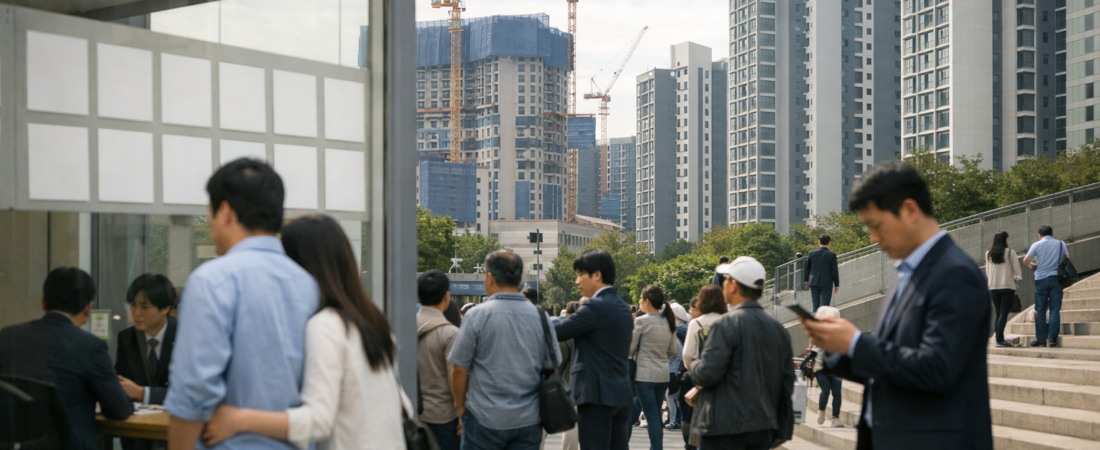
Let’s break down the “one smart house” phenomenon. Instead of owning multiple average homes, many wealthy Koreans now concentrate their capital into a single, top-tier property.
Think Gangnam-district apartments or luxury units in prestigious Seoul neighborhoods. These are the homes everyone wants — and few can access.
This concentrated demand pushes prices in elite areas far above the national average, creating a two-tier housing market. Regular apartments across the rest of the country may stagnate or even decline in value.
Meanwhile, trophy properties in a handful of desirable zones keep breaking price records. That’s the distortion Lee referenced during the real estate policy discussion.
Why does this matter beyond Seoul’s wealthy neighborhoods? Because it signals a structural problem in how Koreans think about homeownership.
A house is no longer just shelter — it’s treated as the single most important asset a family can hold. This mindset, amplified by decades of price appreciation in prime locations, has made “abnormal demand” a defining feature of Korea’s real estate policy challenges.
Historically, Korean households have leaned heavily on real estate for wealth-building, more than stocks or other investments. That cultural pattern helps explain why one perfect home can outweigh diversification in the public imagination.
President Lee’s comments during the forum weren’t just political rhetoric. They reflected a genuine diagnosis: without addressing this psychology, any real estate policy reform risks treating symptoms instead of causes.
You can pass tax law after tax law, but if buyers still chase a handful of “smart” properties, prices in those zones will keep climbing regardless.
Four Big Ideas on the Table for Real Estate Policy

So what concrete tools did officials discuss at this forum? Four major proposals stood out, each targeting a different piece of the real estate policy puzzle.
First, stronger property holding taxes on ultra-expensive homes. This targets the exact “one smart house” behavior Lee criticized, making it costlier to park wealth in a single luxury unit.
Second, adjustments to capital gains tax breaks for single-home owners. Currently, many one-house owners enjoy generous exemptions when they sell.
Officials debated whether these exemptions unintentionally encourage speculative upgrading — selling a modest home to buy an even more expensive “smart” one. Third, reforms to jeonse loan programs.
Jeonse is Korea’s unique lump-sum deposit rental system, and government-backed loans supporting it have been blamed for inflating housing demand in some analyses. Adjusting these loans could cool speculative borrowing tied to real estate policy loopholes.
Fourth — and perhaps most ambitious — accelerating supply through third-phase new towns, known as 3rd New Towns. These are large-scale planned communities meant to ease housing pressure around Seoul.
Faster construction timelines could add much-needed supply to a market where scarcity drives up prices in popular districts. You might ask: can these four measures really work together?
That’s the real test facing Korea’s real estate policy makers this year. Raising taxes without adding supply risks frustrating buyers without solving scarcity.
Adding supply without addressing “smart house” psychology risks letting new developments become the next luxury target. For deeper analysis on how tax and supply policies interact globally, resources like Korea Daily Life News Desk offer useful comparative context.
Balance, not a single silver bullet, seems to be the government’s real strategy here.
What Comes Next for Korea’s Housing Market
Here’s the timeline that matters most right now. The government plans to announce a comprehensive tax reform package, including real estate policy changes, by the end of this month or early next month.
That’s a tight window. Whatever gets decided will directly shape how homeowners, investors, and renters plan their next moves.
Will the government actually raise holding taxes on ultra-expensive homes? Will one-house owners lose some of their capital gains protections?
These aren’t abstract policy questions — they affect millions of Korean households deciding whether to buy, sell, or wait. For international observers, this moment offers a fascinating case study.
Few countries treat housing as intensely as Korea does, both culturally and politically. Real estate policy here isn’t just an economic tool — it’s a measure of social fairness, generational opportunity, and even national identity.
When President Lee talks about “abnormal demand” distorting the market, he’s touching a nerve that runs through Korean society. Young Koreans increasingly feel priced out of homeownership entirely.
Meanwhile, older generations who bought decades ago in now-prime locations have seen wealth multiply many times over. This generational tension adds real urgency to the upcoming real estate policy announcement.
Any reform package needs to address rising inequality without punishing families who bought homes responsibly years ago. That’s a delicate balance for any government to strike.
Looking ahead, expect intense debate once the tax reform details become public. Real estate policy in Korea rarely settles quietly — it tends to spark passionate reaction from every side of the political spectrum.
Whether this round of reforms actually curbs the “one smart house” trend remains to be seen. But one thing is clear: Korea’s approach to housing will keep evolving, shaped by public forums just like this one.
So here’s a question worth sitting with: does concentrating tax pressure on luxury homes actually fix the underlying psychology, or does it just push wealthy buyers toward new loopholes? What do you think about Korea’s approach to reshaping real estate policy through public dialogue rather than closed-door decisions?
AI-Generated Photorealistic Image — All people, scenes, and details in this image are entirely AI-generated and fictional. Not a real photograph of an actual person or event. 이 이미지는 AI로 생성된 가상 이미지입니다.
Leave a Reply