
Table of Contents
Can a personal apology settle a political scandal? That question sits at the heart of a controversy now facing People Power Party floor leader Jeong Jeom-sik. A physical altercation over committee assignments has put one lawmaker under ethics review, and Jeong finds himself caught between personal forgiveness and institutional duty.
This isn’t just a story about one heated moment in the National Assembly. It’s a window into how Korean political parties balance personal relationships with formal accountability. Let’s break down what actually happened.
What Happened: The Committee Assignment Dispute
The controversy started over something that sounds mundane: committee assignments. In the Korean National Assembly, standing committee seats determine a lawmaker’s influence, visibility, and legislative reach.
Competition for these spots can get intense. Lawmaker Kwon Young-jin reportedly grabbed a colleague by the collar during a dispute over these assignments, an act that quickly escalated into a party-wide controversy.
Physical confrontations between lawmakers are rare in modern Korean politics, though not unheard of. When they happen, they draw immediate public attention and often trigger formal disciplinary review.
That’s exactly what occurred here. The party’s Ethics Committee opened a disciplinary procedure against Kwon, setting up a review process that Jeong Jeom-sik, as floor leader, must now navigate carefully.
Jeong Jeom-sik’s Response and Political Context
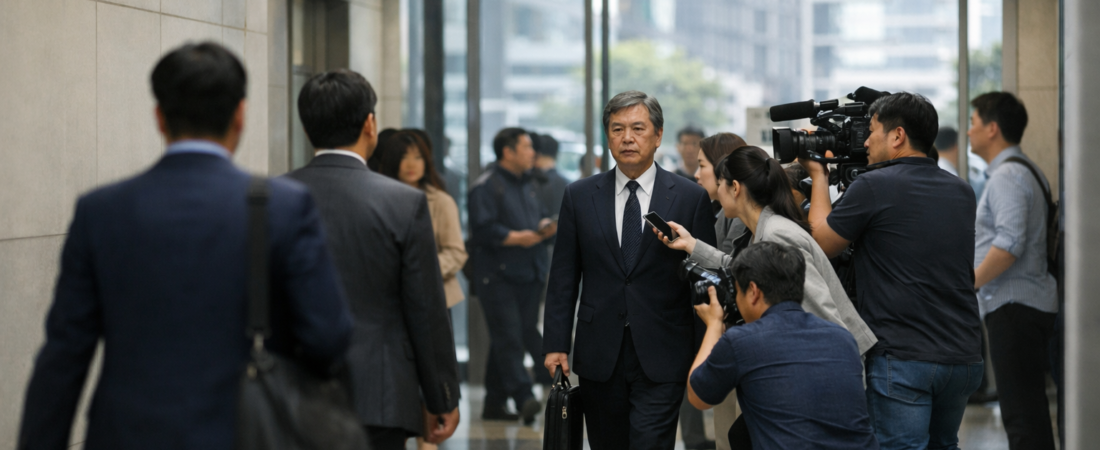
So how did Jeong Jeom-sik actually respond? He struck a notably measured tone, one that separates his personal feelings from his institutional responsibilities.
Jeong Jeom-sik confirmed that Kwon Young-jin personally visited him to apologize. According to Jeong Jeom-sik, that apology was sincere enough to resolve the matter between the two of them on a personal level.
“Personally, I hope for leniency,” Jeong Jeom-sik reportedly said, signaling where his private sympathies lie. But here’s where it gets interesting — Jeong Jeom-sik made clear that his personal wishes cannot override an official disciplinary process already underway.
Why does this distinction matter so much? Because in Korean political culture, floor leaders occupy a dual role, part team captain and part institutional gatekeeper.
Jeong Jeom-sik acknowledged that since the Ethics Committee has already launched its review, he cannot offer an official evaluation of the case. Still, he left the door open, saying that if the committee asks for his input as the affected party, he would share his perspective.
This careful balancing act reveals something important about how senior Korean lawmakers handle internal conflict. Public statements from party leadership carry weight, and Jeong Jeom-sik clearly understands that his words could be read as pressure on an independent review process.
How Party Ethics Committees Work in Korea

Understanding this story requires knowing how ethics committees function inside Korean political parties. Every major party, including the People Power Party, maintains an internal disciplinary body separate from the National Assembly’s own ethics apparatus.
These committees investigate member misconduct, ranging from financial irregularities to, as in this case, physical altercations between colleagues. Their decisions can range from warnings to suspension of party membership, and in serious cases, expulsion.
Here’s the key point: once a committee formally opens a case, party leaders like Jeong Jeom-sik are expected to step back from the substance of the decision. Why?
Because Korean parties, learning from past controversies over leadership interference, have tried to protect these committees’ independence. A floor leader publicly demanding leniency could look like undue influence, even if his private opinion is genuine.
This is precisely why Jeong Jeom-sik’s phrasing matters so much. He didn’t call for Kwon Young-jin’s exoneration outright.
Instead, he framed his hope for leniency as a personal wish, while respecting the committee’s procedural authority. It’s a subtle but important distinction for anyone trying to understand Korean party governance.
Readers curious about the broader institutional framework behind Korea’s National Assembly can find additional background through Yonhap News Agency, which regularly covers legislative procedure and party discipline cases.
What This Means for Korean Political Culture
What can outside observers learn from this episode? First, it shows that Korean lawmakers, even senior ones like Jeong Jeom-sik, are not immune to personal conflict spilling into public view.
Second, it highlights a tension familiar to anyone who has managed a team: how do you separate your role as a colleague from your role as an authority figure? Jeong Jeom-sik’s response suggests an attempt to honor both.
Is this approach effective, or does it risk looking indecisive? That’s a fair question.
Some critics might argue that Jeong Jeom-sik should take a firmer public stance, given his position of authority. Others would say his restraint actually strengthens the Ethics Committee’s independence by avoiding any appearance of leadership interference.
Either way, the case of Kwon Young-jin now becomes a small but telling test of how the People Power Party enforces internal discipline. Will personal apologies factor into the committee’s final decision?
Jeong Jeom-sik has signaled that his own view could be requested, but he stopped short of predicting the outcome. This kind of restraint is common among experienced Korean politicians, who understand that public commentary before a ruling can backfire.
Looking ahead, this incident may prompt renewed discussion about how committee assignments are decided in the first place. If competition over these seats is intense enough to trigger physical altercations, perhaps the underlying process deserves scrutiny too.
Jeong Jeom-sik, as floor leader, sits at the center of both the immediate personnel dispute and any future reform of assignment procedures. His handling of this case, measured and procedurally cautious, may shape expectations for how future intra-party conflicts get resolved.
For global readers unfamiliar with Korean legislative culture, this story offers a useful lesson. Political institutions everywhere struggle with the same core question: when does personal reconciliation satisfy public accountability, and when does it not?
Jeong Jeom-sik’s careful language, hoping for leniency while respecting institutional process, reflects a broader pattern in Korean governance. Leaders often try to preserve relationships while still allowing formal systems to run their course.
What do you think about Jeong Jeom-sik’s approach to this delicate situation? Should personal apologies carry weight in formal disciplinary proceedings, or should institutions like the Ethics Committee remain completely insulated from personal appeals?
AI-Generated Photorealistic Image — All people, scenes, and details in this image are entirely AI-generated and fictional. Not a real photograph of an actual person or event. 이 이미지는 AI로 생성된 가상 이미지입니다.



Leave a Reply