
Table of Contents
Korea’s Heatwave Crisis: Why Nonghyup Is Mobilizing Right Now
Right now in Korea, one topic dominates every farm village conversation: the record-breaking heatwave scorching the countryside. Temperatures have climbed to dangerous levels this week, and rural communities are feeling the strain first. That’s why Nonghyup, Korea’s National Agricultural Cooperative Federation, just launched an all-out emergency response.
Have you ever wondered what happens when an entire nation’s food supply depends on people working outdoors in extreme heat? That’s exactly the pressure facing Korean farmers this summer. Nonghyup isn’t waiting for the crisis to worsen—it’s acting immediately, and at massive scale.
This isn’t a routine seasonal announcement. Prolonged drought combined with record heat has created what officials call a genuine emergency for agricultural workers. Nonghyup’s response, spanning cooling centers, protective equipment, and health supplies, shows how seriously the organization treats this threat.
Cooling Centers and Emergency Supplies: Nonghyup’s Frontline Response
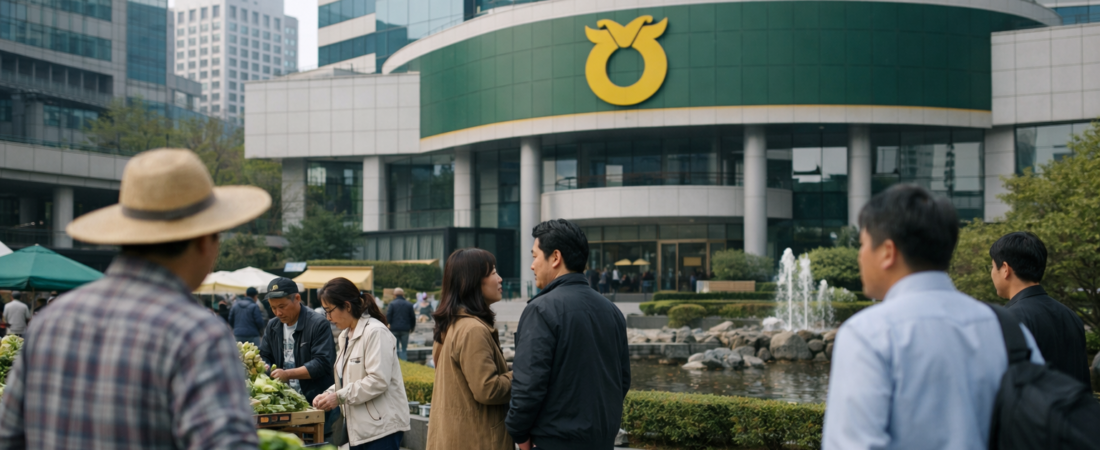
So what exactly is Nonghyup doing on the ground? The numbers tell a striking story. Nonghyup is currently operating 5,927 heat shelters nationwide, giving farmers and rural residents somewhere safe to escape the sun.
Beyond shelter space, Nonghyup has distributed 320,000 neck coolers to workers who spend hours in open fields. It has also supplied one million packets of onion juice, a traditional Korean remedy believed to help the body cope with heat stress. (Yes, someone at Nonghyup actually counted all one million packets—that’s dedication to detail.)
These aren’t token gestures. Neck coolers provide continuous relief during long field hours, while hydration-focused supplies address the very real risk of heatstroke among older farmers. Nonghyup’s economic holding company, Nonghyup Economic Federation, has coordinated much of this distribution effort directly to vulnerable farming regions.
Why does this level of detail matter? Because heatwave deaths in Korea have risen sharply in recent years, and elderly agricultural workers face the highest risk. Nonghyup’s leadership clearly understands that supply logistics can be the difference between a manageable season and a tragic one.
Understanding Nonghyup’s Role in Korea’s Agricultural Safety Net

You might be asking: why is a cooperative bank and agricultural group leading a public health response? The answer lies in Nonghyup’s unique structure. Nonghyup isn’t just a financial institution—it’s the backbone of Korea’s entire agricultural economy.
Founded to support farmers through credit, insurance, and supply distribution, Nonghyup has evolved into something closer to a rural community safety net. When drought threatens crops or heat threatens lives, Nonghyup often responds faster than government agencies because its regional branches are embedded directly in farming communities.
This current heatwave campaign follows that same pattern. Nonghyup mobilized what officials describe as a “pan-Nonghyup” effort, meaning every branch of the organization—insurance divisions, economic holding units, and local cooperative offices—contributed resources. That kind of coordinated, organization-wide response is rare outside of Korea’s cooperative model.
For readers outside Korea, this might sound unusual. Imagine if your local bank also ran your town’s emergency shelters and distributed medical supplies during a crisis. That’s roughly the role Nonghyup plays in rural Korea, and it explains why so many farmers view the cooperative as more than a financial institution.
According to Maeil Business Newspaper, this year’s combination of drought and extreme heat has pushed Nonghyup to expand its typical seasonal support into a full emergency mobilization. That escalation itself signals how seriously Korean institutions are treating this year’s weather patterns.
What This Heatwave Response Reveals About Rural Korea’s Future
Step back for a moment. What does this crisis actually tell us about rural Korea’s long-term challenges? Korea’s farming population is aging rapidly, and many farmers now work fields alone, without younger family members nearby to help during emergencies.
That reality makes Nonghyup’s heat shelters and supply drops more than convenience—they’re often a lifeline for isolated elderly residents. The same tight-knit rural communities that Koreans take pride in can also hide a quieter problem: older farmers living and working alone, with fewer people checking in on their wellbeing day to day.
There’s real hope in how this is being addressed, though. Nonghyup’s network of local branches means someone often does notice when a farmer needs help, and organized responses like this heatwave campaign show that institutional support can reach even the most remote villages. Community resilience in rural Korea isn’t a myth, but it works best when it’s paired with organized systems like this one, not left to informal goodwill alone.
Climate patterns aren’t returning to normal anytime soon. Scientists expect more frequent extreme heat events across East Asia in coming years, which means Nonghyup’s current mobilization may become a template rather than an exception.
For global readers, this matters beyond Korea’s borders. As climate stress intensifies worldwide, agricultural cooperatives everywhere may need to take on broader public health roles, not just financial ones. Nonghyup’s model—embedding emergency response directly into everyday cooperative infrastructure—offers a case study other countries facing similar rural aging and climate pressures might learn from.
What do you think about Korea’s approach to protecting its farmers through organizations like Nonghyup rather than government agencies alone?
AI-Generated Photorealistic Image — All people, scenes, and details in this image are entirely AI-generated and fictional. Not a real photograph of an actual person or event. 이 이미지는 AI로 생성된 가상 이미지입니다.
Leave a Reply