Table of Contents
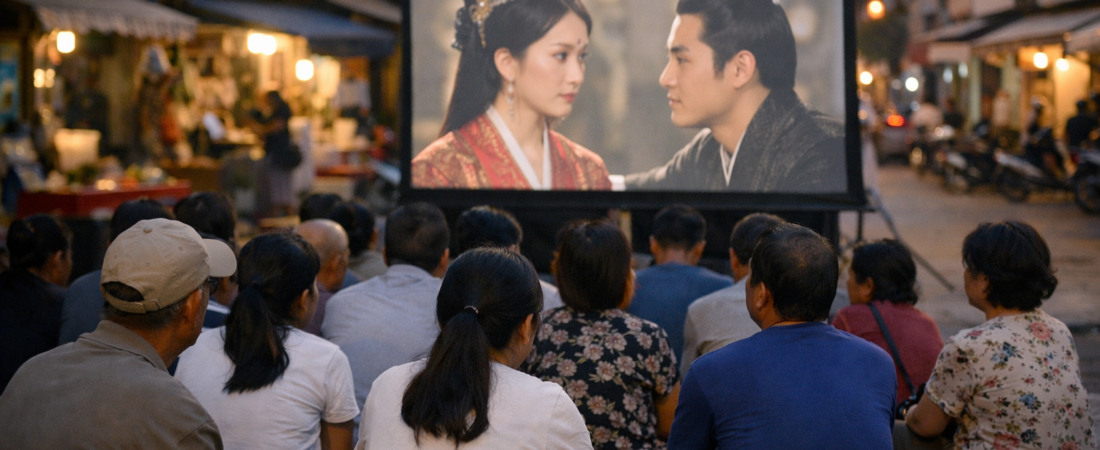
A birthday party for a Chinese actor filled six floors of a Bangkok mall with fan-rented screens last week, and hundreds of Thai fans showed up. The event, entirely organized by fans of actor Yang Yang, took place at Union Mall, a spot long known for celebrating Korean stars. It shows Chinese entertainment is no longer a quiet presence in Southeast Asia.
Could this be the beginning of a real shift? Or just one enthusiastic fan group having a good weekend? Let’s look closer at what happened, and what it means.
A Bangkok Mall Becomes a Battleground
Union Mall in Bangkok’s Lat Phrao district has a reputation. Fans of K-pop and Korean dramas have flooded it for years with posters, pop-up cafes, and birthday ads for their favorite idols.
Last Sunday, something different happened. LED screens on six towering pillars, stretching from the first floor to the sixth, were covered with images of just one man.
That man was Yang Yang, one of China’s “Big Four” leading actors. His Thai fan community, known affectionately as “Yangmao,” meaning “wool,” rented every single digital ad screen in the mall to celebrate his birthday.
The celebration ran from 11 a.m. to 5 p.m. and drew hundreds of fans. They wore T-shirts printed with his face, posed with a life-size cutout, and wrote birthday cards in fluent Chinese.
No studio paid for this. No brand sponsored it. Fans built the entire event themselves, and that grassroots energy is exactly what makes it worth paying attention to.
Why Chinese Entertainment Is Rising Now
You might wonder why this matters beyond one mall in Bangkok. Chinese entertainment has quietly built momentum across Southeast Asia for several years now, and this event simply made that momentum visible.
Chinese streaming platforms have expanded aggressively into the region. Dramas, variety shows, and actors once known mainly inside China now reach audiences in Thailand, Vietnam, and the Philippines through local subtitles and dubbing.
China’s entertainment industry also benefits from something Korea cannot easily replicate: sheer market size. A domestic audience of over a billion people gives Chinese productions massive budgets, and those budgets eventually fund higher production values for export.
Fan culture plays a role too. Thai fans didn’t wait for an official promotional campaign; they organized the Yang Yang event on their own initiative, much like K-pop fandoms have done for over a decade.
In some ways, Chinese entertainment fandom is borrowing directly from the Korean wave playbook, which itself borrowed from earlier Japanese and Hong Kong pop culture exports. If you’ve followed regional pop culture for a while, you’ll recognize the pattern: yesterday’s underdog fandom becomes tomorrow’s mainstream force.
The Korean Wave’s Deep Roots in Southeast Asia
Korean entertainment did not build its Southeast Asian audience overnight. The Korean wave, known in Korean as Hallyu, began spreading regionally in the late 1990s with dramas like “Winter Sonata.”
Over two decades, Korean content built infrastructure that goes far beyond television. K-pop concerts, Korean beauty brands, Korean restaurants, and Korean language classes all grew together across Thailand, Vietnam, and Indonesia.
This is why Union Mall became a Korean fan hub in the first place. Years of consistent content, consistent marketing, and consistent fan engagement built loyalty that doesn’t disappear overnight.
Still, loyalty built over decades can feel different from loyalty built this year. Long-term dominance can create comfort, and comfort sometimes means missing early signs of new competition standing right at your door.
Korean entertainment companies have noticed the shift. Some are already responding by producing content specifically for Southeast Asian markets, rather than assuming exported Korean-language content will always be enough on its own.
What This Competition Means Going Forward
So does Chinese entertainment threaten to overtake the Korean wave in Southeast Asia? The honest answer is: not yet, but the gap is narrowing faster than many expected.
Competition between Chinese entertainment and Korean content isn’t necessarily a story of decline. It’s also a story about fans everywhere finding new sources of joy, connection, and creative expression, and that part deserves honesty rather than alarm.
There is a real tension here worth naming plainly. Korean entertainment companies built their regional reach over twenty years, and seeing a newer competitor gain ground that fast can feel unsettling, even unfair, to an industry that invested so much time and effort.
But competition has also pushed Korean entertainment to keep improving, localizing content, and listening more closely to Southeast Asian audiences instead of assuming loyalty will simply continue. The same fan energy that filled Union Mall with Yang Yang’s face has filled that same mall with Korean idols for years, and it can just as easily inspire Korean companies to innovate rather than retreat. Rivalry, handled well, tends to raise the quality of everyone involved rather than simply declaring a single winner.
For readers watching from outside the region, this rivalry offers a bigger lesson too. Cultural influence is never permanent, and no industry, no matter how dominant, should assume its audience will wait around forever (a lesson every pop culture giant eventually learns the hard way).
According to Korea Times, the Bangkok event marks a visible turning point in how openly Chinese entertainment now competes for the same fan spaces Korean content has occupied for years. Expect more of these fan-organized showcases in malls, cafes, and city squares across Southeast Asia in the months ahead.
Korean entertainment isn’t disappearing anytime soon, and its fanbase remains deeply loyal across the region. But the competitive landscape is shifting, and companies on both sides will need to earn attention rather than assume it.
What do you think about Chinese entertainment’s growing presence in Southeast Asia? Do you see it as a genuine challenge to the Korean wave, or simply more good content for fans to enjoy?
AI-Generated Photorealistic Image — All people, scenes, and details in this image are entirely AI-generated and fictional. Not a real photograph of an actual person or event. 이 이미지는 AI로 생성된 가상 이미지입니다.

Leave a Reply