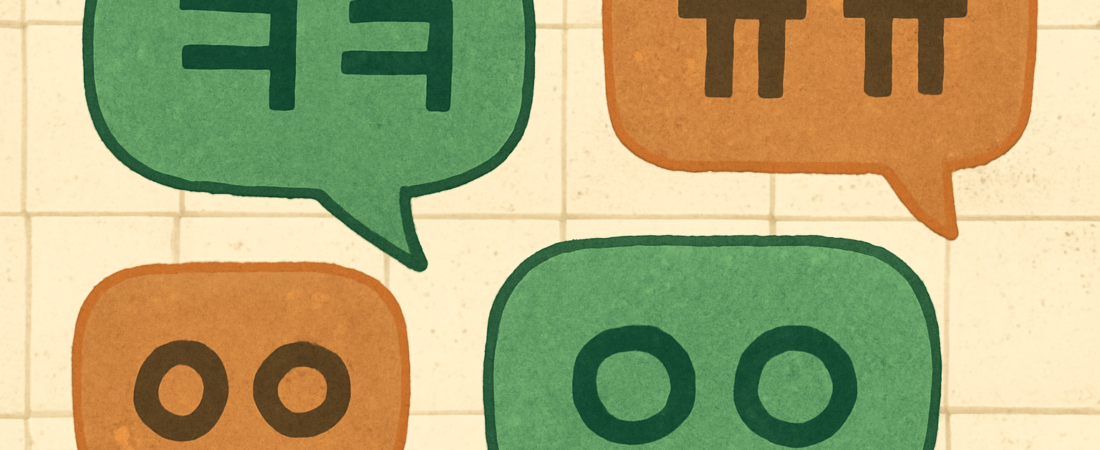
Korean texting slang mostly uses consonant letters instead of full words. ㅋㅋ means laughing, ㅠㅠ shows crying or sadness, and ㅇㅇ means “yes.” These shortcuts are casual and best kept for friends. Check the National Institute of Korean Language for current usage, because internet slang changes quickly.
Last checked: 2026-11-07
- Why Koreans text with consonants
- The core slang, explained
- Quick comparison table
- Tone and manners
- How to check what is current
- FAQ
- Sources
- Related guides
Why Koreans text with consonants
Hangul is built from consonant and vowel letters. Each letter is one sound.
That makes shortcuts easy. A single consonant can stand for a whole sound or word.
Most of these forms come from the first letter of a common word. Others copy the look of a face.
So this is not random code. It follows simple rules you can learn fast.
You will see these forms in chat apps, comments and social posts. Messaging apps are the main place they appear.
The core slang, explained
ㅋㅋ (kk): This is the standard laugh. It comes from the sound “k” in words like 크크. More ㅋ letters can mean a bigger laugh. Treat it like “haha” or “lol.”
ㅎㅎ (hh): A softer, friendlier laugh. Many people read it as a gentle smile. It feels warmer than ㅋㅋ.
ㅠㅠ and ㅜㅜ: These look like eyes with tears running down. They show sadness, disappointment or being touched. They can also mean “I’m so grateful” in a dramatic way.
ㅇㅇ (ng): Short for 응, an informal “yeah” or “uh-huh.” Use it only with close friends or peers.
ㄴㄴ: Short for 노노, meaning “no no.” It is playful and blunt.
ㅇㅋ: Short for “okay.” You may also see ㅇㅋㅇㅋ, which is a cheerful “okay okay.”
ㄱㅅ: Short for 감사, meaning thanks. It is quick and casual.
ㅈㅅ: Short for 죄송 or 미안, meaning sorry. It sounds very casual, so avoid it with elders.
ㄱㄱ: Short for “go go.” It means “let’s go” or “let’s do it.”
Many of these have wider internet slang cousins too. Those change faster, so treat any list as a snapshot.
Quick comparison table
| Slang | Roughly means | Feels like | Safe with |
|---|---|---|---|
| ㅋㅋ | laughing | casual, fun | friends, peers |
| ㅎㅎ | soft laugh, smile | warm, polite-casual | friends, coworkers you know well |
| ㅠㅠ | crying, sad | emotional, cute | friends, peers |
| ㅇㅇ | yeah | very casual | close friends only |
| ㄱㅅ | thanks | quick, informal | friends, younger people |
| ㅈㅅ | sorry | very casual | close friends only |
| ㄱㄱ | let’s go | energetic | friends, group chats |
This table shows tone, not price. No cost applies here, since texting slang is free to use.
Tone and manners
Korean has speech levels that show respect. Texting slang sits at the casual end.
Sending ㅇㅇ to a boss would feel too blunt. Many people use fuller polite endings at work instead.
A safe habit is to copy the other person. If they use ㅋㅋ first, you can too.
ㅎㅎ is often a gentler choice with people you do not know well. Even so, tone depends on the person and the group.
If you are unsure, use a full polite sentence. It is rarely wrong.
How to check what is current
Slang shifts with age groups and online communities. A term popular last year may sound dated now.
For a reliable picture, look at primary language sources. The National Institute of Korean Language publishes dictionaries and language research. Its Standard Korean Language Dictionary and the Urimalsaem open dictionary are useful starting points.
For real usage, look at corpus data and language surveys. Some come from Korean research institutes and universities.
Do not trust any single list of “top slang” without a date. Always check who made it and when.
When you read numbers on how often a term is used, verify them on the original site. Figures change and I cannot confirm current ones here.
FAQ
Is ㅋㅋ rude to send?
No, it is a normal laugh. It is casual, though, so use it with friends or peers rather than formal contacts.
What is the difference between ㅋㅋ and ㅎㅎ?
ㅋㅋ is a louder, funnier laugh. ㅎㅎ is softer and often reads as a warm smile.
Can I use ㅇㅇ with my Korean coworkers?
It is better to avoid it. ㅇㅇ is a very casual “yeah,” so a polite full reply suits work chats more.
Where can I check if a slang word is still used?
Start with the National Institute of Korean Language and its dictionaries. Also ask native speakers, since slang changes fast.
Sources
- National Institute of Korean Language (국립국어원): https://www.korean.go.kr
- Standard Korean Language Dictionary (표준국어대사전): https://stdict.korean.go.kr
- Urimalsaem open dictionary (우리말샘): https://opendict.korean.go.kr
Leave a Reply