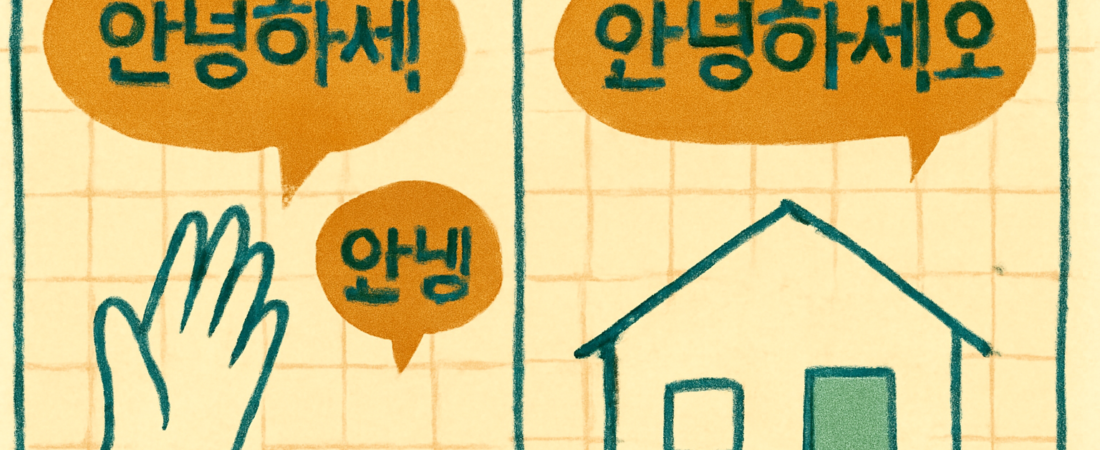
Use annyeong with close friends, younger people, and family you speak casually to. Use annyeonghaseyo as your safe, polite default for almost everyone else. Use annyeonghashimnikka in very formal settings, such as business presentations, ceremonies, military, and announcements. When unsure, choose annyeonghaseyo. It works almost everywhere.
Last checked: 2026-11-07
- The short answer
- Annyeong: casual and friendly
- Annyeonghaseyo: your everyday default
- Annyeonghashimnikka: formal situations
- Side-by-side comparison
- FAQ
- Sources
- Related guides
The short answer
All three phrases share one root. They come from the Korean word for “peace” or “well-being.” Each one is a greeting that asks, in effect, “Are you well?”
The difference is politeness level. Korean changes verb endings depending on who you are talking to. That is called a speech level.
Here is the simple rule. Ask yourself two questions. Is this person close to me? Is this person older, or in a higher position? If you are unsure, go polite.
Annyeong: casual and friendly
Annyeong (안녕) is the informal greeting. It is the same word for both “hello” and “bye” in casual speech.
Use it with these people:
- Close friends your own age
- Younger siblings and younger relatives
- Children
- Partners and very close companions
Do not use it with strangers or elders. It can sound rude or overly familiar. Even among friends, it is best to wait until the other person invites casual speech.
Many learners hear annyeong in dramas and variety shows. Those scenes often show close friends. Do not copy it into every real-life situation.
Annyeonghaseyo: your everyday default
Annyeonghaseyo (안녕하세요) is the polite greeting. It is the one most textbooks teach first, and for good reason.
Use it with these people:
- Shop staff, cafe workers, and restaurant staff
- Taxi drivers and hotel front desks
- Coworkers and neighbors
- Anyone older than you
- New acquaintances of any age
It also works as “hello” at any time of day. Koreans do not usually change the greeting for morning or evening.
A small tip: a light nod or slight bow often goes with it. You do not need a deep bow as a visitor. A friendly nod is enough.
If you only learn one greeting before your trip, learn this one.
Annyeonghashimnikka: formal situations
Annyeonghashimnikka (안녕하십니까) is the formal, deferential greeting. It belongs to a higher speech level than annyeonghaseyo.
You are most likely to hear it here:
- Business meetings and company presentations
- News broadcasts and public announcements
- Weddings, ceremonies, and speeches
- Military settings
- Staff greeting customers in some formal service roles
As a traveler, you will mostly hear it, not say it. Using it in a casual cafe may sound stiff or even funny. It is not wrong, but it can feel overly formal.
If you give a formal speech or present at work in Korea, this is the right choice. Ask a Korean colleague to confirm what suits your setting.
Side-by-side comparison
| Greeting | Korean | Politeness | Best for | Cost to learn |
|---|---|---|---|---|
| Annyeong | 안녕 | Casual | Close friends, younger people | $0 / 0 KRW |
| Annyeonghaseyo | 안녕하세요 | Polite | Strangers, elders, daily life | $0 / 0 KRW |
| Annyeonghashimnikka | 안녕하십니까 | Formal | Business, ceremonies, announcements | $0 / 0 KRW |
All three are free to use. No price applies to a greeting, so the cost column simply confirms that.
Quick decision steps:
- Is it a close friend your age or younger? Use annyeong.
- Is it a stranger, shopkeeper, or elder? Use annyeonghaseyo.
- Is it a formal speech or business setting? Use annyeonghashimnikka.
- Still unsure? Use annyeonghaseyo.
FAQ
Can I say annyeong to a Korean person I just met?
It is safer not to. Annyeong is casual and can sound too familiar with new people. Use annyeonghaseyo until the other person suggests speaking more casually.
Is annyeonghaseyo too formal for friends?
Not usually. Many friends use it, especially when they are not yet very close. Friends of the same age often switch to annyeong over time. You can follow their lead.
Does annyeonghaseyo mean both hello and goodbye?
Annyeonghaseyo is mainly “hello.” Casual annyeong can mean both hello and bye. For polite goodbyes, Koreans use other phrases, which depend on whether you are leaving or staying.
Will people be offended if I get it wrong?
Rarely. Most people appreciate any effort to speak Korean. Visitors who mix up speech levels are usually met with patience and a smile.
Sources
- National Institute of Korean Language (국립국어원): https://www.korean.go.kr/
- King Sejong Institute Foundation: https://www.ksif.or.kr/
- Korea Tourism Organization (Visit Korea): https://english.visitkorea.or.kr/
Speech levels can vary by region, age, and situation. For formal or business use, please confirm with a native speaker or the official language institute above.

Leave a Reply