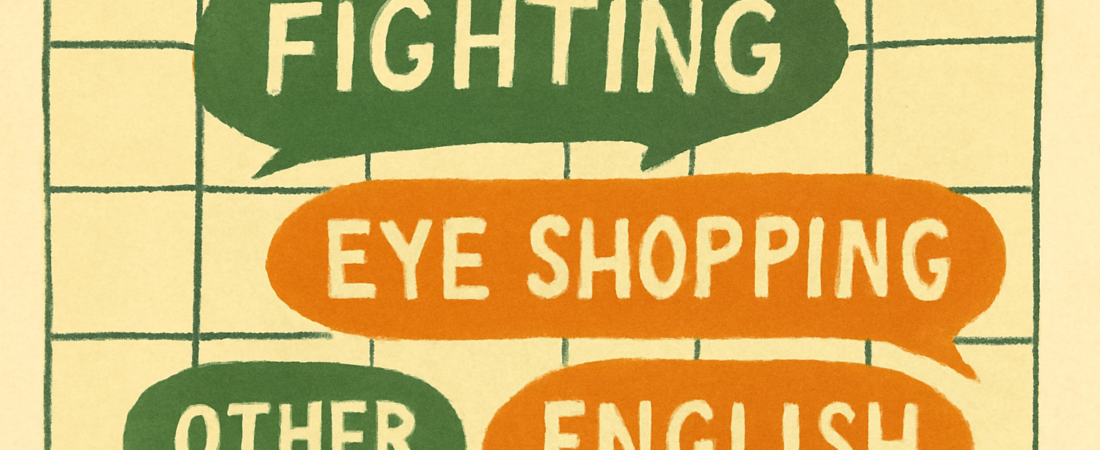
Konglish is Korean made from English-looking words, often with new meanings. “Fighting” means “you can do it,” “eye shopping” means window shopping, and a “hand phone” is a mobile phone. These words follow Korean logic, not English rules. Check the National Institute of Korean Language for current standard forms.
Last checked: 2026-11-04
- What Konglish really is
- Why “fighting” is a cheer
- Eye shopping and other shopping words
- Konglish vs. everyday English
- How to check what people say now
- FAQ
What Konglish really is
Konglish is not bad English. It is Korean vocabulary built from English parts. Linguists call many of these words loanwords or coinages.
Koreans often shorten, mix or reshape English words. The meaning then drifts away from the original. Then the new word becomes normal in daily Korean.
This is common in many languages. Japanese has a similar group of words. English also borrows from other languages and changes the meaning.
For travelers, the key point is simple. A word can look English and still confuse a native English speaker. Korean speakers usually know the English word is different.
Why “fighting” is a cheer
“Fighting” is usually written in Korean as 파이팅 (paiting) or 화이팅 (hwaiting). It works as a cheer. Think “you’ve got this!” or “go for it!”
You will hear it before exams, sports matches and big work projects. Friends say it by text. Fans shout it at concerts and games.
It can also be a quiet message. A coworker might say it after a hard week. It is warm, not aggressive.
In English, “fighting” suggests a fight. So avoid shouting it at a stranger abroad. Use “you’ve got this” instead.
Spelling varies. The National Institute of Korean Language sets standard spellings, and its official guidance on loanwords can differ from casual use. Verify the current rule on its site.
Eye shopping and other shopping words
“Eye shopping” (아이쇼핑) means looking at items without buying. English speakers say “window shopping.”
The Korean phrase is easy to guess. Your eyes do the shopping. It is a clear example of how Konglish builds meaning from simple parts.
Other words you may hear in shops and cafés:
- Service (서비스): something free, like a bonus side dish or a free gift.
- One-piece (원피스): a dress.
- Hand phone (핸드폰): a mobile phone. Many people now say “smartphone” too.
- Skinship (스킨십): physical affection, like hugging or holding hands.
- Cider (사이다): a clear lemon-lime soda, not apple cider.
The “service” meaning is useful for visitors. If a café owner says a free extra is “service,” it is a gift. You do not need to pay for it.
Konglish vs. everyday English
| Korean word (romanized) | What it means in Korea | Everyday English |
|---|---|---|
| Paiting / hwaiting | A cheer: “you can do it” | “You’ve got this!” |
| Eye shopping | Browsing without buying | Window shopping |
| Service | A free extra from a seller | “On the house” |
| One-piece | A dress | Dress |
| Hand phone | A mobile phone | Cell phone / mobile |
| Cider | Clear lemon-lime soda | Lemon-lime soda |
| Skinship | Affectionate touch | Physical affection |
None of these words has a price. If you want to see how a drink like cider is sold, prices vary by shop. A typical canned soda might cost around $1-2 / 1,300-2,700 KRW at a convenience store, but check the shelf label.
How to check what people say now
Slang changes fast. A word that was common last year may sound dated now. So treat any list, including this one, as a starting point.
Here are the types of Korean data sources worth checking:
- The National Institute of Korean Language: the official body for standard Korean. Its dictionaries and loanword guidance show approved spellings.
- The Standard Korean Language Dictionary (표준국어대사전) and the Urimalsaem (우리말샘) open dictionary: both are run by the institute and list meanings.
- Korean search and trend tools: large Korean portals publish search-trend tools. They show how often a word is searched over time.
- Corpus projects: the institute also supports large collections of real text. Researchers use them to see how words are used.
I cannot give you exact search numbers or rankings here. They change often, and I would not want to guess. Open the tools yourself for current figures.
One tip for learners: search the Korean spelling, not the English word. You will find real usage, not tourist guides.
FAQ
Is Konglish the same as Korean slang?
Not exactly. Konglish means Korean words built from English. Slang is informal speech of any origin. Some words are both, but many Konglish words are fully standard.
Will Koreans understand me if I say “fighting” in English?
Many will, since the cheer is so common. In an English-speaking country, though, people may think you mean a fight. Use “you’ve got this” with non-Korean speakers.
Is it rude to use Konglish words in Korea?
No. People use these words every day. Using them in Korean sentences sounds natural. Just learn the Korean meaning first, so you do not mix it up with English.
Where can I check the correct spelling of a loanword?
Use the National Institute of Korean Language dictionaries. Spelling rules for loanwords are updated from time to time, so verify the current form on the official site.
Sources
- National Institute of Korean Language (국립국어원): https://www.korean.go.kr
- Standard Korean Language Dictionary (표준국어대사전), run by the National Institute of Korean Language: https://stdict.korean.go.kr
- Urimalsaem open dictionary (우리말샘), run by the National Institute of Korean Language: https://opendict.korean.go.kr

Leave a Reply