
Table of Contents
Have you ever walked barefoot through mud that stretches to the horizon? In Korea, that muddy landscape just earned a bigger place on the world stage. UNESCO has officially expanded “Getbol, Korean Tidal Flats,” adding four new sites to what was once a four-part World Heritage listing.
That means Korea’s tidal flats now count six protected components instead of four. This is not a small bureaucratic update. It signals a much larger commitment to protecting one of Asia’s most important coastal ecosystems.
UNESCO Expands Korea’s Tidal Flats: What Just Happened
Let’s start with the basics. Korea’s tidal flats were first inscribed as a UNESCO World Heritage site in 2021. Back then, the listing included four locations known for their rich mudflats and rare wildlife.
Now, UNESCO has approved an expansion. The tidal flats in Yeosu, Goheung, Muan, and Seosan have joined the original group. So why does this matter to you, even if you’ve never set foot in Korea?
World Heritage status is not just an honor. It comes with real protection duties, monitoring requirements, and international attention. When Korean tidal flats grow from four sites to six, the government takes on a bigger promise to the world.
Think of it like a expanding a national park system, but for coastal mud instead of mountains. Each new site adds unique habitat types, migratory bird stopovers, and marine species. The result is a stronger, more complete ecological network stretching across Korea’s western and southern coasts.
This kind of expansion rarely happens quickly. UNESCO evaluations involve years of scientific data, site visits, and diplomatic negotiation. The fact that Korea’s tidal flats passed this rigorous process twice—first in 2021, now again—shows consistent, serious conservation work.
Meet the Four New Sites: Yeosu, Goheung, Muan, and Seosan

Where exactly are these new additions? Yeosu and Goheung sit along Korea’s southern coast, in South Jeolla Province. Muan lies nearby, also in South Jeolla, while Seosan is located further north in South Chungcheong Province.
Each site brings something different to the table. Yeosu’s tidal flats connect to a coastline famous for its scenic beauty and fishing traditions. Goheung offers wide mud flats shaped by strong tidal action, creating ideal feeding grounds for shorebirds.
Muan is already known among birdwatchers for its migratory bird populations. Seosan, meanwhile, sits closer to major wetland reserves that have long attracted conservation researchers. Together, these four sites round out the geographic and ecological diversity of Korea’s tidal flats.
Why did UNESCO choose these specific locations? The answer lies in habitat variety. A single type of tidal flat cannot support every species that depends on Korea’s coastline.
Sandy flats, muddy flats, and mixed sediment zones each attract different organisms. By adding Yeosu, Goheung, Muan, and Seosan, UNESCO recognized that Korean tidal flats function as one interconnected system. Protecting only part of that system would leave gaps that endangered species simply cannot survive in.
This is similar to how national parks in other countries sometimes expand piece by piece. The Wadden Sea in Europe, another major tidal flat World Heritage site, grew through a similar multi-country, multi-phase process. Korea’s approach follows that same logic: protect the full ecological picture, not just the most famous spots.
Why Korean Tidal Flats Matter for Global Biodiversity
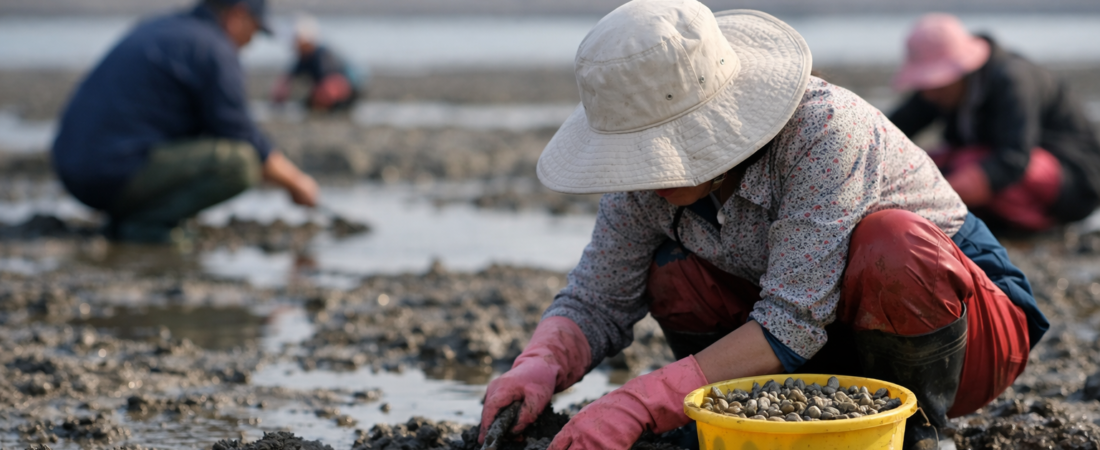
Here’s a question worth asking: why do muddy coastlines deserve UNESCO recognition at all? The answer comes down to biodiversity and species survival. UNESCO specifically praised Korean tidal flats as critical natural habitat for biodiversity conservation and endangered species protection.
Tidal flats act as a biological engine. Millions of tiny organisms—worms, crabs, mollusks—live buried in the mud. These creatures form the base of a food chain that supports fish, birds, and even larger predators along the coast.
Migratory birds depend heavily on this system. Species traveling the East Asian-Australasian Flyway stop at Korean tidal flats to rest and refuel during their long journeys. Without healthy tidal flats, many of these birds simply would not survive their migration.
Some of these species are already endangered. The spoon-billed sandpiper, for example, relies on flats like these as a critical stopover point. When Korea protects its tidal flats, it protects a lifeline for species that many people around the world have never even heard of.
This matters beyond Korea’s borders too. Migratory birds don’t recognize national boundaries. A healthy stopover site in Korea supports bird populations that travelers might later see in Australia, Russia, or Southeast Asia.
In this sense, Korea’s tidal flats function as a shared global resource, not just a domestic asset. If you’re curious about the science behind these ecosystems, organizations like Korea Herald have covered similar wetland conservation stories in detail.
Beyond birds, tidal flats also filter pollutants, absorb storm surges, and store carbon in their sediment. Scientists increasingly describe these ecosystems as “blue carbon” habitats, alongside mangroves and seagrass meadows. That means Korean tidal flats aren’t just pretty to look at—they play a quiet but powerful role in fighting climate change.
What This Expansion Means for Korea’s Future
So what happens next? Expanding Korean tidal flats to six components brings new responsibilities. Local governments in Yeosu, Goheung, Muan, and Seosan must now align conservation plans with UNESCO standards.
That includes stricter environmental monitoring. It also means limiting development that could damage the mudflats or disturb wildlife habitats. Coastal construction projects will likely face tighter scrutiny going forward.
For local communities, this shift brings both challenges and opportunities. Fishing villages near these tidal flats may see new eco-tourism interest. Visitors curious about Korean tidal flats and their unique ecosystems could bring fresh income to small coastal towns.
But is tourism growth always good news for fragile ecosystems? Not necessarily. More visitors mean more foot traffic, more waste, and more pressure on the very habitats UNESCO wants to protect.
Korea will need careful planning to balance public interest with conservation goals. Successful models exist elsewhere—Japan’s Shiretoko Peninsula and the Wadden Sea both manage visitor numbers through strict guided tours and seasonal restrictions.
Korea could adapt similar strategies for its expanded tidal flat network. Education plays a role here too. When local schools and community centers teach residents about why Korean tidal flats matter, protection becomes a shared value rather than a government mandate.
That kind of grassroots understanding often determines whether conservation efforts succeed long-term. This expansion also strengthens Korea’s global environmental reputation. As countries face increasing pressure to address climate change and habitat loss, Korea now has six internationally recognized reasons to prioritize coastal conservation.
That’s a meaningful diplomatic and environmental asset. Looking ahead, more tidal flat sites along Korea’s coastline could eventually join this UNESCO listing.
Conservation groups continue to study areas beyond these six locations for potential future inclusion. If that happens, Korean tidal flats could become one of the most extensively protected coastal ecosystems in the world.
For now, the addition of Yeosu, Goheung, Muan, and Seosan marks real progress. It shows that Korea takes its environmental commitments seriously, even when the process takes years to complete.
What do you think about Korea’s approach to protecting its coastal ecosystems, and would you consider visiting these tidal flats yourself someday?
AI-Generated Photorealistic Image — All people, scenes, and details in this image are entirely AI-generated and fictional. Not a real photograph of an actual person or event. 이 이미지는 AI로 생성된 가상 이미지입니다.




Leave a Reply