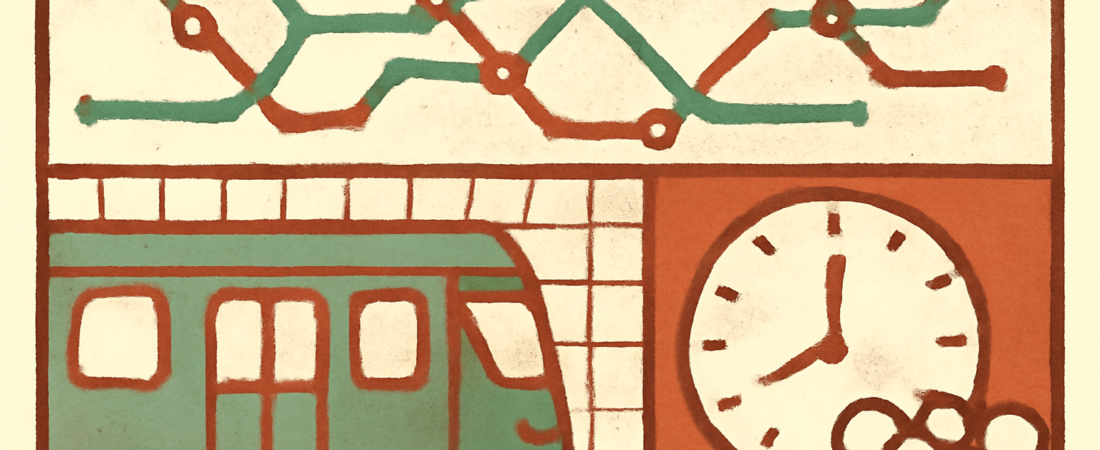
To ride the Seoul subway, buy or load a transit card (T-money or a similar card), tap in at the gate, follow the line color and number to your station, and tap out when you exit. Check the exit number before you leave. Avoid 7:30-9:00 a.m. and 6:00-7:30 p.m. if you can.
Last checked: 2026-11-08
- How the Seoul subway works
- Paying and choosing a transit card
- Reading lines and making transfers
- Rush hours and when to ride
- Etiquette and practical tips
- FAQ
- Sources
- Related guides
How the Seoul subway works
The Seoul subway is one of the easiest ways to get around the city. It is clean, frequent, and signed in English. Most signs also show Chinese and Japanese.
The network covers Seoul and reaches many nearby cities in Gyeonggi Province and Incheon. It has numbered lines, such as Line 1 through Line 9, and several named lines. Each line has its own color. Learn the color and number of your line, and you can follow it almost anywhere.
Here is the basic trip, step by step.
- Find your destination station on a map app or the station map.
- Note the line number and the direction. Directions are named by the last station on the line.
- Tap your transit card at the gate to enter.
- Follow the colored signs to the correct platform.
- Check the digital sign or announcements for the next stop.
- Get off, follow the exit signs, and tap your card at the gate again.
Every station has a number. Many stations also have a name in Korean and English. Announcements on board are in Korean and English on most lines. Some also add Japanese and Chinese.
Trains usually run from early morning until around midnight. Exact first and last train times differ by line, station, and direction. Check the official operator site or a live map app for your station. Do not rely on a single fixed time.
Paying and choosing a transit card
You do not need to buy a ticket for every trip. Most visitors use a rechargeable transit card. You tap it on the reader at the gate. The fare comes off your balance.
Cards are sold at convenience stores and station machines. Many local residents use T-money. Several similar cards work on the same system. Some phones can also use mobile transit cards. Support depends on your phone model and country. Check before you rely on it.
There is also a single-trip card for people who ride only once. You pay a small deposit on top of the fare. You get the deposit back at a machine at your exit station. The machines are marked in English.
Fares depend on distance. A basic adult fare has been in the range of roughly $1.20-1.50 / 1,550-2,000 KRW in recent years. Fares change. Check the official Seoul Metro site for the current amount.
Transfers between subway lines and buses can be free or discounted if you tap out and in within a set time. The rules on timing are specific. Verify them on the official site before you depend on them.
One more point: you must tap out when you leave. If you forget, the system may charge extra on your next trip. It can also block your next entry until you fix it. A station attendant can help.
| Option | Best for | Approximate cost | Notes |
|---|---|---|---|
| Rechargeable transit card (T-money or similar) | Most visitors and residents | Card around $2-4 / 2,500-5,000 KRW, plus the balance you add | Also works on buses and many taxis. Prices and rules can change. Confirm at the shop. |
| Mobile transit card on a phone | Visitors with a compatible phone | Depends on the app and your balance | Support varies by phone and country. Test it before relying on it. |
| Single-trip card | One-off trips | Fare plus a small refundable deposit (often around $0.40 / 500 KRW) | Get the deposit back at a machine at your exit station. Check the current deposit amount. |
| Tourist or unlimited-ride passes | Short, heavy-use trips | Varies by pass and period | Check the official tourism site to see if the pass is worth it for your plans. |
All prices above are estimates for planning. Always check the official source for current prices.
Reading lines and making transfers
Most beginners worry about transfers. They are simpler than they look if you slow down.
Step 1: Know your line and direction
Look at the line color and number. Then look at the direction. Platforms show the end stations of the line, such as “toward” a final stop. Pick the platform that points to the end of the line you want. A map app will tell you which direction to take.
Step 2: Follow transfer signs
When you reach a transfer station, look for signs in the line color you need next. You will often see a colored circle with the line number. Follow those signs through the corridors. Do not tap out. Transfers inside the paid area do not need a new tap.
Step 3: Watch for long walks
Some transfers are short. Others involve long corridors, stairs, and escalators. A few large stations can take several minutes on foot. Plan extra time if you have luggage or a tight connection. Look for elevators if you need step-free access. Many stations have them, but they are not always next to the platform.
Step 4: Choose the right exit
Large stations can have a dozen exits or more. The wrong exit can leave you far from your goal. Check the exit number in your map app or on the venue’s website. Many Korean addresses and guides list the exit number, such as “Exit 3.” Then follow the exit number signs.
Express trains and special lines
Some lines have express services that skip stations. Some lines connect to the airport. Check the train sign and the platform display to confirm that your train stops at your station. Not every train on a platform goes to the same final stop. This is common on lines that branch. Read the destination on the front of the train and on the platform screen.
Rush hours and when to ride
Seoul has heavy commuter traffic. Trains and platforms can be packed at peak times.
The usual patterns are these:
- Morning rush: roughly 7:30 to 9:00 a.m. on weekdays.
- Evening rush: roughly 6:00 to 7:30 p.m. on weekdays.
- Busy lines: lines through central business areas and major transfer stations tend to be the most crowded.
- Weekends and events: crowds can build near shopping districts, concert venues, and festival areas, even outside normal rush hours.
These are general patterns, not official figures. Crowd levels change by line, station, season, and event. Some map apps show live or typical crowding. You can use that to plan.
How to ride during busy times
- Stand in line at the marked spots on the platform. Let people exit first.
- Move to the middle of the car instead of blocking the door.
- Take off your backpack and hold it in front of you or put it down by your feet.
- If you need to get off, start moving toward the door a stop early. Say a short “excuse me” if needed.
If you can, plan your trip for mid-morning or early afternoon. You will get more space and an easier time with luggage or a stroller.
Etiquette and practical tips
Good manners make the ride smoother for everyone. Most of this is common sense.
- Priority seats are marked, usually for older adults, pregnant passengers, people with disabilities, and others who need them. Leave them free if you can.
- Keep your voice low. Many riders use their phones quietly. Use headphones for videos and music.
- Avoid loud phone calls. Short, quiet calls are generally fine.
- Stand on one side of the escalator if the station asks you to. Rules vary by station and have changed over time. Follow the signs and what people around you do.
- Do not block the doors. Step off to the side to let others pass, then get back on.
- Eating and drinking rules can differ by operator. Follow posted signs. Avoid strong-smelling food in any case.
Useful practical tips
- Download a map app that works in Korea before you arrive. Apps made for Korea often give more accurate subway data than some global apps.
- Keep a little cash in your transit card balance so you do not get stuck at the gate.
- Look for the gender-specific or women-only car notices on some lines if you want them. Rules and availability vary. Check signs and the official site.
- If you feel lost, ask a station attendant or look for a help intercom. Many stations have English-speaking staff or translation tools, though this is not guaranteed.
- Keep valuables close, as you would in any big city.
FAQ
Do I need to buy a ticket every time I ride the Seoul subway?
No. Most people load money on a rechargeable transit card and tap it at the gate each time. Single-trip cards exist for one-off rides. They include a small deposit you can get back at a machine at your exit station.
How do I transfer between subway lines in Seoul?
Stay inside the gates. Follow the signs in the color and number of your next line. Do not tap out. You will tap out only when you leave the system. Allow extra time, since some transfers involve long walks and stairs.
When is the Seoul subway most crowded?
It is usually most crowded around 7:30-9:00 a.m. and 6:00-7:30 p.m. on weekdays. Exact crowding varies by line and station. Events and shopping areas can also be busy on weekends. Check a live map app if you can.
Is the Seoul subway easy to use if I do not speak Korean?
Yes, for most people. Signs and announcements are usually in English as well as Korean. A map app, the line color, and the station number help a lot. Check the exit number before you leave the station.
Sources
- Seoul Metro (official operator): http://www.seoulmetro.co.kr/
- Seoul Metropolitan Government: https://english.seoul.go.kr/
- Visit Korea (Korea Tourism Organization): https://english.visitkorea.or.kr/
- T-money (official card service): https://www.tmoney.co.kr/
Fares, hours, and rules can change. Always confirm current details on the official sites above before you travel.
Leave a Reply