Table of Contents
A new wellness complex called Raonjae has opened at The Hanok Heritage in Yeongwol, Gangwon Province, spanning roughly 895 square meters. It combines a traditional Korean hanok building with an outdoor infinity pool, private spa, and fine dining. This guide explains how wellness complexes like Raonjae work and how to pick one for your own trip to Korea.
What Makes a Hanok Wellness Complex Special
You might picture a spa as glass walls and minimalist furniture. A hanok wellness complex flips that idea completely.
Hanok are traditional Korean houses built with wood beams, paper-covered doors, and curved tile roofs. Builders designed them centuries ago to work with the seasons, using ondol floor heating in winter and open courtyards for summer breeze.
A modern wellness complex borrows this architecture, then adds pools, saunas, and spa treatments inside it. Why does this combination work so well? Because it lets you relax your body while staying surrounded by centuries of design wisdom, instead of a sterile hotel room.
This is not a new idea in Korean hospitality. Jjimjilbang, the public bathhouse culture found across Korea, has offered communal heat therapy and rest for decades.
What has changed is the setting. Instead of a fluorescent-lit public bathhouse, today’s wellness complex often sits inside a restored or newly built hanok, blending old-fashioned comfort with private luxury (imagine a spa day, but your changing room has a 200-year-old roofline).
Inside Raonjae: A Model Wellness Complex in Yeongwol
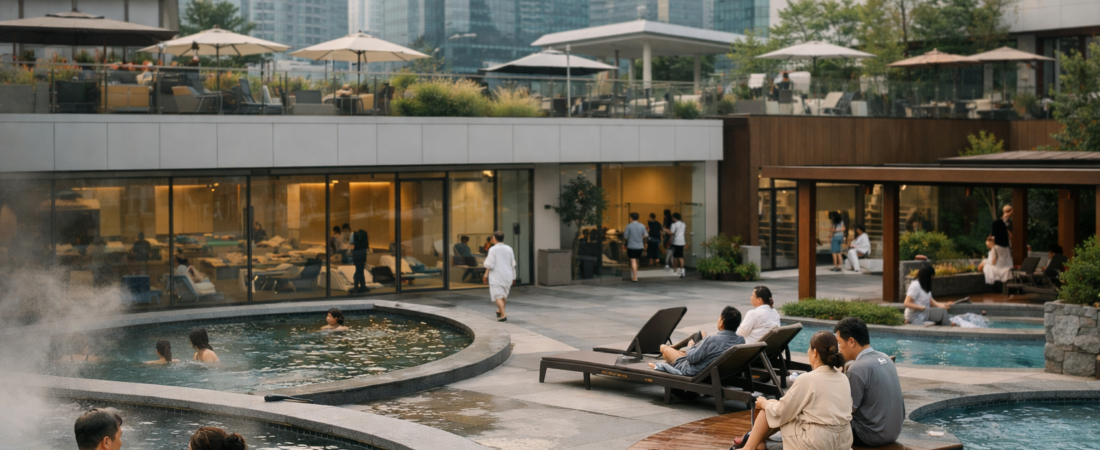
Raonjae gives us a clear picture of what a modern wellness complex looks like in practice. Its ground floor holds an outdoor hanok infinity pool, a separate kids’ pool, and a private spa.
There is also a lounge area and Monto, a Korean fine dining restaurant, all under one roof. This layout matters because it lets families and couples share one space without competing needs.
Parents can relax poolside while children swim nearby, then everyone gathers for dinner without leaving the property. The basement level extends the experience further, with a dry sauna, an indoor pool, and locker rooms open all year.
This year-round access solves a real problem for outdoor hanok pools. Winter in Gangwon Province gets cold, so an indoor option keeps the wellness complex usable in every season, not just summer.
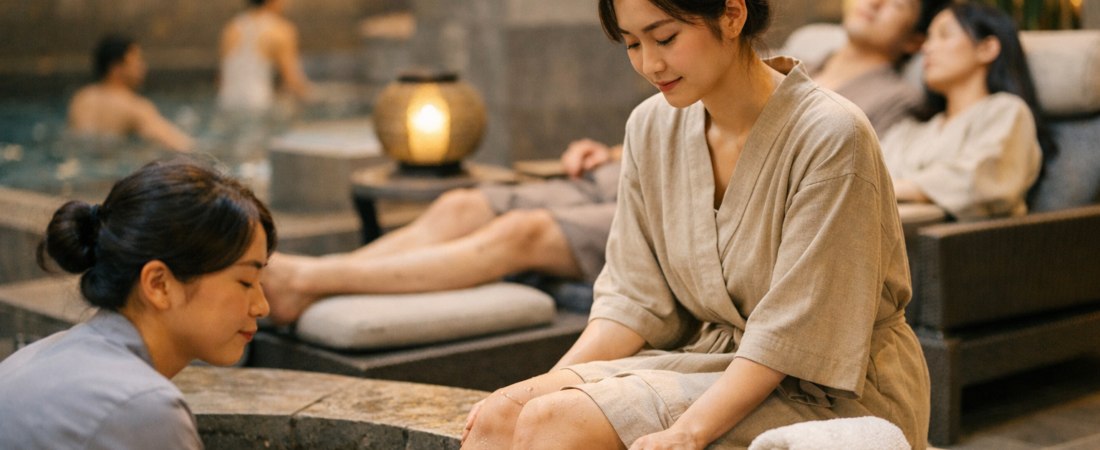
Raonjae has also introduced five wellness programs to give guests structured ways to unwind. These include a traditional tea ceremony class and a floating experience, where guests rest on the water using flotation support.
Programs like these turn a simple pool visit into something closer to a guided retreat. You are not just swimming — you are learning a slower pace of living, one tea bowl at a time.
How to Choose the Right Wellness Complex for You
Not every wellness complex suits every traveler, so how do you know what fits your trip? Start by asking what balance you want between activity and stillness.
Some complexes focus on active features like infinity pools and fitness programs. Others lean toward quiet rituals such as tea ceremonies or meditation sessions.
Location matters just as much as amenities. A wellness complex in a rural province like Gangwon offers mountain views and cleaner air, while an urban option gives you easy access to restaurants and transit.
Consider these practical questions before booking any hanok-style retreat:
- Does the complex offer year-round facilities, or only seasonal outdoor pools?
- Are family-friendly features like kids’ pools available if you are traveling with children?
- Do the wellness programs match your interests, such as tea ceremony, floating therapy, or traditional bathing?
- Is dining included on-site, or will you need to travel elsewhere for meals?
For readers researching options directly, sources like Korea Herald regularly cover new openings across the country. Checking recent coverage helps you compare a new wellness complex against established names before committing your travel dates.
Booking in advance also helps, especially for programs with limited spots like tea ceremony classes. Private spas and floating experiences often cap group sizes to keep the atmosphere calm.
Why This Trend Matters for Travelers and Korea
Wellness tourism keeps growing across Korea, and hanok-based complexes sit at the center of that shift. Why are these spaces gaining attention outside Korea too?
Because they offer something international wellness resorts often lack: a direct link to centuries-old architecture and daily life. Guests are not just buying relaxation.
They are experiencing a living piece of Korean history, reshaped for modern comfort. This growth brings real benefits to smaller regions like Yeongwol, which do not always draw the same tourist numbers as Seoul or Busan.
A well-designed wellness complex can bring steady visitors, local jobs, and renewed interest in traditional building methods that might otherwise fade. Still, it is worth asking honestly whether this growth reaches everyone equally.
Rural communities sometimes see tourism dollars concentrate in a single upscale complex, while smaller family-run guesthouses nearby struggle to compete for attention. That tension is real, and it deserves acknowledgment rather than a simple happy ending.
At the same time, projects like Raonjae often work with local craftsmen, regional food producers, and traditional program instructors, spreading some benefit beyond the property itself. The most promising path forward is not one grand complex absorbing all the visitors, but a network of smaller hanok stays and wellness spaces supporting each other across a region.
Korea’s wellness tourism sector will likely keep expanding through 2026 and beyond, as more travelers seek slower, culturally rooted trips. A wellness complex built around a hanok gives that traveler both comfort and context, something a standard resort rarely offers in the same package.
What kind of wellness complex would you choose for your own trip to Korea — one built for quiet reflection, or one designed for family fun?
AI-Generated Photorealistic Image — All people, scenes, and details in this image are entirely AI-generated and fictional. Not a real photograph of an actual person or event. 이 이미지는 AI로 생성된 가상 이미지입니다.
Leave a Reply