Table of Contents
Who paints on city walls, sells work for millions, and still nobody knows his real name?
That mystery belongs to Banksy, and it has never stopped growing. A new special exhibition dedicated to Banksy is now bringing his most famous images together in one place.
From “Girl with Balloon” to “Flower Thrower,” you can now see the full range of Banksy’s vision under one roof. This is your chance to understand why a faceless artist became one of the most talked-about names in contemporary art.
Who Is Banksy, Really?
Banksy is a British street artist who has never revealed his face or his name. Think about that for a second — how many artists reach global fame while staying completely anonymous?
Banksy started with stencils and spray paint on ordinary city walls. War, poverty, power, and the contradictions of capitalism became his favorite subjects.
His images look simple at first glance. But look closer, and you find sharp political commentary hiding in plain sight.
Banksy’s anonymity is not just a gimmick, either. It protects him from legal trouble, since much of his early work was technically illegal graffiti.
But it also does something more interesting. It forces viewers to focus entirely on the message, not the celebrity behind it.
You cannot look up Banksy’s biography or his childhood photos. All you have is the work itself, and that is exactly the point.
This mystery has helped Banksy grow from a local graffiti artist into a truly global cultural phenomenon. His work now appears in galleries, auction houses, and now, this dedicated special exhibition.
Inside the Banksy Special Exhibition
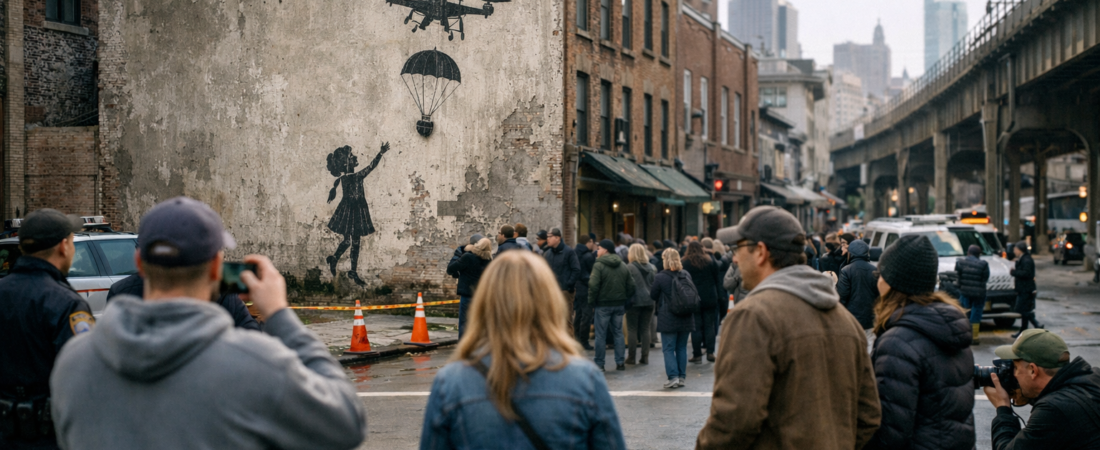
This new exhibition, organized in cooperation with Banksy Exhibition Culture Co., Ltd., gathers his most recognizable works in a single showcase. Visitors can trace Banksy’s artistic journey from his early street stencils to his later, more elaborate installations.
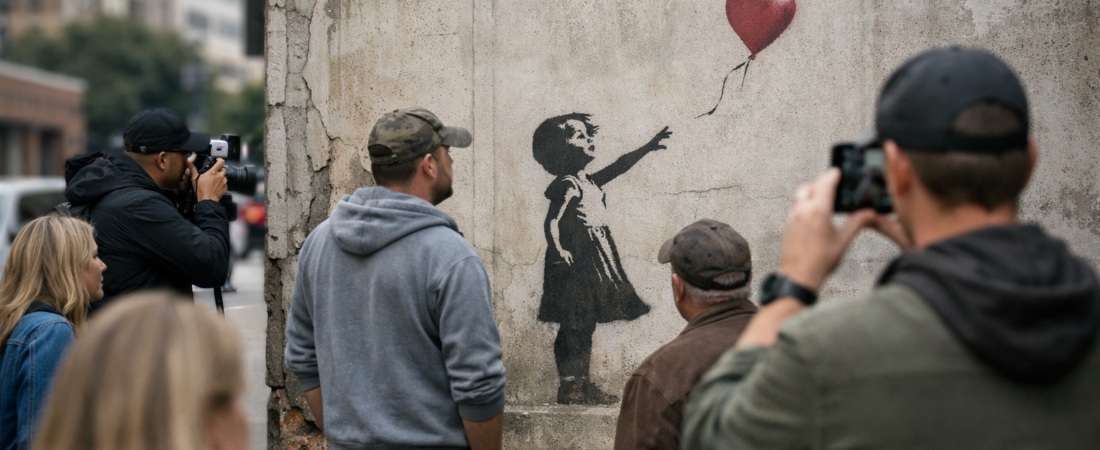
The centerpiece is “Girl with Balloon,” arguably Banksy’s most iconic image. A young girl reaches toward a red, heart-shaped balloon slipping just out of her grasp.
It is simple, emotional, and instantly recognizable — which is exactly why it became a symbol people around the world now associate with hope and loss at once.
Also featured is “Flower Thrower,” sometimes called “Love is in the Air.” The image shows a masked protester in mid-throw, except instead of a weapon, he holds a bouquet of flowers.
That single substitution — violence replaced with beauty — captures Banksy’s entire artistic strategy. He takes something threatening and flips it into something disarming, almost gentle.
The exhibition walks visitors through these works with context about where each piece first appeared, often on real city walls in London, Bristol, or the West Bank. This is where you learn something interesting: Banksy takes his street art seriously enough to leave a paper trail, even while hiding his identity completely (yes, someone actually tracked and cataloged every wall he ever touched).
You can read more background on Banksy’s career and cultural impact through The Kyunghyang Shinmun, which has followed his work closely over the years.
Why Banksy’s Art Still Shocks Us
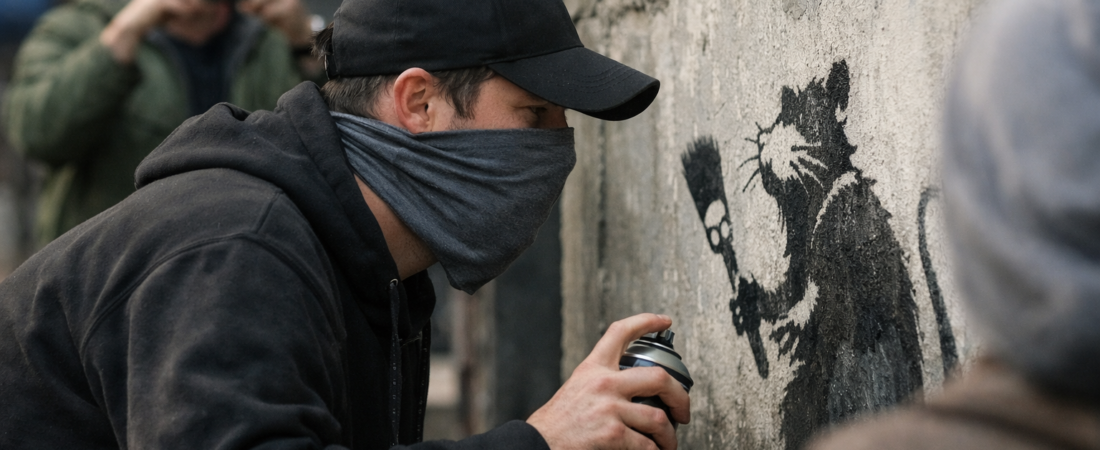
Why does a masked artist from Bristol matter to people in Seoul, New York, or Sydney? Because Banksy’s themes are universal, not local.
War touches every country differently, but its cost is always the same. Poverty looks different depending on where you live, but the feeling of being ignored by power never changes.
Banksy takes these heavy topics and makes them accessible. You do not need an art history degree to understand “Flower Thrower.” You just need eyes and a moment of attention.
That accessibility is exactly what turned Banksy’s work into pop culture, not just gallery art. His images appear on T-shirts, phone cases, and social media memes constantly.
Is that a compliment or a contradiction? Banksy critiques capitalism, yet his own images now drive massive commercial demand.
This tension follows him everywhere. When his painting famously shredded itself moments after selling at auction in 2018, the stunt only made the piece more valuable, not less.
Banksy seemed to be mocking the art market from inside the art market itself. That irony is part of why people keep returning to his work — it never gives you a simple, comfortable answer.
What Banksy Teaches Us About Art and Power
Step back for a moment and ask yourself what Banksy is really doing. He takes the suffering of ordinary people — war refugees, the poor, the powerless — and turns it into images the whole world recognizes.
That is a real achievement. It gives visibility to people who usually have none.
But here is the harder question: does turning suffering into a million-dollar auction piece actually help anyone, or does it just turn pain into a product? This is the honest tension sitting at the center of Banksy’s entire career, and pretending otherwise would be dishonest.
The art market has absorbed Banksy almost completely, the very system his early street work seemed to criticize. Wealthy collectors now pay enormous sums for images that once existed to embarrass wealthy collectors.
That contradiction deserves to be named plainly, not smoothed over with vague praise. Yet there is a genuine counterweight here too, and it matters just as much.
Exhibitions like this one carry Banksy’s images far beyond auction houses and private collections. They put his message about dignity, injustice, and quiet resistance in front of everyday visitors who could never afford an original canvas.
A student, a retired teacher, a curious teenager — all of them can stand in front of “Girl with Balloon” and feel something real, regardless of the art market swirling around it. That is not a small thing.
Human beings have always found ways to smuggle meaning past the systems built to contain it. Banksy’s contradictions do not cancel his message; they simply prove how complicated it is to speak truth to power while still needing to eat, sell, and survive within that same power structure.
So where does Banksy’s story go from here? Anonymity cannot last forever, technology and investigative journalism keep closing the gap.
Yet maybe the mystery matters less than the message underneath it. Wars continue, poverty persists, and power still needs watching — Banksy simply gave the world a shared visual language to talk about all three.
What do you think — does knowing Banksy’s real identity even matter anymore, or has the mystery become part of the message itself?
AI-Generated Photorealistic Image — All people, scenes, and details in this image are entirely AI-generated and fictional. Not a real photograph of an actual person or event. 이 이미지는 AI로 생성된 가상 이미지입니다.

Leave a Reply