Table of Contents
A Quiet Corner of Paju Book City
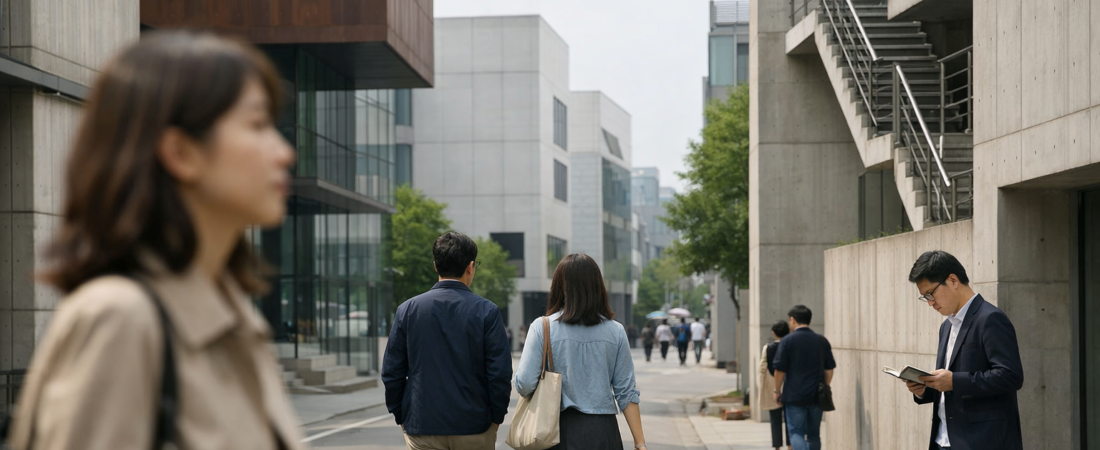
What makes a place built entirely around books feel more like a living town than a shopping district? That question kept coming back during a recent return trip to Paju Book City, just outside Seoul. This unusual publishing complex blends concrete architecture with quiet courtyards, and it rewards anyone willing to slow down.
An earlier visit had already left a strong impression. Modern buildings stood beside soft, wooden reading spaces, especially inside the well-known “Forest of Wisdom” hall. That memory sparked a personal promise: come back someday, with more time to spare.
This time, the return led somewhere unplanned — a small, easy-to-miss old book museum tucked inside Paju Book City. Arriving just before closing time added a bit of drama, the kind any book lover instantly recognizes. What happened next turned out to be the real story of the day.
The Architecture and History Behind Paju Book City
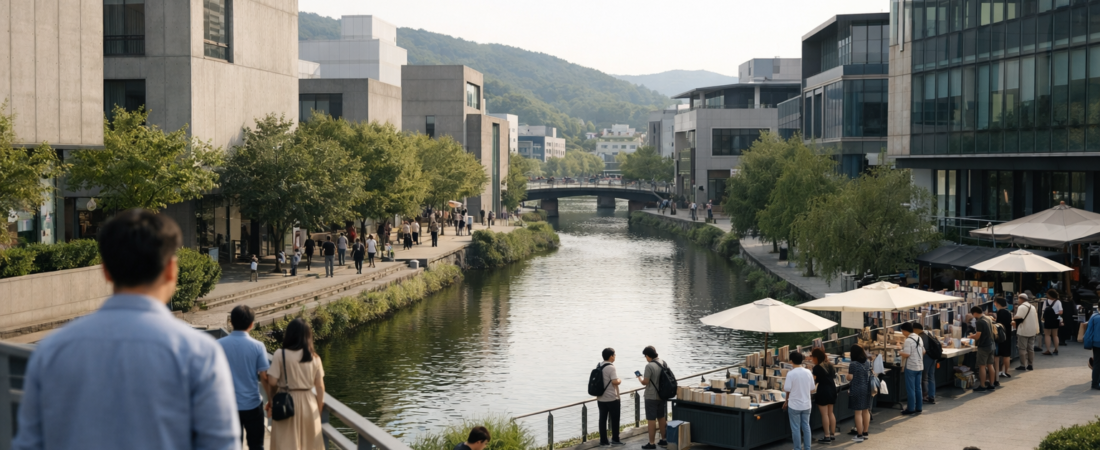
Paju Book City did not appear by accident. Korean publishers built it starting in the late 1990s as a shared cultural district, gathering dozens of publishing houses, bookstores, and printing studios in one carefully planned neighborhood. Each building expresses its own design philosophy, yet somehow the whole area still feels unified.
You can see this in the way concrete walls meet unexpected curves, and glass windows frame the nearby Han River wetlands. Paju Book City sits close to Heyri Art Village, another cultural district filled with galleries and small museums. Together, the two places form a corridor where books, art, and architecture constantly talk to each other.
Why does this matter for a country often associated with fast-paced digital life? Because Paju Book City proves that Korea’s relationship with print culture runs deep, not shallow. The buildings themselves argue that books deserve space, light, and quiet — not just a shelf.
Visitors sometimes assume Paju Book City is only for publishing professionals. That assumption misses the point entirely. Cafés, small museums, and open courtyards make it genuinely walkable for casual travelers, families, and curious readers passing through on a weekend trip from Seoul.
An Unexpected Warmth at the Old Book Museum
The book museum inside Paju Book City is easy to overlook. It does not announce itself with bright signs or crowds. On this visit, the museum was moments away from closing for the day, and a small worry crept in — what if the doors shut before there was time to look around?
A staff member noticed the hesitation at the entrance. Instead of rushing the visit along, she offered something warmer than expected. “Have a cool cup of tea at the book café first,” she said. “You can always come back later with more time. There’s no need to worry.”
That single sentence changed the entire mood of the visit. Old books lined the shelves, their pages carrying decades of handling, folding, and quiet reading by strangers long gone. Touching those worn covers felt oddly personal, like shaking hands with someone from another era.
Small institutions like this book museum often survive on tight budgets and modest staff. Yet the hospitality offered that afternoon carried no trace of that pressure. It felt generous, unhurried, and completely unnecessary — which is exactly what made it feel like a gift.
This kind of encounter rarely shows up in official guidebooks about Paju Book City. Most travel writing focuses on the striking buildings or the famous bookstore chains. But the human warmth found inside a quiet museum, minutes before closing, may be the most memorable part of the entire district.
King Jeongjo, Goethe, and the Power of Old Books

Standing among those old books naturally brought two historical figures to mind: King Jeongjo of Joseon and Johann Wolfgang von Goethe of Germany. Neither man ever visited Paju Book City, obviously. But both understood something the museum’s shelves seemed to whisper — books carry power beyond their pages.
King Jeongjo, who ruled Korea in the late eighteenth century, built the royal library known as Kyujanggak to collect and study texts from across Asia. He believed a strong nation needed strong scholarship, and scholarship needed books treated with genuine respect. His reign is often remembered as a golden age of learning, largely because he treated reading as a form of governance, not just leisure.
Goethe, writing in Europe around the same historical period, saw books as tools for shaping a person’s entire inner life. His famous work “Faust” explores a scholar who trades everything for deeper knowledge, only to discover that wisdom demands more than information alone. Both men, separated by continents and language, agreed on one thing: books change the people who take them seriously.
Why bring these two figures into a story about a small museum in Paju Book City? Because the warmth felt that afternoon connects directly to their shared belief. A book is never just paper and ink. It is a bridge between the person who wrote it and the person who, centuries later, still bothers to open it.
Why Paju Book City Still Matters Today
Korea’s publishing industry faces real pressure in 2026. Digital reading, shrinking bookstore numbers, and shifting attention spans all challenge places like Paju Book City to justify their existence. That pressure is honest and should not be brushed aside with easy optimism.
And yet, something in that small museum encounter suggests the opposite conclusion. If a single staff member can offer that much warmth to one visitor near closing time, then the spirit behind Paju Book City has not disappeared. It has simply moved from grand architecture into small, human gestures — arguably a harder thing to sustain, but a more meaningful one.
The same closeness that makes Korean hospitality so memorable can also hide real strain underneath it. Staff at small cultural sites often work long hours for modest pay, quietly absorbing the cost of keeping these spaces open to strangers. That tension deserves honest acknowledgment, not just admiration from grateful visitors passing through.
Still, the direction forward looks hopeful rather than hopeless. Independent publishers, local governments, and visitor groups continue investing in districts like Paju Book City precisely because they see cultural value worth protecting. Every traveler who returns, tells a friend, or simply sits quietly with an old book adds a small weight on the side of continuity rather than decline.
You do not need to be a scholar of Joseon history or German literature to feel this. A worn book cover, a kind offer of tea, a museum willing to stay open a few extra minutes — these small moments carry more cultural weight than they first appear to. For more background on Korea’s publishing districts and cultural policy, readers can explore OhmyNews for additional context.
Paju Book City will likely keep changing over the coming years, as every living place must. New buildings may rise, and some small museums may struggle to stay open. But if the warmth found in one quiet corner of Paju Book City can survive closing-time pressure and tight budgets, it suggests something durable about how Koreans still value books, memory, and unexpected kindness toward strangers.
Have you ever had a place surprise you with kindness right when you least expected it? What do you think keeps a cultural space like Paju Book City meaningful, even as reading habits keep changing around the world?
AI-Generated Photorealistic Image — All people, scenes, and details in this image are entirely AI-generated and fictional. Not a real photograph of an actual person or event. 이 이미지는 AI로 생성된 가상 이미지입니다.



Leave a Reply