Table of Contents
Can eight French chefs really fall in love with a bowl of soybean paste? Apparently, yes.
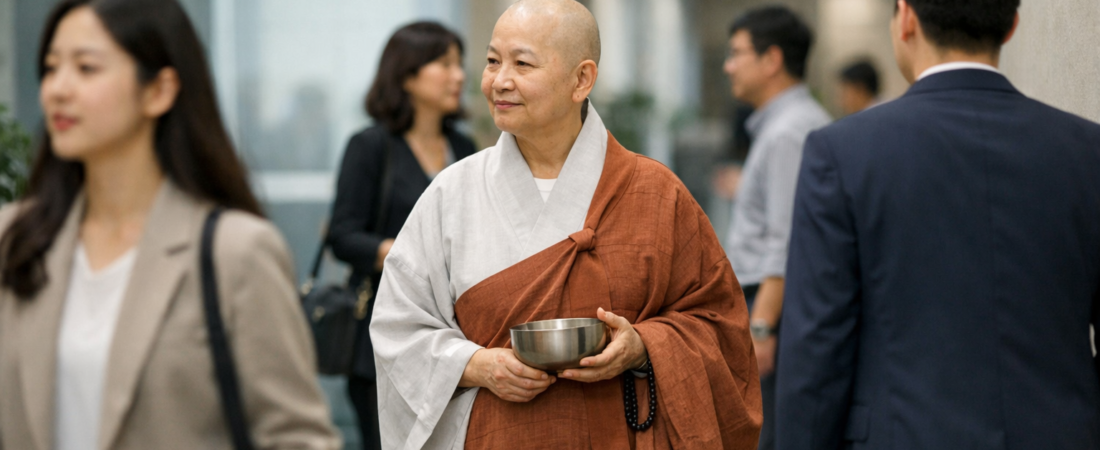
At Cheonjinam Temple in Jangseong, South Jeolla Province, eight chefs from across France spent four nights and five days learning Korean fermentation straight from Buddhist nun Jeong Gwan Seunim.
They mashed meju, they salted jars, and they left saying one thing: they plan to keep making doenjang once they get home.
This story isn’t just about soybeans. It’s about how one respected figure, Jeong Gwan Seunim, keeps opening doors between Korean temple food and the world’s culinary elite.
A Temple Kitchen, Eight French Chefs
Picture a quiet mountain temple, wooden floors, steam rising from an outdoor kitchen. Now picture eight professional chefs, trained in French technique, kneeling next to Jeong Gwan Seunim to learn how Koreans have preserved food for centuries.
That’s exactly what happened at Cheonjinam Temple in Jangseong this month.
The visit was organized by Choi Eun-ok, head of the Korea-France Buddhist Exchange Association, as part of an 11-day, 10-night program bringing French chefs deep into Korean food culture.
Why send chefs from major French kitchens all the way to a temple in rural Jangseong?
Because Jeong Gwan Seunim isn’t just any teacher. She’s arguably the most internationally recognized figure in Korean temple cuisine, someone who has already introduced fermentation and vegetable-based cooking to audiences far beyond Korea.
Her reputation made this trip possible in the first place. When she agreed to host, the program instantly gained credibility with chefs who could have chosen any culinary destination in the world.
Who Is Jeong Gwan Seunim?
You may already know the name if you’ve watched food documentaries. Jeong Gwan Seunim gained global attention through a widely viewed Netflix series on Korean temple food, where her calm teaching style and deep knowledge of fermentation impressed viewers worldwide.
Since then, she has become something like an ambassador for Korean Buddhist cuisine, welcoming chefs, journalists, and curious travelers to her temple kitchens.
Her approach isn’t flashy. It’s patient, almost meditative, built on decades of practice passed down through Korea’s Buddhist monastic tradition.
Temple food in Korea has never been about spectacle. It grew out of practicality and discipline — monks needed food that stored well through harsh winters, so fermentation became essential, not optional.
That history matters here. When Jeong Gwan Seunim teaches meju-making, she’s passing on a survival skill turned art form, one shaped by centuries of monastic life rather than modern restaurant trends.
For the French chefs, this context reportedly changed how they saw the process. It wasn’t just a recipe demonstration; it was a window into a different relationship with time, patience, and food itself.
From Meju to Doenjang: Learning Fermentation
So what exactly did the chefs do for four nights and five days? A lot of hands-on, sometimes messy, work.
They started with meju, the fermented soybean brick that forms the base of doenjang, Korea’s staple soybean paste. Making meju means boiling soybeans, mashing them, shaping them into blocks, and letting natural bacteria do the rest — a process that can take weeks, not hours.
The chefs also joined Jeong Gwan Seunim in “jang-galeugi,” the traditional splitting and separating of fermented paste into doenjang and soy sauce.
Beyond soybean paste, they made kkaennip kimchi, using perilla leaves layered with seasoning — a dish that surprised many of the visiting chefs with its bold, herbal flavor.
Korean fermentation isn’t a single technique; it’s a whole philosophy of managing time and microbes. Ask any home cook here — timing, temperature, and salt ratios matter as much as the ingredients themselves.
(And yes, some of the French chefs reportedly admitted their kitchens back home have never smelled quite like a Korean jangdokdae, the outdoor terrace where fermenting jars sit in the sun — a smell you either love immediately or need a few days to appreciate.)
By the end of the stay, the chefs weren’t just observing. They were fermenting on their own, adjusting salt levels, tasting batches, asking Jeong Gwan Seunim detailed questions about microbial balance and aging time.
Why This Matters for Global Korean Food
Here’s the real question: does one temple visit actually change how Korean food spreads internationally? On its own, maybe not much.
But multiply this moment by every chef who takes fermentation knowledge home, and the picture shifts.
The chefs explicitly said they want to keep making doenjang once they return to France, and they hope to bring Korean fermented flavors into culinary centers that have historically overlooked Korean cuisine.
That’s a meaningful shift. French gastronomy has long set global taste standards, so chefs choosing to feature doenjang or kkaennip kimchi on their own menus could introduce Korean flavors to entirely new audiences.
You might wonder whether this kind of cultural exchange is genuine or just a nice story for headlines. It’s worth asking honestly, because these programs cost money, time, and institutional support — not every good intention survives contact with a real restaurant kitchen back home.
Still, there’s something quietly hopeful in watching chefs mash soybeans with Jeong Gwan Seunim and leave already planning their next batch. Real cultural exchange rarely arrives as a grand gesture; it usually looks like eight people, a temple kitchen, and a shared curiosity about how food connects us across very different histories.
If even a few of those chefs keep fermenting doenjang in France, the impact outlasts the headline. You can read more about the broader exchange program through Kyunghyang Shinmun, which documented the full 11-day journey.
Korean temple food, guided by figures like Jeong Gwan Seunim, keeps proving it travels well beyond Korea’s borders. The next time you see doenjang on a French menu, you might just be tasting the result of a temple kitchen in Jangseong.
What do you think — could fermented Korean staples like doenjang become a regular feature in Western fine dining?
AI-Generated Photorealistic Image — All people, scenes, and details in this image are entirely AI-generated and fictional. Not a real photograph of an actual person or event. 이 이미지는 AI로 생성된 가상 이미지입니다.


Leave a Reply