
Table of Contents
Two people share one piano bench and four hands move across the same 88 keys. This performance style, called “four-hands” piano, appears at the center of tvN’s new drama Four Hands. The show uses this centuries-old musical tradition to explore intimacy, rivalry, and trust between two young pianists.
Have you ever wondered why two musicians would choose to play one instrument instead of two? It sounds impractical at first. But four-hands piano has survived for over 200 years precisely because it forces something rare: real musical intimacy.
What Is Four-Hands Piano, Exactly?
Four-hands piano means two pianists sit side by side at a single keyboard. One plays the higher notes, the other the lower ones. Their hands sometimes cross, their elbows sometimes touch, and their timing must match almost perfectly.
This is different from a piano duet performed on two separate pianos. Here, physical space is limited and shared. You cannot hide mistakes, and you cannot ignore your partner’s breathing or body language.
That physical closeness is exactly what makes four-hands piano so revealing. Composers throughout history noticed this and used the format to write music about friendship, courtship, and even quiet emotional negotiation. The instrument becomes a stage for a relationship, not just a stage for sound.
The Drama That Brought Four-Hands Piano Back
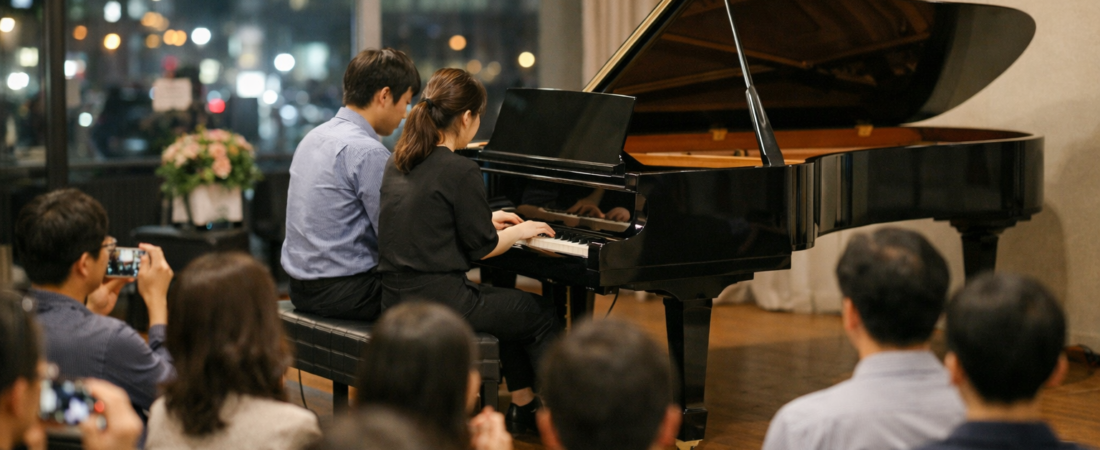
In Four Hands, piano student Kang Bi-o, played by Song Kang, asks his teacher Do Hyun-soo, played by Kim Joo-heon, for private lessons. The teacher’s condition surprises everyone watching. He tells Kang Bi-o to sit beside rival student Choi Jeong-yo, played by Lee Jun-young, and perform a four-hands piece together.
“What you lack right now isn’t technique,” the teacher says. “It’s warm musical connection with another person.” That single line captures the whole point of four-hands piano.
Technical skill alone cannot fill a concert hall with feeling. You need trust, timing, and a willingness to listen to someone else’s rhythm. The drama uses this musical format as a mirror for the two young men’s tense, competitive friendship, letting piano playing say what dialogue cannot.
This is where the focus keyword becomes clear: four-hands piano is never just a technical exercise. It is a relationship test set to music, and the drama leans into that fully.
Schubert, Friendship, and the History of Four-Hands Music
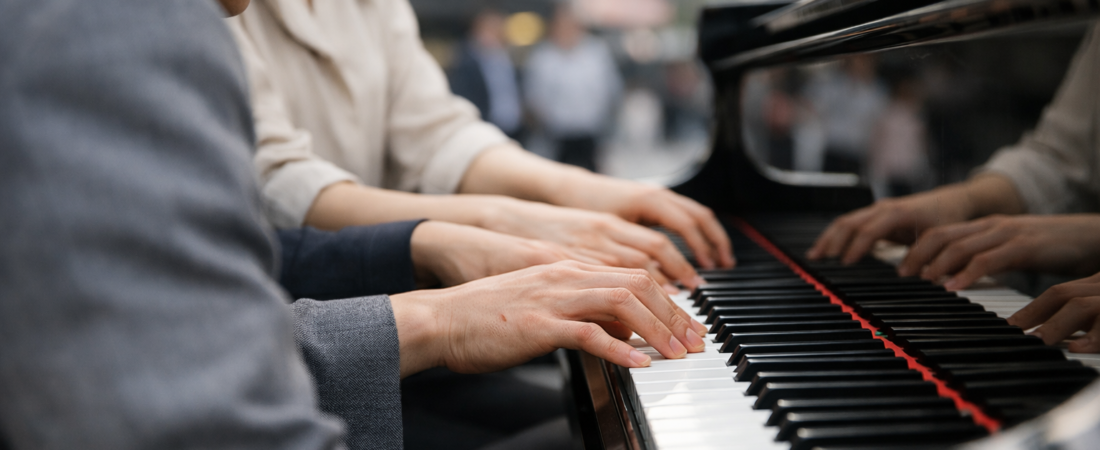
Long before Korean television discovered four-hands piano, European composers had already fallen in love with it. Franz Schubert wrote dozens of four-hands pieces, many of them performed with close friends in private salons. Music historians often point to Schubert’s four-hands works as some of his most personal, intimate compositions.
Why would a composer choose this limited format for his most private music? The answer lies in the social world of 19th-century Vienna. Home concerts were common, pianos were expensive, and sharing one instrument was often simply practical.
But practicality alone doesn’t explain the emotional depth found in these pieces. Sitting shoulder to shoulder, composers and performers built genuine closeness through four-hands playing. Some historians even describe it as a kind of socially acceptable flirtation, a way for young men and women to sit close together in an era with strict courtship rules (imagine holding hands, but with sheet music as your excuse).
Composers like Brahms and Mozart also wrote four-hands works, often for teaching purposes or family entertainment. A parent and child, or two siblings, could bond through shared practice sessions. This tradition of using four-hands piano to build relationships, not just perform music, stretches across generations and cultures.
You can read more about the broader classical tradition behind this format through Kyunghyang Shinmun, which first reported on the drama’s musical background.
Why Four-Hands Piano Still Speaks to Us
Four-hands piano asks something modern life often avoids: physical closeness with another person while working toward a shared goal. That’s rare today, isn’t it? Most collaboration now happens through screens, not shared instruments.
The drama’s choice to center four-hands piano feels almost quietly countercultural. It insists that real connection requires proximity, patience, and shared vulnerability, not just talent performed alone. Still, this same closeness carries its own tension.
Sitting elbow to elbow with a rival or a stranger can create warmth, but it can also expose old wounds, unspoken competition, or discomfort neither person wants to admit. The story doesn’t pretend four-hands piano magically fixes every relationship. It shows two flawed young men working through friction, missed timing, and pride, slowly finding rhythm together anyway.
That honesty is what makes the format meaningful rather than sentimental. Music, like any relationship, asks for repeated small adjustments rather than one perfect performance. Four-hands piano simply makes those adjustments visible, note by note, in front of an audience.
As Four Hands continues its run, expect more viewers to search out real four-hands recordings from Schubert and beyond. Perhaps that’s the quiet gift of this drama: it sends people back to old sheet music with new curiosity. What do you think — could sharing one instrument teach us something about sharing life with another person?
AI-Generated Photorealistic Image — All people, scenes, and details in this image are entirely AI-generated and fictional. Not a real photograph of an actual person or event. 이 이미지는 AI로 생성된 가상 이미지입니다.




Leave a Reply