
Table of Contents
Yangyang International Airport sits in one of Korea’s most scenic corners, yet it rarely fills its flights. Sokcho city officials now propose a regional fix: stop marketing Gangwon province city-by-city, and instead sell it as one connected tourism zone with better transit links to the airport.
Have you ever landed at a small airport only to find no easy way to reach your actual destination? That is the reality many travelers face at Yangyang International Airport, tucked along Korea’s northeastern coast near the East Sea.
This guide explains why the airport struggles, what local leaders want to change, and how these plans could shape your future trip to Gangwon province.
Why Yangyang International Airport Struggles to Fill Seats
Yangyang International Airport opened in 2002 with big ambitions. It was meant to serve as a gateway to Korea’s stunning east coast, including Seoraksan National Park and the beaches around Sokcho.
But passenger numbers have never matched those early hopes. Why does a beautifully located airport struggle so much to attract flights and travelers?
Part of the answer lies in fragmented marketing. Each city near the airport, including Sokcho, Yangyang, and Gangneung, has historically promoted its own attractions separately, rather than presenting Gangwon as one unified travel region.
This approach makes sense locally. Every city wants credit for its own tourism revenue.
But for an international traveler comparing flight options, a fragmented pitch is a weak pitch. Airlines look at total regional demand, not just one city’s numbers, when deciding whether a route is worth running.
Sokcho’s Regional Tourism Solution
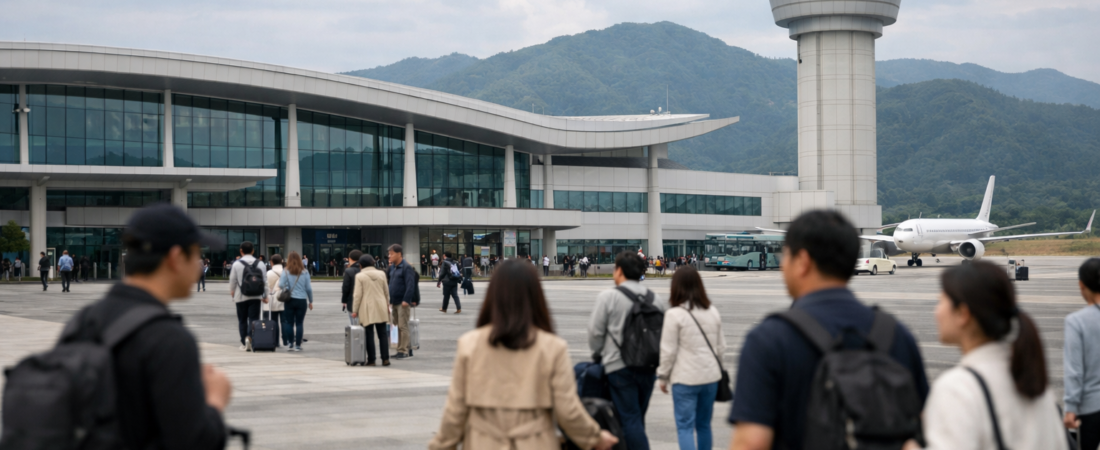
Sokcho city has proposed a different path forward. Instead of competing with neighboring cities for tourism attention, Sokcho wants to combine forces and market the entire Gangwon region as a single travel destination.
This is not a small shift. It means coordinated marketing campaigns, shared branding, and joint packages that highlight Sokcho’s seafood markets alongside Yangyang’s surf beaches and Gangneung’s coffee culture.
The logic makes sense once you think about it. A traveler from Southeast Asia does not care which city hosts which mountain trail.
They care about the overall experience: can they see beautiful nature, eat great food, and travel easily between stops? By presenting Yangyang International Airport as the entry point to a whole region rather than one town, Sokcho hopes to boost the case for more international routes.
Regional tourism cooperation has worked elsewhere in Korea before. Jeju built its brand as a single island destination rather than dozens of separate towns, and that unified identity helped it become one of Asia’s most recognized travel names.
Gangwon’s coastal cities may be attempting something similar, just on a smaller and more localized scale.
Getting There: Transportation Links That Matter

Marketing alone will not fix low passenger numbers. Sokcho’s proposal also calls for stronger regional transportation connections, making it easier for travelers to move between Yangyang International Airport and nearby attractions.
Right now, getting from the airport to popular destinations can feel disconnected. Limited shuttle options and inconsistent bus schedules discourage visitors who might otherwise choose this route over flying into Seoul first.
Think about it from a practical traveler’s perspective. Would you book a flight to a smaller airport if you were not confident about reaching your hotel afterward?
Probably not, and that uncertainty pushes many visitors toward Incheon or Gimpo instead, even when Yangyang International Airport is geographically closer to their final destination. Improved shuttle services, better signage, and coordinated bus timetables linked to flight arrivals could change that calculation significantly.
This is the kind of infrastructure improvement that rarely makes headlines but quietly shapes whether a regional airport survives or fades. You can read more background on regional aviation policy discussions through Yonhap News Agency, which has tracked this issue closely.
What This Means for Travelers Planning a Gangwon Trip
For now, Yangyang International Airport remains an underused resource with real potential. If regional cooperation succeeds, future visitors could enjoy more direct international flights, smoother transit connections, and a genuinely unified Gangwon travel experience.
Is it realistic to expect several Korean cities to set aside individual interests for a shared tourism goal? History suggests it is difficult, but not impossible, especially when the economic incentive is strong enough for everyone involved.
There is something honest worth naming here: local governments in Korea, like anywhere, often compete for budget and recognition rather than cooperate freely. That competitive instinct has real costs, including empty airport gates and missed opportunities for smaller cities like Sokcho.
Yet the same instinct that divides can also motivate change, once city leaders see that a rising regional tide lifts every local economy together. Sokcho’s proposal itself is a small sign of that shift, an admission that going it alone has not worked, and a willingness to try something more collaborative instead.
If you are dreaming of a quieter alternative to Seoul’s crowded airports, keep an eye on Yangyang International Airport’s progress. As transportation links and regional partnerships mature, this coastal gateway may finally match the natural beauty surrounding it (assuming the bus schedule finally cooperates too).
What do you think about regional cooperation as a solution for underused airports like this one?
AI-Generated Photorealistic Image — All people, scenes, and details in this image are entirely AI-generated and fictional. Not a real photograph of an actual person or event. 이 이미지는 AI로 생성된 가상 이미지입니다.




Leave a Reply