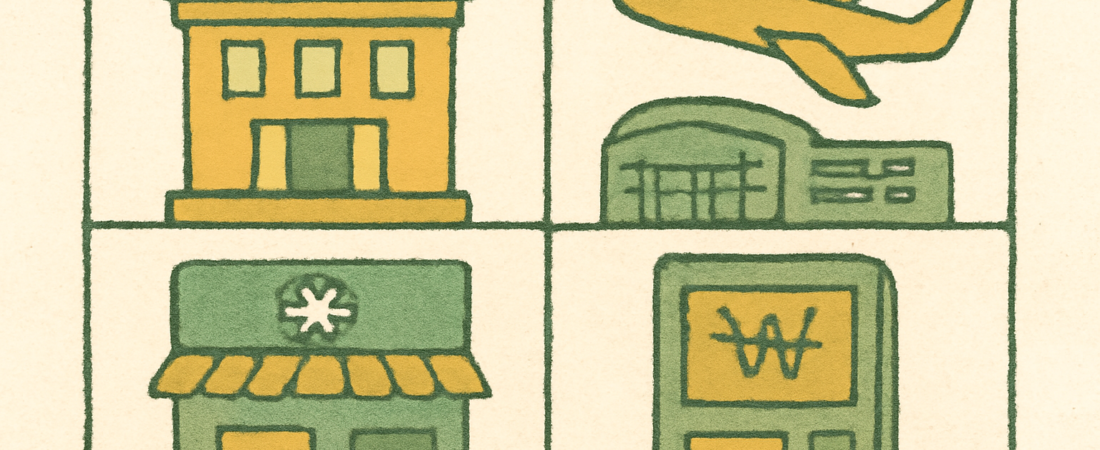
For most visitors, the best rates come from withdrawing won at a Korean ATM with a foreign card, or from a licensed exchange shop in Seoul’s Myeongdong. Airport counters are convenient but usually cost more. Banks give fair rates but have short hours. Always compare the live rate and fees before you commit.
Last checked: 2026-11-13
- The short version: what to do first
- Where to exchange money in Korea
- Comparison table: banks, airports, shops and ATMs
- Step by step: how to exchange cash
- Using ATMs and cards safely
- FAQ
- Sources
- Related guides
The short version: what to do first
You do not need to change a lot of money before you land. Korea is a very card-friendly country. Many shops, cafes, subway systems and taxis accept cards.
Still, cash is useful. Some traditional markets, small food stalls and local buses may prefer it. You will also want a little cash for your first day.
Here is a simple plan for most travelers:
- Bring a small amount of your home currency, or some US dollars, as a backup.
- Withdraw a modest amount of Korean won at an ATM on arrival.
- Use a credit card for hotels, restaurants and shopping where accepted.
- Exchange extra cash at a licensed shop if you need a better rate.
Exchange rates change every day. Because of that, we do not quote a rate here. Check a live rate on the day you travel. For an official reference, see the Bank of Korea link in the Sources section.
Where to exchange money in Korea
There are four main places to get Korean won. Each has trade-offs in rate, speed and convenience.
Banks
Major Korean banks exchange foreign cash into won. Rates are usually fair and the service is reliable. Branches follow weekday business hours, often closing mid-afternoon. They are closed on weekends and public holidays.
Bring your passport. Staff may ask for it and may record your details. Some branches only handle major currencies such as US dollars, euros, Japanese yen and Chinese yuan. If you carry a less common currency, ask first.
Airport counters
Incheon and Gimpo airports have exchange counters in arrivals. They are open long hours and are very handy right after landing. You can change a small amount to cover transport and a first meal.
The trade-off is that airport rates are often less favorable than in the city. Treat the airport as a convenience stop, not the place for a large exchange. Counter hours and the banks that operate them can change, so check the airport’s official site before you fly.
Licensed exchange shops
Private exchange shops are common in tourist areas. Myeongdong in Seoul is well known for them. Many shops compete for customers, so rates can be good. Hours are often longer than banks, and some open on weekends.
Look for a posted rate board and a licensed storefront. Compare two or three shops before you decide. Walking a few doors can change what you receive. Keep your receipt.
ATMs
Many ATMs in Korea accept foreign cards, but not all do. Look for machines marked for international cards. Convenience store ATMs and bank ATMs in busy areas often work. Your own bank sets your fees and rate, so check with them before you travel.
Comparison table: banks, airports, shops and ATMs
This table compares the four options in general terms. We avoid fixed rates because they change daily. Example figures below use a simple round amount of $100 / 140,000 KRW for illustration only. Your real number will differ with the day’s rate.
| Option | Typical rate quality | Convenience | Hours | Example fee note |
|---|---|---|---|---|
| Bank branch | Fair, fairly stable | Medium; passport needed | Weekday daytime only | Fee varies by bank; ask before you exchange |
| Airport counter | Often lower than city rates | High; right after landing | Long hours, often early to late | Spread can add several dollars on $100 / 140,000 KRW |
| Licensed exchange shop | Often the best for cash | High in tourist areas | Often evenings and weekends | Usually no separate fee; the rate board is the cost |
| ATM withdrawal | Close to market rate | High; many locations | Many are 24 hours | Machine fee plus your home bank fee can apply; check both |
A note on fees: some ATMs charge a flat fee per withdrawal, and your home bank may add its own. Ask your bank for exact figures. As a rough illustration only, a flat fee of $3 / 4,200 KRW on a small withdrawal can be a large share of the money. Larger, less frequent withdrawals often make the fee less painful. Verify real fees with your own bank.
Also check for dynamic currency conversion. Some machines and card terminals offer to charge you in your home currency. This usually gives a worse rate. When asked, choose to be charged in Korean won.
Step by step: how to exchange cash
Follow these steps whether you use a bank or an exchange shop.
- Check the live rate. Look up the day’s rate before you go. This gives you a fair benchmark.
- Bring your passport. Most places ask to see it.
- Bring clean, undamaged notes. Torn or heavily marked notes may be refused or discounted.
- Compare two or three places. In Myeongdong, shops sit close together. Compare their rate boards.
- Ask for the final amount. Ask how many won you will receive in total, after any fees.
- Count your money. Count the won in front of the teller before you leave.
- Keep the receipt. You may need it if there is a question later.
Larger bills are common in Korea. Ask for a mix of notes. Smaller notes help with buses, markets and street food. Large notes can be awkward at small stalls.
Some rules apply to large cash amounts entering or leaving the country. Customs and reporting thresholds can change. Check the Korea Customs Service site before you travel if you carry a large sum.
Using ATMs and cards safely
ATMs are often the easiest way to get won. A few habits make them safer and cheaper.
- Tell your bank you are traveling. This can prevent a card block.
- Check your card works abroad. Confirm it supports international withdrawals and a PIN.
- Use bank-branch ATMs when you can. They are usually well lit and easy to find.
- Choose won, not your home currency. Decline any offer to convert at the machine.
- Withdraw in sensible amounts. Avoid many tiny withdrawals that stack up fees.
- Cover your PIN. Shield the keypad as you type.
Some foreign cards do not work in every Korean ATM. If one machine rejects your card, try another that shows international card symbols. Look for a bank ATM rather than a standalone machine.
Cards are widely accepted, but not everywhere. Small vendors may be cash-only. Keep a little won on hand. Mobile payment apps are popular locally, but many need a Korean bank account or phone number, so they may not work for visitors. Check each app’s current rules before relying on it.
If you are staying longer, a travel-friendly card with low foreign fees can help. Ask your own bank about options. We do not recommend any specific product here.
FAQ
Where is the best place to exchange money in Korea?
For cash, licensed exchange shops in tourist areas like Myeongdong often offer the best rates. ATMs are also a strong option if your card has low fees. Airport counters are convenient but often cost more. Compare the live rate before you choose.
Should I exchange money before I arrive in Korea?
You usually do not need to. Exchanging at home can give a poor rate, and won may be hard to find abroad. Bring a small backup in US dollars or your home currency. Then withdraw or exchange won once you arrive.
Do I need my passport to exchange money in Korea?
Often, yes. Banks and many exchange shops ask to see a passport. Bring it with you. Requirements can vary by place and amount, so ask the staff or check the provider’s official site.
Can I use foreign credit cards in Korea?
Many places accept major foreign cards, especially in cities and tourist areas. Some small shops, markets and stalls may be cash-only. Carry some won as a backup. Check with your card issuer about foreign transaction fees.
Sources
- Bank of Korea (official exchange rate and central bank information): https://www.bok.or.kr
- Korea Customs Service (rules on carrying currency): https://www.customs.go.kr
- Incheon International Airport (arrivals and airport services): https://www.airport.kr
- Korea Tourism Organization (official visitor information): https://english.visitkorea.or.kr
Rules, rates and opening hours change. Verify details on the official sites above before you travel.
Leave a Reply