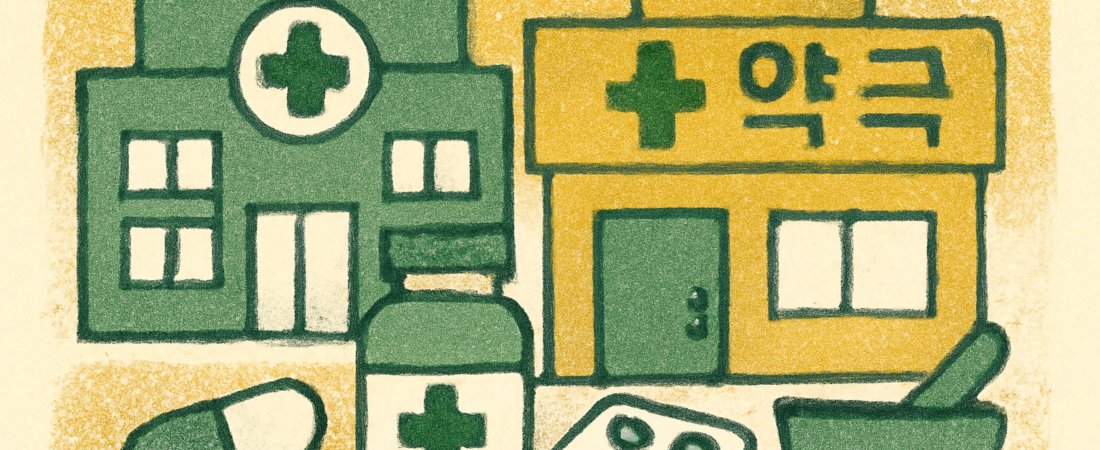
For minor problems, Korean pharmacies (yakguk) and small neighborhood clinics are fast and inexpensive. For serious or after-hours problems, go to a hospital emergency room. Tourists pay out of pocket, and prices vary. Carry your passport, buy travel insurance, and call 1339 for English medical help. Always confirm current fees and rules on official sites.
Last checked: 2026-11-15
- Pharmacies: your first stop for small problems
- Clinics, hospitals and emergency rooms
- What to say: useful Korean and English phrases
- What it costs and how to pay
- What the data shows, and where to check it
- FAQ
- Sources
- Related guides
Pharmacies: your first stop for small problems
Korean pharmacies are everywhere. Look for the sign that says 약국 (yakguk). Many sit on the ground floor near clinics, so you will often see several in one block.
Pharmacists can help with colds, mild stomach trouble, headaches, motion sickness and minor skin irritation. Many common medicines are sold over the counter. Some stronger drugs need a prescription from a doctor. This system differs from some Western countries, so do not assume a drug you buy casually at home is available the same way here.
Pharmacists usually ask a few quick questions. Expect something like: what are your symptoms, how long have you had them, and do you have allergies. Many speak a little English. Tourist areas such as Myeongdong, Hongdae and Itaewon often have staff who speak more.
Keep these tips in mind:
- Show the pharmacist a photo of the medicine box if you take a regular medication. Brand names differ between countries.
- Check the active ingredient, not only the brand name.
- Ask how many times a day to take it. Instructions are often printed on the packet in Korean, so ask the pharmacist to explain or write it down.
- If symptoms are severe or last several days, see a doctor instead.
This article is general travel information, not medical advice. For health concerns, speak to a qualified professional.
Clinics, hospitals and emergency rooms
Korea has several levels of care, and knowing the difference saves time. Here is a simple guide.
Neighborhood clinics (uiwon, 의원). These are small practices run by one or a few doctors. They focus on one area, such as internal medicine, ear-nose-throat, dermatology or orthopedics. You can often walk in without an appointment. Waits are usually short. Look for signs naming the specialty, such as 내과 (internal medicine), 이비인후과 (ENT) or 피부과 (dermatology).
General hospitals (byeongwon, 병원). These are larger and offer more services and tests. Some big university hospitals have international clinics with English-speaking coordinators. These are helpful if you need a complex exam or a written medical report for insurance.
Emergency rooms (eungeupsil, 응급실). Use these for serious injury, chest pain, trouble breathing, heavy bleeding or other urgent problems. For a true emergency, call 119. This is the national number for ambulance and fire services.
Dental and skin clinics. Dental clinics (chigwa, 치과) and dermatology clinics are common. Many cater to foreign visitors. Be aware that cosmetic procedures and medical treatments are different things, and pricing and rules differ. Verify a clinic’s credentials before booking anything beyond basic care.
A practical rule for tourists: minor and non-urgent means pharmacy or clinic. Serious, sudden or after-hours means emergency room. If you are unsure, call 1339, the Korea Tourism Organization’s help line, which offers interpretation support. Check the current service hours and languages on the official site before you travel.
What to say: useful Korean and English phrases
You do not need fluent Korean. A few short phrases go a long way. You can also show your phone screen with the Korean text.
- 제가 아파요 (jega apayo): I am sick or in pain.
- 머리가 아파요 (meori-ga apayo): My head hurts.
- 배가 아파요 (bae-ga apayo): My stomach hurts.
- 열이 있어요 (yeol-i isseoyo): I have a fever.
- 알레르기가 있어요 (allereugi-ga isseoyo): I have an allergy.
- 영어 하세요? (yeongeo haseyo): Do you speak English?
- 도와주세요 (dowajuseyo): Please help me.
Write down or screenshot three things before you go: your allergies, the medicines you take, and any long-term conditions. Translate them with a trusted app, then ask a Korean speaker to check the wording if possible. Machine translation can make mistakes with medical terms.
At a clinic, you will usually be asked to fill in a short form and show ID. Bring your passport or a clear copy. The desk staff often use a simple phrase meaning “please wait a moment.” Listen for your name, or watch the screen if there is a queue display.
What it costs and how to pay
Foreign tourists are generally not covered by Korea’s national health insurance, so you normally pay the full fee yourself. Prices vary by clinic, region, time of day and the tests involved. The table below gives rough, illustrative ranges only. These are not official fees. Confirm the actual cost with the pharmacy or clinic before treatment.
| Service | Typical situation | Rough range (USD / KRW) | Notes |
|---|---|---|---|
| Pharmacy, basic over-the-counter item | Cold, headache, upset stomach | $2-$10 / 2,500-13,000 KRW | Varies by product. No appointment needed. |
| Neighborhood clinic visit | Minor illness, one doctor | $15-$60 / 20,000-80,000 KRW | Tests and injections cost extra. |
| Prescription medicine from a pharmacy | After a clinic visit | $3-$20 / 4,000-26,000 KRW | Depends on the drugs and days supplied. |
| Hospital outpatient visit | Specialist or tests needed | $50-$300+ / 65,000-400,000+ KRW | Imaging and lab work raise the total. |
| Emergency room visit | Urgent or after-hours care | $100-$1,000+ / 130,000-1,300,000+ KRW | Can rise sharply with treatment or admission. |
These ranges are rough estimates for planning, and I cannot verify them as current official prices. Exchange rates change, so the USD figures are approximate. Check a live rate and ask for a price before you agree to any treatment.
Paying. Most places accept credit and debit cards. Some small clinics prefer cash. Keep your receipts and any medical documents. Ask for an itemized bill and a diagnosis in English if you plan to claim on travel insurance. Insurers often require original paperwork, so check your policy terms before you travel.
What the data shows, and where to check it
If you want to understand how people in Korea actually use these services, look at official health statistics. Korea publishes a lot of public data, and it explains why pharmacies and clinics feel so convenient.
The useful data sources fall into a few types:
- National health insurance statistics. The national insurer and its review agency publish figures on clinic visits, prescriptions and medical spending. These show how often residents use outpatient care.
- Government health ministry reports. The health ministry releases statistics on the number of clinics, hospitals and pharmacies, and their regional spread.
- National statistics office releases. The national statistics agency publishes population and household survey data that include health and medical use.
- Tourism authority data. The tourism organization tracks medical tourism and visitor services, including the interpretation help line.
These sources are updated on different schedules, and figures change from year to year. I have not quoted specific numbers here because I cannot confirm the latest releases. Before you rely on any statistic, open the official site and check the most recent edition. Look at the publication date, and note whether the figure covers residents only or also visitors.
One broad takeaway that is widely discussed in public reporting: access to outpatient care in Korea is generally easy, and walk-in visits are common. That is why short waits and quick pharmacy stops are normal for locals. Tourists benefit from the same convenience, even though they pay full price.
FAQ
Do I need a prescription for common medicines in Korea?
Many mild medicines are sold over the counter, but stronger drugs need a prescription. Rules can differ from your home country. Ask the pharmacist, and check the official health authority’s guidance if you are unsure.
Is there an English help line for medical problems?
Yes. The 1339 line offers interpretation and guidance for visitors. For a life-threatening emergency, call 119 instead. Check the official tourism site for current hours and supported languages.
Will my home health insurance work in Korea?
Usually it does not work directly. Most tourists pay first and claim later. Buy travel insurance before your trip, keep itemized receipts and medical reports, and confirm the claim process with your insurer.
Can I bring my own prescription medicine into Korea?
Often yes, in limited amounts, but some drugs are restricted. Carry them in original packaging with a doctor’s letter. Check the current customs rules on the official Korea Customs Service website before you fly.
Sources
- Korea Tourism Organization (visitor help line 1339 and travel information): https://english.visitkorea.or.kr/
- Ministry of Health and Welfare: https://www.mohw.go.kr/
- National Health Insurance Service: https://www.nhis.or.kr/
- Health Insurance Review and Assessment Service: https://www.hira.or.kr/
- Statistics Korea (KOSTAT): https://kostat.go.kr/
- Korea Customs Service (rules on bringing medicine): https://www.customs.go.kr/
Leave a Reply