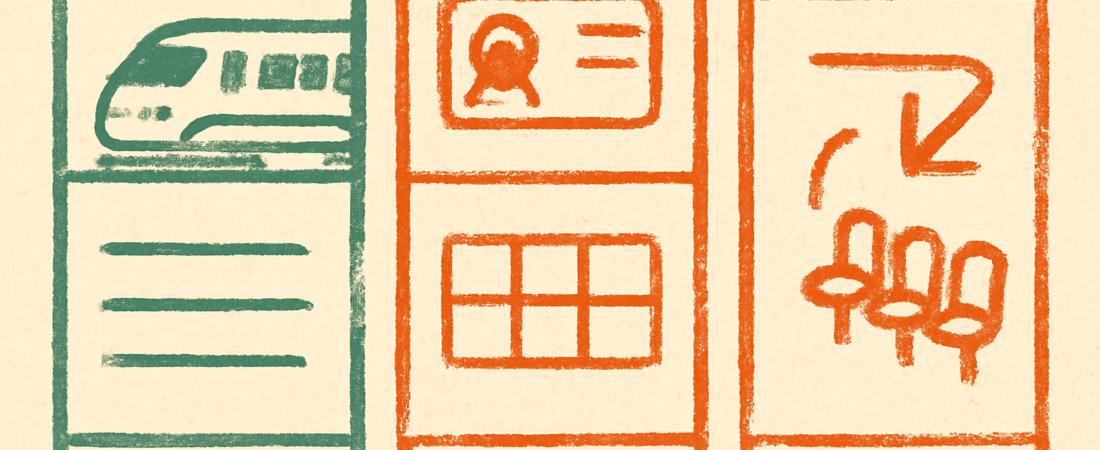
Most tourists can book KTX tickets on the Korail Talk app or the Korail website, or buy them at a station kiosk. Reserve early for weekends and holidays. A Korail Pass can save money if you ride often over a few days. Check current prices and pass rules on the official Korail site before you buy.
Last checked: 2026-11-10
- KTX basics: what it is and where it goes
- How to book a KTX ticket step by step
- Korail Pass: is it worth it?
- Seat choices: classes, direction and luggage
- On the day: stations, gates and common mistakes
KTX basics: what it is and where it goes
KTX is Korea’s high-speed rail service. It is run by Korail. The trains link Seoul with many major cities, including Busan, Daejeon, Gwangju and Gangneung.
Korea also has slower train types. These include ITX-Saemaeul, Mugunghwa and other regional services. They cost less, but they take longer.
There is also a separate high-speed operator called SRT. It runs from Suseo Station in southern Seoul. Its routes overlap with KTX on some lines, mainly toward Busan and Gwangju.
This matters for one reason. A Korail Pass covers Korail trains. It does not cover SRT. Check which operator your ticket belongs to before you pay.
Seoul has several major stations. KTX trains to Busan usually leave from Seoul Station. Some other routes use Yongsan Station. Always check the departure station printed on your booking.
A trip from Seoul to Busan takes roughly two and a half to three hours on KTX. Exact times vary by train and stops. Check the timetable for your date.
How to book a KTX ticket step by step
You have three main ways to book. You can use the app, the website, or a station machine. Here is the usual order of steps.
Option 1: The Korail Talk app or website
- Download the Korail Talk app, or open the English Korail website.
- Choose your departure station and arrival station.
- Pick your date and the time you want to leave.
- Select the number of passengers.
- Choose a train from the list shown.
- Pick your seat type, then your seat if the system allows it.
- Pay with an international card, if accepted.
- Save the booking number and the ticket shown in the app.
Foreign cards can sometimes fail on Korean sites. This is a known problem for visitors. If your card is rejected, try another card. You can also pay at a station counter instead.
Some booking options may require a Korean phone number or ID. Rules change. Check the official site for what applies to foreign visitors now.
Option 2: Station kiosks
Most big stations have ticket machines with an English setting. Look for a language button on the first screen. The steps are similar to the app.
Kiosks are handy if you are already at the station. They are less handy if the train is full. Popular trains can sell out well before the day.
Option 3: The ticket counter
Staff at the counter can book for you. Bring your passport if you hold a pass. Write your destination, date and time on a note. This helps if there is a language gap.
When to book
Booking windows are set by Korail and can change. Tickets usually open a set number of days before travel. Check the official site for the current rule.
Book early for these busy times:
- Friday evenings and Sunday evenings
- Major holidays such as Seollal and Chuseok
- Cherry blossom season and autumn leaf weekends
- Peak summer beach weekends
On quiet weekdays, you can often buy a ticket close to departure. Do not count on it, though.
Korail Pass: is it worth it?
The Korail Pass is made for foreign visitors. It gives unlimited rides on many Korail trains for a set number of days. You still need to reserve a seat for each KTX trip. A pass does not guarantee a seat.
Pass types, prices and rules have changed over the years. I cannot confirm today’s exact prices. Look at the Korail pass page on the official site for current options. The table below shows the kinds of choices you may see.
| Option | Best for | Price | Main catch |
|---|---|---|---|
| Single KTX ticket | One or two long trips | Varies by route; check Korail for your trip (for example, Seoul to Busan is often in the range of about $45-$65 / 60,000-85,000 KRW, but verify) | Prices differ by train and seat class |
| Korail Pass (multi-day) | Several long rides in a short time | Check the official pass page; the price depends on pass length and traveler type | Seat reservation still needed; some trains or seats may be excluded |
| Slower trains (ITX, Mugunghwa) | Budget trips and scenic routes | Usually lower than KTX; check your route | Longer travel time |
| Express bus | Cheap alternative on many routes | Often lower than KTX; check a bus site | Traffic can add delays |
A simple way to decide
Add up the single-ticket prices for the trips you plan. Then compare the total to the pass price. If the pass costs less, it may be worth buying.
A pass tends to help when you plan many long hops. An example is Seoul to Busan, then Busan to Gwangju, then back to Seoul. It tends to help less if you stay mostly in Seoul. Seoul’s subway uses a separate transport card.
Also check the pass rules on the official site. Ask these questions:
- Is the pass sold only to non-residents?
- Do I need to collect it at a station with my passport?
- Which train types are covered?
- Are there blackout dates?
- Can I buy it before I arrive?
Pass sales channels have also changed over time. Use only the official Korail site or its listed partners.
Seat choices: classes, direction and luggage
KTX seats come in two main types. These are standard seats and first class. Names and layouts may differ by train model, so check the seat map when you book.
Standard vs. first class
Standard seats are set up in a 2-and-2 pattern. They are comfortable for most travelers. First class usually has wider seats in a 2-and-1 pattern. It costs more.
For a short trip, standard is often enough. For a long trip with a laptop or a tired body, first class may feel nicer. That is a matter of taste and budget.
Window or aisle?
- Choose a window seat if you want views and a wall to lean on.
- Choose an aisle seat if you need easy exits or have long legs.
- Solo travelers sometimes pick a single-seat row in first class, if offered.
Forward or backward facing?
Some seats face backward. This can feel odd, and some people get motion discomfort. When you book, check whether the seat map shows direction. If not, ask at the counter.
In many cars, seats can be turned. Do not turn a seat to face another traveler without asking. Staff and signs may explain the rules on your train.
Luggage
Large bags can go on racks at the end of each car. Smaller bags fit on overhead shelves. Keep valuables with you at your seat.
Pick a seat near the end of the car if you carry a big suitcase. That way you stay close to it. Rack space is limited, so board early if you can.
Standing tickets
When a train is full, you may see a standing-room option. It is cheaper but not comfortable on a long ride. It is best left as a last resort.
Quiet and phone etiquette
Koreans generally keep calls short and quiet on trains. Set your phone to silent. Use earphones for videos. Take longer calls to the area between cars.
On the day: stations, gates and common mistakes
Plan to reach the station early. Twenty to thirty minutes is a sensible buffer. Big stations are large and signs can be confusing at first.
Before you board
- Check the departure board for your train number and platform.
- Find your car number on the ticket.
- Walk to the matching spot on the platform.
- Board a few minutes before departure.
- Match your seat number to the label above the seat.
Most stations let you use a ticket in your app or a printed ticket at the gate. Gate rules vary by station and train. Check what applies to yours.
Common mistakes
- Wrong station. Seoul has several. Confirm the one on your ticket.
- Mixing up SRT and KTX. A Korail Pass does not cover SRT.
- Missing the pickup step. Some passes must be collected with your passport.
- Waiting too long to book. Holiday trains sell out fast.
- Sitting in the wrong seat. Check your car and seat number.
If you miss your train
Rules for changes and refunds depend on your ticket type and timing. Go to a counter right away. Staff can explain what is possible. Check the official site for the current refund policy, since fees and cut-off times may change.
Getting from the station to your hotel
Large stations connect to the subway and to taxis. In Seoul, a transport card works on the subway and buses. In other cities, check local options at the station information desk.
FAQ
Can I book KTX tickets before I arrive in Korea?
Often yes, through the Korail website or app. Some booking features may require steps that work differently for foreign cards. Check the official site for what is open to overseas visitors now.
Does the Korail Pass cover every train?
No. It covers many Korail trains, but not all. It does not cover SRT. You must also reserve a seat for each KTX ride. Read the pass terms on the official Korail site first.
Is first class on KTX worth it?
It depends on your budget and trip length. First class usually has wider seats and a calmer feel. For short rides, standard is usually fine. Compare current prices for your route before you decide.
What if the KTX I want is sold out?
Try a different departure time or another day. You could also check slower Korail trains, SRT on overlapping routes, or an express bus. Counter staff can show you other options if you are at the station.
Do I need to print my ticket?
Often you do not. Many travelers use the ticket shown in the app. Some stations or ticket types may work differently. Keep your booking number handy and check the rules for your ticket.
Sources
- Korail (official operator of KTX): https://www.letskorail.com/
- Korail English information portal: https://www.korail.com/
- SRT (separate high-speed operator): https://etk.srail.kr/
- Visit Korea, official Korea Tourism Organization: https://english.visitkorea.or.kr/

Leave a Reply